





ON THIS PAGE
I’ve always been a coffee drinker, and I rarely touch energy or carbonated drinks. But one of my closest gym buddies got hooked on Nocco, the Swedish energy drink, and recently switched to ordering Celsius, the hugely popular American brand you now see everywhere. He asked me straight out: is Celsius bad for you? As a registered dietitian, I went digging, and here’s what I found.
The quick answer: for most healthy adults, Celsius is not bad in moderation. But that answer comes with real caveats around caffeine, who should steer clear, and the marketing claims on the can, all of which deserve a closer look.
This article is informational and not a substitute for personalised medical or dietary advice. If you have a health condition or any concerns, speak to a qualified healthcare professional.
What Is Celsius?
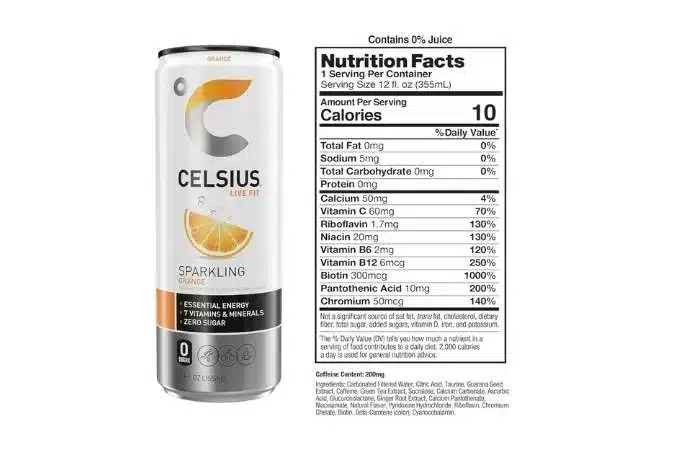
Celsius is a ready-to-drink energy beverage marketed as a “fitness drink,” positioned as a zero-sugar, metabolism-boosting alternative to traditional energy drinks. Unlike many older energy drinks, it contains no added sugar and no high-fructose corn syrup, and each can is low in calories, typically around 10, with zero grams of carbohydrate.
Inside, you’ll find a blend of caffeine (from green tea and guarana), taurine, ginger extract, and a range of added vitamins. It’s this “cleaner” ingredient list, combined with bold claims, that has made Celsius so popular with gym-goers and young adults. Let’s break down what’s actually in it.
What’s Actually in Celsius?
Caffeine sources. Celsius gets its kick from multiple sources, including guarana seed extract and green tea extract, both natural sources of caffeine, on top of added caffeine. Guarana, a plant from the Amazon, is essentially a concentrated caffeine source, and green tea extract adds both caffeine and antioxidants called catechins, including EGCG. There’s nothing alarming about these ingredients themselves, but it’s worth noting they all stack caffeine on top of caffeine, which matters for the total dose.
Taurine. A naturally occurring amino acid involved in hydration, cardiovascular function, and nerve function, and it acts as an antioxidant. It’s well studied and generally considered safe for adults, though I wouldn’t recommend taurine-plus-caffeine drinks for children or adolescents.
Ginger extract. Ginger has genuine benefits in meaningful doses, but the amount in a can of Celsius is tiny, so treat it as a flavour ingredient rather than a health feature.
Added B vitamins and vitamin C. A single can delivers well above the daily recommended amount of vitamins B6 and B12, along with vitamin C. Here’s the honest take, though: these are water-soluble vitamins, so your body simply excretes what it doesn’t need, and most people already get plenty from a normal diet. The high percentages look impressive on the label, but they aren’t a meaningful reason to drink Celsius, and stacking megadoses from multiple cans and other supplements isn’t something to make a habit of.

How Much Caffeine Is in Celsius?
This is the part that actually matters most. Caffeine content varies by product line, but the standard is significant:
- Celsius Original: around 200 mg of caffeine per 12 oz can.
- Celsius Essentials: around 270 mg per can.
- Some specialty and older lines have ranged higher, up to around 300 mg.
To put 200 mg in perspective, a standard 8 oz cup of coffee has about 95 mg, and a can of Red Bull has around 80 mg. So a single Celsius packs roughly the caffeine of two smaller coffees into one easy-to-drink can.
In fairness, coffee portions have ballooned too. Most home mugs hold far more than 8 oz, and a Starbucks Grande can carry around 310 mg, so a Celsius isn’t necessarily more caffeine than a big coffee-shop order. But because it goes down quickly and tastes like a soft drink, it’s easy to underestimate just how much stimulant you’re taking on.
Is That Amount of Caffeine Safe?
For most healthy adults, yes, in moderation. Health authorities such as the Mayo Clinic consider up to 400 mg of caffeine per day generally safe for healthy adults. That means a single 200 mg can of Celsius uses up roughly half your daily allowance in one go.
The practical implication is simple: watch your total daily caffeine. If you’re also drinking coffee, taking a caffeinated pre-workout, or having more than one can, it adds up fast, and going well over 400 mg can bring jitteriness, a racing heart, anxiety, and disrupted sleep. If you use Celsius as a pre-training boost, be mindful of doubling up with other stimulants, the same caution applies to caffeinated pre-workouts, as we discuss in our guide on dry scooping pre-workout. My general advice is to treat one can as your energy drink for the day, not the first of several.
Who Should Avoid or Limit Celsius?
This is where a blanket “it’s fine” answer falls short. Certain people should be more cautious or avoid it altogether:
- Children and teenagers. Major paediatric guidance advises against energy drinks for young people. A single Celsius far exceeds sensible caffeine limits for a teen.
- Pregnant or breastfeeding women. Caffeine intake during pregnancy is usually advised to stay under about 200 mg per day total, which one can alone meets or exceeds.
- People sensitive to caffeine, who may experience jitters, palpitations, or anxiety even at lower doses.
- Anyone with a heart condition or high blood pressure, since stimulants can raise heart rate and blood pressure.
- People with anxiety or sleep problems, as caffeine can worsen both.
- Anyone on medications that interact with caffeine or stimulants.
If you fall into any of these groups, it’s worth checking with your doctor rather than relying on general advice.
Do the Metabolism and Fat-Burning Claims Hold Up?
Right on the can, Celsius claims to provide energy, accelerate metabolism, and burn body fat. Those are enticing promises, so how much is real?
Celsius does point to some peer-reviewed research, and a few of its ingredients, notably caffeine and green tea extract, have genuinely been studied for modest effects on metabolism and fat oxidation. A frequently cited 2016 study found that consuming a thermogenic drink produced a slight short-term increase in resting energy expenditure compared with a placebo.
But there are big caveats. These effects are small, temporary, and don’t reliably translate into meaningful fat loss on their own. Notably, research suggests any metabolic benefit shows up alongside exercise, not simply from drinking the product while sitting on the sofa. In other words, adding Celsius to your day without also training and eating well is very unlikely to move the needle on your metabolism or body fat. It is not a fat-burning shortcut, and treating it as one is the real mistake. Genuine results come from your overall training and nutrition, the sort of fundamentals we cover in guides like clean bulk vs dirty bulk and how many protein shakes a day.
Can Drinking Celsius Be Good For You Then?
Celsius stands out with its bold claims, even in the trendy beverages industry. But do these claims hold up against real scientific scrutiny, or are they just too good to be true? This is where I really started to dig deeper, as the contents of Celsius surprised me positively.
Front and center on the can, Celsius boasts of providing “essential energy, accelerating metabolism, and burning body fat.” Now, those are some pretty enticing promises if you ask me!
Interestingly, Celsius does have peer-reviewed research to support some of the claims featured on their website. Let’s dive into their research studies and see what they reveal. You’ll find the studies here.
A Word on Sweeteners and Hydration
Many Celsius products use sucralose, an artificial sweetener. Sucralose is approved by regulatory agencies and considered safe at normal intakes, though some emerging research suggests artificial sweeteners may affect gut bacteria in some people, and a few individuals report bloating or digestive discomfort. It’s not a reason to panic, but if you notice you don’t tolerate sugar-free drinks well, that’s worth listening to.
One more practical point: Celsius is not a substitute for water. It does contribute fluid, but it’s a stimulant-based drink, and if it starts replacing your actual water intake, especially around workouts, that’s a habit worth correcting. Hydration should come from water first.
The Celsius Lawsuit
Interestingly, the most notable legal issue with Celsius had nothing to do with those metabolism claims. In 2022, Celsius faced a class-action lawsuit over its “no preservatives” labelling. The argument was that citric acid, which the company used and described as a flavouring, also functions as a preservative.
Celsius settled the case for close to $8 million and updated its labelling to clarify that citric acid is included for flavour. It’s a useful reminder to read labels critically rather than taking front-of-can marketing at face value. Does it add any health risk to drinking the product? No, it’s a labelling and transparency matter, not a safety one.
Celsius Pros and Cons
| Pros | Cons |
|---|---|
| No added sugar and low calorie | High caffeine (around 200 mg per can) |
| Convenient, portable energy | Easy to exceed safe caffeine limits |
| Contains added vitamins | Not suitable for teens, pregnancy, or the caffeine-sensitive |
| A reasonable pre-workout option for some | More expensive than coffee or water |
| “Cleaner” profile than many energy drinks | Marketing claims outpace the evidence |
FAQ
Is Celsius bad for you?
For most healthy adults, no, when consumed in moderation. It’s a high-caffeine energy drink rather than a health drink, so the main thing to manage is your total daily caffeine intake. It isn’t something to panic about, but it isn’t a wellness beverage either.
How much caffeine is in a Celsius?
Most Celsius drinks contain around 200 mg of caffeine per can, with the Essentials line at roughly 270 mg. That’s about the same as two smaller cups of coffee, and around half the 400 mg daily limit generally considered safe for healthy adults.
Can I drink Celsius every day?
Many healthy adults can have one can a day without issue, provided they account for it in their total caffeine intake. Just be careful stacking it with coffee or pre-workout, and don’t treat it as a replacement for water.
Does Celsius actually burn fat or boost metabolism?
Only modestly and temporarily, and mainly alongside exercise. It is not a fat-burning shortcut. Any real metabolic effect is small and won’t produce meaningful results without proper training and nutrition.
Is Celsius healthier than coffee?
Not really “healthier,” just different. Coffee is a simpler, cheaper source of caffeine with its own antioxidants. Celsius offers convenience and added vitamins but more caffeine per serving and a higher price. Neither is required for health.
The Bottom Line
After digging into it, I’ll admit I was more positively surprised by Celsius than I expected. It’s genuinely lower in sugar than most energy drinks, and for a healthy adult, it can be a reasonable occasional energy boost or pre-workout, in moderation.
But let’s be clear about what it isn’t: this is not a metabolism-boosting, fat-cutting super drink, and it’s not for everyone. The high caffeine content means teens, pregnant women, and anyone sensitive to stimulants should skip it, and everyone else should keep an eye on their total daily caffeine. Enjoy it sensibly if you like it, but don’t expect a can to do the work that only consistent training and good nutrition can.

Reda El Is a CSCS trainer, Registered Dietitian, ACE-certified nutritionist, With more than 12 years of experience, also he's a Brazilian Jiu-Jitsu competitor, he has done many articles and information sources on many authority sites, such as lifehack.org, Healthline, eat this, wealthygorilla.com, and more. He always keeps improving and updating his knowledge to help everyone to achieve their goals.
All articles by Reda Elmardi →