





ON THIS PAGE
If you’re new to using protein powder, one of the first questions you’ll ask is the simplest: can you just mix it with water? The answer is yes, and for a lot of lifters, water is the default. It’s cheap, convenient, calorie-free, and it does the job perfectly well.
But “can you” isn’t quite the whole story. The more useful question is when you should choose water over milk, because the right mixer depends entirely on your goals. This guide covers exactly that, plus how to make a water-based shake actually taste good, so you’re never stuck with a thin, chalky drink again.
This article is informational and not a substitute for individual dietary advice.
How Do I Mix Protein Powder With Water?
Just stick to the basics: add 6-12 oz of water for each scoop of protein powder and shake well with your shaker or mix in a mixer. If it’s to blend, add more protein powder. If it’s too thick, simply add more water. A pro tip is to always start by adding the water before the powder.
The Short Answer
Yes, you can absolutely mix protein powder with water, and it’s one of the most popular ways to take it. Mixing with water gives you all the protein with none of the extra calories, carbs, or fat that come from milk. For anyone watching their calorie intake, it’s the obvious choice, and personally it’s what I reach for twice a day.
Crucially, mixing with water does not make your protein any less effective. The powder delivers the exact same amino acids whether it goes into water, milk, or a smoothie. What changes between mixers is the calories and macros you add around it, and how quickly it digests, not the quality of the protein itself.
How to Mix Protein Powder With Water
It couldn’t be simpler:
- Add 6 to 12 oz of cold water per scoop of protein powder.
- Add the water to your shaker first, then the powder. This simple order prevents clumping at the bottom of the bottle.
- Shake well for 20 to 30 seconds, ideally with a shaker ball or in a blender.
- If it’s too thick, add more water. If it’s too thin, add more powder.
Cold water tends to taste better and mixes cleanly, and letting the shake sit for 30 seconds before drinking helps any remaining powder dissolve fully.
Water vs Milk: Which Should You Use?
This is the real decision, and it comes down to your goal. Here’s how the two compare:
| Factor | Water | Milk |
|---|---|---|
| Calories added per shake | Around 110 to 130 total | Around 250 to 270 (whole milk) |
| Extra macros | None | Protein, carbs, fat, calcium |
| Digestion speed | Faster | Slower |
| Taste and texture | Thinner, neutral | Creamier, richer |
| Best for | Cutting and lean gains | Bulking and gaining mass |
When to Choose Water
Water is your ally when you’re keeping calories in check. A protein shake with water clocks in around 110 to 130 calories, compared to roughly 270 for the same shake with whole milk. Over the course of a day, and especially if you drink more than one, that difference adds up fast, which makes water ideal during a cutting phase or any time you’re prioritising leanness. Our guide on getting more vascular and defined covers the wider fat-loss picture that water shakes fit into.
Water also digests faster. Because there’s no fat or casein from milk to slow things down, whey mixed with water is absorbed quickly, which makes it a solid choice around your workout. It’s also the easier option if you’re lactose intolerant, watching your budget, or mixing a shake on the go where milk isn’t practical.
When to Choose Milk
If you’re trying to bulk up, milk is a valuable ally, particularly for hard gainers who struggle to add mass. Milk brings extra protein, carbohydrates, and fats, all of which fuel muscle growth and add the calories a gaining phase demands. The carbs also support recovery and refuel your muscles after heavy training. If your goal is size, those extra calories are a feature, not a drawback. For more on eating to grow, see our guide on clean bulk vs dirty bulk.
The bottom line: neither is universally better. Both build muscle equally well, since that depends on your total daily protein and calories. Water suits cutting and calorie control, milk suits bulking and mass. You can even split the difference with a 50/50 mix of water and milk to land on the macros you want.
Making a Water Shake Taste Great
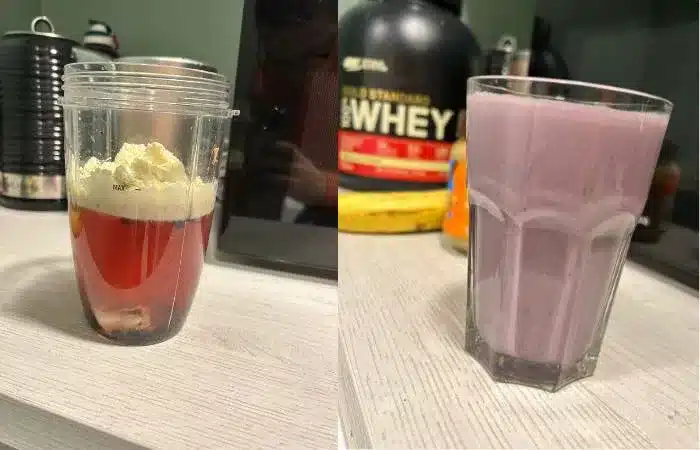
Here’s the honest truth: whey mixed with only water can be thin and a little bland. But with a couple of additions it becomes genuinely delicious, and you keep it far lighter than a milk-based shake. This is my go-to morning recipe, blended rather than shaken:
- Around 12 oz of water
- One and a half scoops of whey protein
- One teaspoon of low-fat peanut butter
- Half a banana
- Three teaspoons of frozen blueberries
Blend it all together (I use a NutriBullet at the office and a Ninja at home), starting with the water and adding the powder last. The result is a thick, tasty, nutritious shake that still comes in far lighter than the same drink made with milk.
| Protein | Carbohydrates | Calories | Extras |
|---|---|---|---|
| 49 g | 17 g | 240 | Fibre, Vitamin C, Vitamin K |
A few more tips for better water shakes: use a quality flavoured whey isolate, which mixes cleaner and tastes better than cheap concentrate; add ice and blend for a milkshake-like texture; or drop in a handful of fruit for natural sweetness without much cost to your calories.
A Note on Other Mixers
Water and milk are the two big options, but they’re far from the only ones. Coffee is hugely popular, and we’ve covered exactly how to do it in our guide on mixing protein powder with coffee. For the full run-down of everything from yogurt to juice to oats, our complete guide on what to mix protein powder with has you covered.
Frequently Asked Questions
Is it OK to mix protein powder with water? Yes, it’s one of the most common and effective ways to take protein. Water keeps the shake low in calories while delivering the full protein content, making it ideal for cutting or calorie control.
Does mixing protein with water make it less effective? No. The protein and its amino acids are identical regardless of what you mix it with. Water simply adds no extra calories or macros, and whey actually digests a little faster in water than in milk. Muscle building depends on your total daily protein, not the liquid.
Is water or milk better for protein shakes? It depends on your goal. Water is better for cutting and staying lean thanks to the lower calories, while milk is better for bulking because of the extra calories, protein, and carbs. Both build muscle equally well.
How much water should I use per scoop? Around 6 to 12 oz of water per scoop. Use less for a thicker shake and more for a thinner one, adjusting to your taste.
Why does my protein clump in water? Usually because the powder went in before the water. Add water to your shaker first, then the powder, shake well, and let it sit for 30 seconds. A shaker ball or blender helps too.
Does water shake taste worse than milk? On its own it’s thinner and more neutral, yes. But with a quality flavoured powder, some ice, or a little fruit and nut butter, a water shake can taste excellent while staying much lighter than milk.
The Bottom Line
Yes, you can mix protein powder with water, and for many people it’s the smartest choice. It gives you all the protein with minimal calories, digests quickly, costs nothing extra, and works anywhere. Reach for water when you’re cutting or controlling calories, choose milk when you’re bulking and chasing mass, and don’t be afraid to mix the two to hit your macros.
And if a plain water shake feels boring, it doesn’t have to be. A little fruit, a spoon of peanut butter, and a good flavoured whey turn it into something you’ll actually look forward to, all while keeping it light. Give the recipe above a try and see for yourself.

Reda El Is a CSCS trainer, Registered Dietitian, ACE-certified nutritionist, With more than 12 years of experience, also he's a Brazilian Jiu-Jitsu competitor, he has done many articles and information sources on many authority sites, such as lifehack.org, Healthline, eat this, wealthygorilla.com, and more. He always keeps improving and updating his knowledge to help everyone to achieve their goals.
All articles by Reda Elmardi →