


ON THIS PAGE
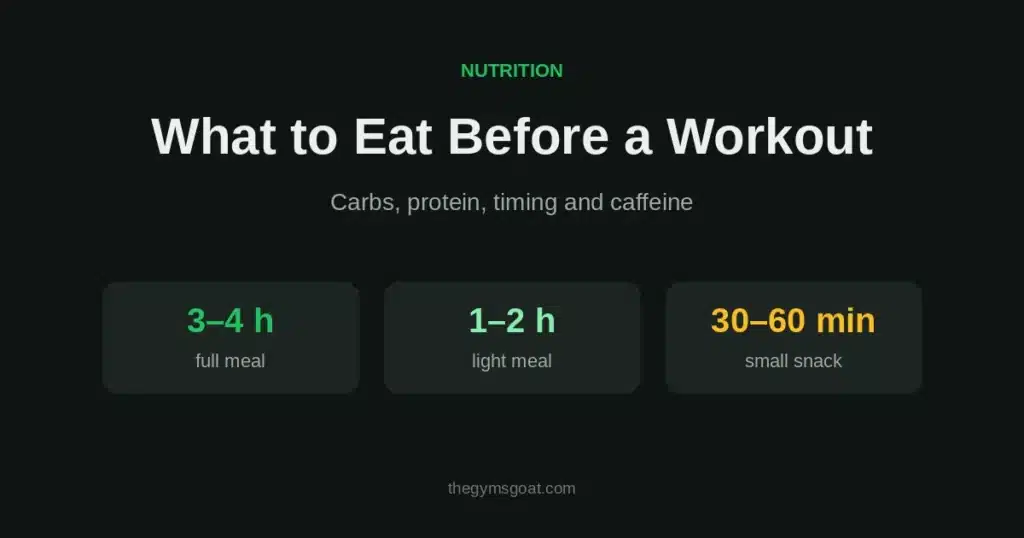
Before a workout, eat a meal with carbohydrates and some protein about 1 to 4 hours beforehand, and keep fat and fibre moderate so it digests easily. If you only have 30 to 60 minutes, choose a small, quick snack such as a banana, a yogurt or a slice of toast with honey. For a typical gym session under an hour, a normal balanced meal earlier in the day is often enough, while longer or harder sessions benefit from more deliberate fuelling.
Pre-workout nutrition is less about magic foods and more about timing, portion size and what kind of training you are doing. This guide explains how much carbohydrate and protein you need, how to time your meal, what to eat if you train early in the morning, whether fasted training is a good idea, and how caffeine and fluids fit in.
This article is informational and not a substitute for individual medical or nutrition advice.
Why What You Eat Before a Workout Matters
Your pre-workout meal has three jobs: give you energy to train hard, reduce muscle breakdown during the session, and keep you comfortable. Carbohydrates top up the glycogen stored in your muscles and liver, which is the main fuel for intense exercise. Protein supplies amino acids that support muscle repair from the moment you start training. Getting the timing right means you have that fuel available without feeling heavy or nauseous.
How much it matters depends on the session. A 45-minute strength workout will rarely be limited by your pre-workout meal if you have eaten normally that day. A long run, a hard interval session or a match is a different story, and that is where pre-exercise carbohydrate makes a measurable difference.
When to Eat Before a Workout
The closer you get to training, the smaller and simpler your meal should be. Large meals with lots of fat, fibre or protein take longer to digest and can cause discomfort if you train too soon after them.
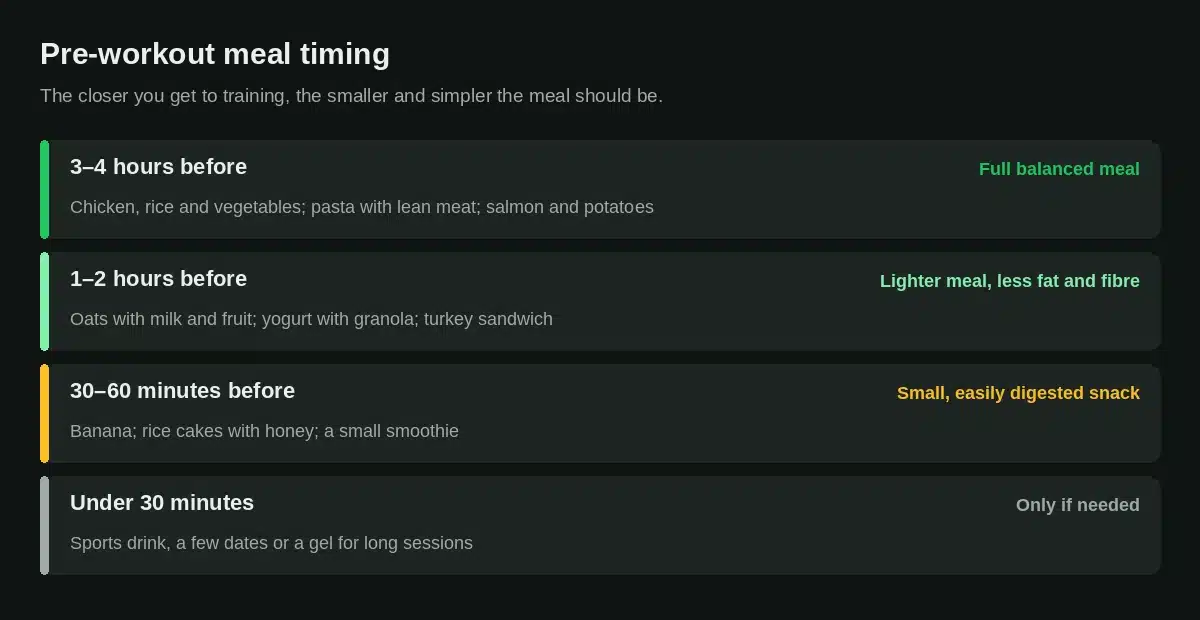
- 3 to 4 hours before: a full, balanced meal with carbohydrates, protein, vegetables and some fat.
- 1 to 2 hours before: a lighter meal or large snack, with less fat and fibre.
- 30 to 60 minutes before: a small, easily digested snack that is mostly carbohydrate.
- Under 30 minutes: usually nothing, unless you are about to do a long endurance session and need quick fuel.
Everyone tolerates food differently. Some people can eat a sandwich 45 minutes before running, others need three hours. Use these windows as a starting point and adjust to what feels right for you.
How Many Carbs Should You Eat Before a Workout?
For most gym sessions under an hour, you do not need to count carbohydrates before training. A normal meal with some carbs, eaten a few hours earlier, keeps your glycogen stores in good shape.
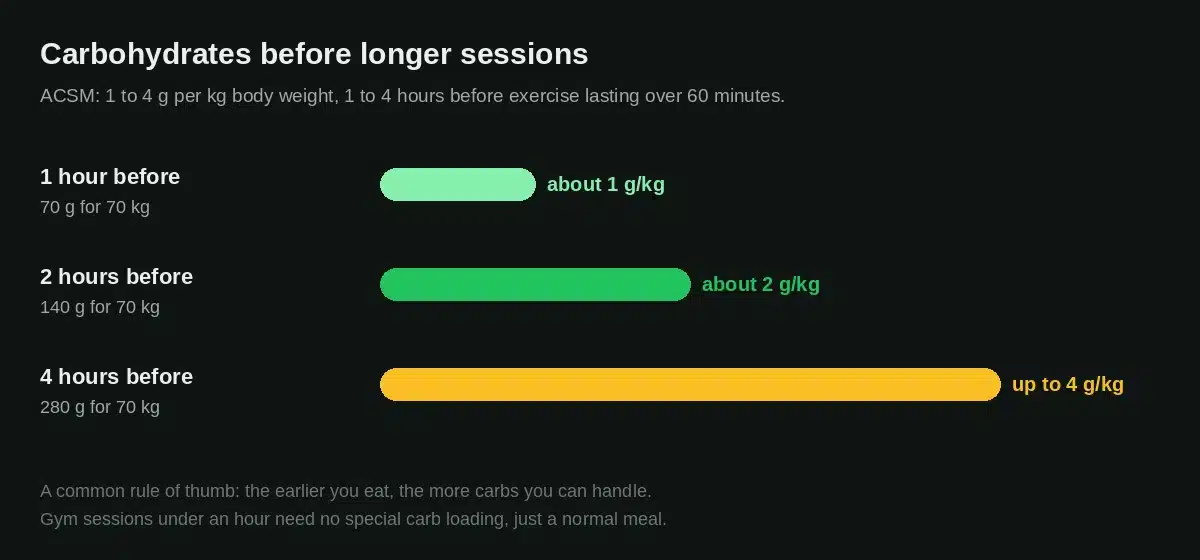
For sessions lasting more than about 60 minutes, the joint position statement on nutrition and athletic performance from the American College of Sports Medicine recommends 1 to 4 grams of carbohydrate per kilogram of body weight, eaten 1 to 4 hours before exercise. A practical rule of thumb is that the earlier you eat, the more you can handle.
The International Society of Sports Nutrition position stand on nutrient timing points in the same direction: carbohydrate before exercise improves performance in longer sessions, and the benefit is smaller for short, low-volume training.
How Much Protein Should You Eat Before a Workout?
Protein before training is useful but less time-critical than many think. The ISSN position stand suggests that a meal with around 0.25 grams of protein per kilogram of body weight, roughly 20 grams for most people, before or after training supports muscle growth. If you had a protein-rich meal a few hours before training, you are already covered and the post-workout meal becomes less urgent.
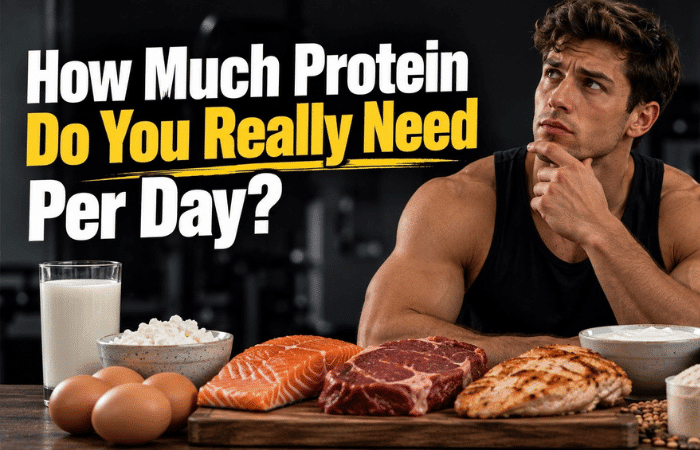
Your total daily protein intake matters more than the exact timing. Our guide on how much protein per day explains how to set your daily target.
What About Fat and Fibre?
Fat and fibre are healthy, but they slow digestion. That is useful in a normal meal and less useful right before training. Keep them moderate in the last couple of hours before a hard session, especially before running or high-intensity work where a full stomach is more noticeable. A few hours out, they are not a problem.
The Best Pre-Workout Foods
Good Carbohydrate Sources
- Oats: a slow, steady source of carbs that works well 1 to 3 hours before training.
- Bananas: quick, portable and easy on the stomach, ideal 30 to 60 minutes before.
- Rice and potatoes: classic choices for a larger meal a few hours out.
- Bread, bagels and rice cakes: simple, fast carbs that pair well with a little protein.
- Dried fruit and dates: very quick energy for longer sessions.
- Pasta: useful the evening before or a few hours before long endurance sessions.
Good Protein Sources
- Greek yogurt and skyr: easy to digest and easy to combine with fruit or oats.
- Eggs: a good choice a few hours before training.
- Chicken, turkey and fish: best in a full meal 3 to 4 hours before.
- Milk and protein shakes: quick protein that sits well for many people.
- Cottage cheese: a protein-rich option with little preparation.
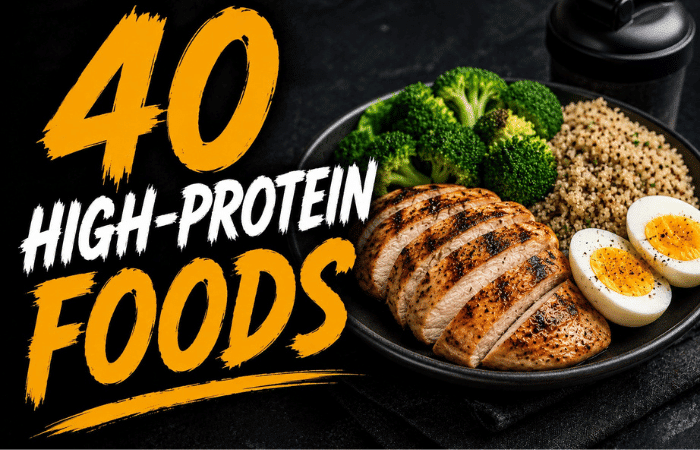
For more protein-rich options, see our list of high-protein foods.
15 Pre-Workout Meal and Snack Ideas
These ideas are grouped by how long you have before training. Adjust portions to your size and session.
| Meal or snack | Best timing | Why it works |
|---|---|---|
| Chicken, rice and vegetables | 3–4 hours before | Balanced meal with carbs and protein |
| Pasta with lean meat sauce | 3–4 hours before | Plenty of carbs for long sessions |
| Salmon with potatoes and greens | 3–4 hours before | Protein, carbs and healthy fats |
| Omelette with toast and fruit | 2–3 hours before | Protein and carbs, moderate fat |
| Oats with milk, banana and honey | 1–2 hours before | Steady carbs, some protein |
| Greek yogurt with granola and berries | 1–2 hours before | Easy to digest, carbs plus protein |
| Turkey sandwich on white bread | 1–2 hours before | Quick carbs and lean protein |
| Rice cakes with peanut butter and jam | 1–2 hours before | Fast carbs, a little fat and protein |
| Smoothie with milk, fruit and protein powder | 1 hour before | Liquid, quick to digest |
| Cottage cheese with pineapple | 1 hour before | Protein and quick carbs |
| Banana | 30–60 minutes before | Fast, portable carbs |
| Toast with honey | 30–60 minutes before | Simple carbs, very light |
| Rice cakes with honey | 30–60 minutes before | Light and easy on the stomach |
| A few dates or dried apricots | 30 minutes before | Very quick energy |
| Sports drink | During or just before long sessions | Carbs and fluid together |
Should You Train Fasted?
Training on an empty stomach, usually first thing in the morning, is popular for fat loss. The evidence does not show a clear advantage. A study by Schoenfeld and colleagues found similar fat loss whether participants did cardio fasted or after a meal, as long as their overall diet was the same. Total calorie balance across the day is what drives fat loss, not whether one session is fasted.
For performance, eating usually helps. A meta-analysis by Aird and colleagues found that eating before exercise improved performance in prolonged aerobic sessions lasting more than an hour, while short sessions showed little difference. If you feel fine training fasted for a short session, it is a reasonable choice. If you train long or hard, a small pre-workout snack is likely to help. For more on fat loss, see our guide on how to lose belly fat.
Early Morning Workouts
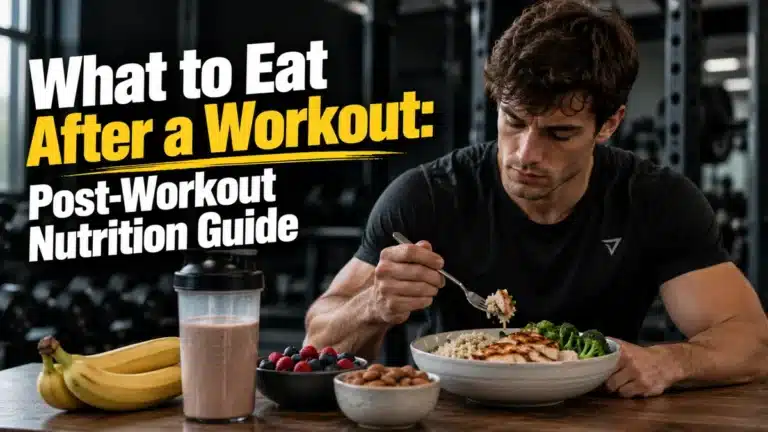
If you train soon after waking, you probably do not have time for a full meal. Choose something small and quick 30 to 60 minutes before, such as a banana, a yogurt or a glass of milk, or simply eat a proper breakfast afterwards if your session is short. If you train fasted, make your post-workout meal a priority. Our guide on what to eat after a workout covers that in detail.
Caffeine Before a Workout
Caffeine is one of the few pre-workout supplements with strong evidence. The ISSN position stand on caffeine concludes that 3 to 6 mg per kilogram of body weight, taken about 60 minutes before exercise, consistently improves performance in a range of activities. For a 70 kg person, that is roughly 200 to 400 mg, or two to four cups of coffee.
Higher doses add side effects without extra benefit, and caffeine late in the day can disrupt sleep. Many pre-workout products also contain large amounts per scoop, so check the label. Our article on dry scooping pre-workout explains why taking it straight from the scoop is a bad idea.
Don’t Forget Fluids
Start every session well hydrated. The ACSM position statement suggests drinking about 5 to 7 ml of fluid per kilogram of body weight at least four hours before exercise, which is roughly 350 to 500 ml for most people. If your urine is still dark, drink a little more. Pale yellow urine is a simple sign that you are well hydrated.
What to Eat Before a Workout Based on Your Goal
For Muscle Gain
Eat a balanced meal with carbs and protein 2 to 4 hours before training, or a smaller snack closer to the session. Combine it with enough total calories and protein across the day. Our guide on how to build muscle covers the bigger picture.
For Fat Loss
Keep your pre-workout meal within your daily calorie budget. A light snack with some protein and carbs is often enough to train well, and fasted training is fine if you prefer it.
For Endurance Training
Carbohydrates matter most here. Aim for 1 to 4 g/kg in the hours before a long session or race, and practise your pre-race meal in training so there are no surprises.
What to Avoid Before a Workout
- Large, fatty meals close to training. They digest slowly and can cause discomfort.
- High-fibre foods right before. Beans, lentils and large salads are better a few hours out.
- New foods before an important session. Test them in training first.
- Too much caffeine. More than 6 mg/kg adds side effects without extra benefit.
- Training on empty before a long, hard session. Performance usually suffers.
Frequently Asked Questions
How long before a workout should I eat? Eat a full meal 3 to 4 hours before, a lighter meal 1 to 2 hours before, or a small snack 30 to 60 minutes before. Choose based on how much time you have and how your stomach handles food.
What is the best thing to eat before a workout? A meal with carbohydrates and some protein, such as oats with milk and fruit, a turkey sandwich, or chicken with rice. If you only have a few minutes, a banana is a simple, reliable choice.
Is it bad to work out on an empty stomach? Not for short sessions if you feel fine. For long or intense workouts, eating beforehand usually improves performance. Fasted training does not lead to more fat loss over time.
Should I eat protein before a workout? It helps, but it is not essential. If you ate a protein-rich meal a few hours earlier, you are already covered. Otherwise, 20 grams of protein before or after training is a good target.
Is coffee good before a workout? Yes, for most people. Caffeine taken about an hour before exercise improves performance. Avoid it late in the day if it affects your sleep.
What should I eat before an early morning workout? Something small and quick, such as a banana, a yogurt or a glass of milk. If your session is short, you can also train fasted and eat a proper breakfast afterwards.
The Bottom Line
What you eat before a workout comes down to timing. Eat a balanced meal with carbohydrates and protein 3 to 4 hours before, a lighter meal 1 to 2 hours before, or a small, easily digested snack 30 to 60 minutes before. For short gym sessions, your normal meals are usually enough, while longer and harder sessions benefit from 1 to 4 g/kg of carbohydrate in the hours beforehand.
Stay hydrated, use caffeine sensibly, and do not stress about fasted training for short sessions. Then follow up with a good post-workout meal, and focus on hitting your daily protein and calorie targets.
Sources
- Kerksick CM, Arent S, Schoenfeld BJ et al. International Society of Sports Nutrition position stand: nutrient timing. Journal of the International Society of Sports Nutrition, 2017.
- Thomas DT, Erdman KA, Burke LM. American College of Sports Medicine Joint Position Statement: Nutrition and Athletic Performance. Medicine and Science in Sports and Exercise, 2016.
- Guest NS, VanDusseldorp TA, Nelson MT et al. International Society of Sports Nutrition position stand: caffeine and exercise performance. Journal of the International Society of Sports Nutrition, 2021.
- Aird TP, Davies RW, Carson BP. Effects of fasted vs fed-state exercise on performance and post-exercise metabolism: A systematic review and meta-analysis. Scandinavian Journal of Medicine and Science in Sports, 2018.
- Schoenfeld BJ, Aragon AA, Wilborn CD et al. Body composition changes associated with fasted versus non-fasted aerobic exercise. Journal of the International Society of Sports Nutrition, 2014.

I'm Tomek, your dedicated fitness coach at TheGymGoat. With years of experience as a certified personal trainer, fitness blogger and a passion for empowering individuals, I'm committed to helping you reach your health and wellness goals. I don't do excuses, I make priorities and always base my workout and diet on reserach.
All articles by Tomek →