




ON THIS PAGE
The honest answer is that you cannot know for certain whether someone is natural or enhanced just by looking at them; only a drug test can confirm it. However, there are several well-known indicators that experienced observers weigh up, from how much muscle someone carries relative to the natural limit, to their rate of gain, to how lean and full they stay year-round. Understanding these signs is less about labelling individuals and more about developing a realistic sense of what is and isn’t naturally achievable.
This guide explains what those indicators are, why none of them prove anything on their own, and, most importantly, why any of this matters for your own training and expectations.
This article is informational and not a substitute for medical advice. It is intended to help you set realistic expectations, not to accuse or diagnose any individual. Performance-enhancing drugs carry serious health and legal risks, and this article does not endorse their use.
First, an Honest Disclaimer
You genuinely cannot tell with certainty whether a specific person is natural or enhanced from the outside, and it is neither fair nor sensible to accuse individuals. Genetics, training age, dedication, and photography all vary so enormously that even experienced coaches get it wrong. The indicators below are patterns that shift the probabilities, not proof, and this article will not label any particular person.
So why cover it at all? Because understanding these signs protects you. Social media is saturated with enhanced physiques presented as natural, often alongside a training programme or supplement for sale. Believing those results are achievable naturally, and on that timeline, is a fast route to frustration, unrealistic goals, and feeling like a failure when your own honest progress doesn’t match. Media literacy here is genuinely good for your training and your mental health.
Why People Ask “Is He Natural?”
People ask whether a physique is natural mainly to calibrate their own expectations, and that is a healthy instinct. If you are comparing your natural, hard-won progress to someone who is enhanced without realising it, you are comparing yourself to a standard you physically cannot reach by the same means. Knowing the difference lets you admire a physique for what it is while keeping your own goals grounded in reality.
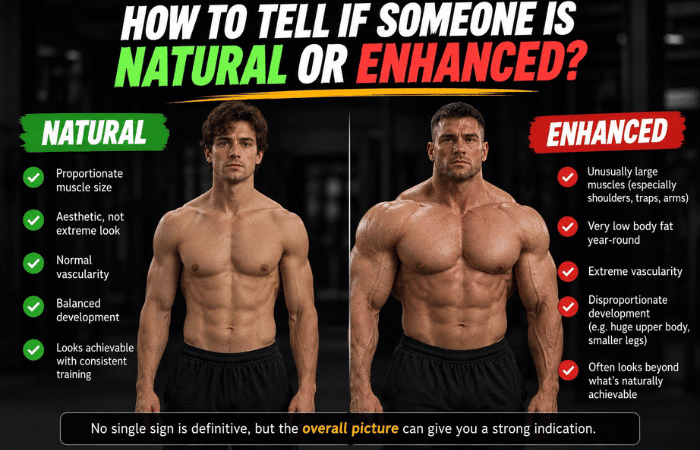
The Main Indicators People Look At
Below are the indicators most often discussed, each paired with why it falls short of proof. Read them as a collection of probabilities, not a checklist that “catches” anyone.
| Indicator | What observers look at | Why it isn’t proof |
|---|---|---|
| Muscle size vs the natural limit | A physique at or beyond the estimated natural ceiling (see FFMI below) | Height, genetics, and measurement error all move the line |
| Rate of muscle gain | Very fast or dramatic transformations, or gaining muscle while getting leaner as an advanced lifter | Beginners, returning lifters, and genetic outliers can progress fast |
| Staying big and lean year-round | Holding very low body fat at high muscle mass continuously | A rare few manage this naturally with elite genetics and discipline |
| Full, round “3D” delts and thick traps | Exceptionally developed shoulders and traps | Natural genetics and training focus vary hugely here |
| Muscle fullness and vascularity | Extreme fullness with very thin skin | Pumps, lighting, dehydration, and camera angles distort all of this |
| Recovery and training capacity | Handling very high training volume and frequency | Experience, sleep, nutrition, and lifestyle explain a lot of this |
Muscle Size and the Natural Limit
The most objective indicator is how much muscle someone carries relative to the natural limit, often estimated using the Fat-Free Mass Index (FFMI). Research suggests that most drug-free athletes top out around an FFMI of 25, so a lean, muscular person sitting well above that, particularly if they are also very tall or very lean, is carrying more muscle than is typical for a natural. That said, FFMI is an estimate with a real margin for error, and genetic outliers exist. We cover this in depth in our dedicated guide to FFMI and your natural muscle potential.
Rate of Muscle Gain
Natural muscle growth is slow, so unusually fast or dramatic gains can be a flag, with an important exception. A trained, lean individual who suddenly adds a lot of muscle, or gains muscle while simultaneously getting leaner, is doing something that becomes very difficult naturally after the first year or so of training. The caveat is large, though: beginners experience rapid “newbie gains,” people returning after a break regain muscle quickly through “muscle memory,” and the genetically gifted simply progress faster. Our guide on how to build muscle sets out what realistic natural progress actually looks like.
Staying Big and Lean All Year
Holding a large amount of muscle while staying very lean all year round is difficult naturally, because natural physiques usually have to trade one for the other. Naturally, building muscle generally requires a calorie surplus and getting very lean requires a deficit, so most naturals cycle between the two, as we explain in our bulking and cutting content. Someone who appears huge and shredded continuously may simply be a genetic standout, may be photographed only at their best, or may be enhanced, you cannot tell which from a photo.
Physical “Look” Signs
Certain physical signs, like exceptionally full, round delts and thick traps, are commonly associated with enhancement, but they are among the least reliable indicators. The shoulders and traps are often cited because they are rich in androgen receptors, so some people point to a very “capped,” 3D shoulder look. The problem is that plenty of naturals have excellent delt and trap genetics, and training emphasis alone can build them, so this “look” proves nothing on its own.
Recovery and Training Capacity
The ability to recover from and grow on very high training volumes is sometimes cited, since enhancement improves recovery. Someone training with enormous frequency and volume while continuing to grow may be recovering faster than is typical. But experience, excellent sleep, low stress, good nutrition, and being a full-time athlete with time to recover all explain high training capacity too.
A More Reliable Signal: Tested vs Untested Competition
The single most reliable indicator is context: whether someone competes in a drug-tested federation. Natural bodybuilding federations run regular drug testing (including polygraphs and urine tests), so athletes competing and winning in these organisations have at least been tested, whereas mainstream federations like the IFBB Pro League are untested, and enhancement is an open reality at the top.
This is factual context rather than speculation, which is exactly why it is more useful than reading someone’s delts. For a sense of what verified natural physiques look like, see our roundup of the biggest natural bodybuilders.
Why You Still Can’t Be Sure
Even with all these indicators, you cannot be certain about any individual, and it is worth understanding why. Genetics vary enormously, so a gifted natural can look extraordinary while an enhanced person with average genetics may look unremarkable. You cannot see someone’s training age, their true body-fat level, their measurements, or their history from a photo. Lighting, pumps, dehydration, posing, and camera angles dramatically change how a physique appears. And even drug tests are imperfect and can be circumvented. In short, these indicators describe populations and probabilities, never a verdict on a person.
Why This Actually Matters for You
The real value of understanding all this is that it lets you set realistic goals and protect your motivation. When you accept that many of the physiques you see online are enhanced, genetically exceptional, or simply photographed at their absolute best, you stop measuring your natural progress against an impossible standard. It keeps you consistent, patient, and proud of real progress rather than discouraged by a comparison that was never fair.
So channel that energy inward. Focus on progressive overload, sound nutrition, and consistency over years, and judge yourself against your own previous best, not against someone else’s highlight reel. A dedicated natural physique is genuinely impressive and absolutely worth pursuing, and it is the only comparison that truly matters.
FAQ
Can you really tell if someone is natural or on steroids?
Not with certainty. Only a drug test can confirm it. There are indicators, such as carrying muscle beyond the natural limit, unusually fast gains, or staying big and lean year-round, but every one has innocent explanations, so they suggest probabilities rather than proof. It is never fair to definitively accuse an individual based on appearance.
What is the natural muscle limit?
Research suggests most drug-free athletes reach an upper limit around a Fat-Free Mass Index (FFMI) of 25, which corresponds to a lean, muscular, but still human-looking physique. It is an estimate with genuine variation between individuals, so treat it as a guide to what is broadly achievable naturally rather than a hard cut-off.
Why do so many fitness influencers claim to be natural?
Claiming to be natural boosts credibility and helps sell programmes and supplements, since the implication is “follow my plan and you can look like this too.” This is why it is wise to be sceptical of natural claims, particularly when tied to something being sold, and to keep your own expectations grounded regardless of what anyone claims.
The Bottom Line
You cannot definitively tell whether someone is natural or enhanced from the outside, and it is not your place to accuse anyone. The indicators, muscle size relative to the natural limit, rate of gain, staying lean and big year-round, and competition context, can shift the probabilities, but genetics, training history, and photography make certainty impossible from a photo or a video.
What matters far more is what you do with this understanding. Use it to build realistic expectations, to recognise that not every physique you admire is naturally achievable, and to keep your focus on your own consistent progress. Train hard, be patient, and measure yourself against your own results. That is how you build a physique you can be genuinely proud of, and it is the only comparison worth making.

Reda El Is a CSCS trainer, Registered Dietitian, ACE-certified nutritionist, With more than 12 years of experience, also he's a Brazilian Jiu-Jitsu competitor, he has done many articles and information sources on many authority sites, such as lifehack.org, Healthline, eat this, wealthygorilla.com, and more. He always keeps improving and updating his knowledge to help everyone to achieve their goals.
All articles by Reda Elmardi →