




ON THIS PAGE
Progressive overload is the gradual increase of the stress you place on your muscles over time, and it is the single most important principle for building muscle, strength, and endurance. Put simply, if you want to keep getting bigger, stronger, or fitter, you have to keep giving your body a reason to adapt by asking a little more of it than it is used to. Do that consistently and progress is almost inevitable; ignore it, and you will stall, no matter how hard your sessions feel.
This guide explains exactly what progressive overload is, why it works, and the many practical ways to apply it, whether you lift weights, train with bodyweight, or simply want to keep improving.
This article is informational and not a substitute for individual medical or training advice.
What Is Progressive Overload?
Progressive overload is the practice of gradually increasing the demands on your body during exercise so that it is continually forced to adapt. The name breaks down neatly: “progressive” means steadily increasing over time, and “overload” means working your muscles beyond the level they are currently comfortable with.
Crucially, and this is where most people get it wrong, progressive overload does not simply mean adding more weight to the bar. Weight is just one of several variables you can increase. You can also do more reps, more sets, train more often, use a fuller range of motion, slow your tempo, or rest less between sets. Any of these, applied gradually, creates the overload that drives adaptation. Understanding this opens up far more ways to keep progressing than load alone.
Why Progressive Overload Works: The Science
Progressive overload works because your body adapts to the demands you place on it, a principle known as the SAID principle (Specific Adaptation to Imposed Demands). When you challenge a muscle beyond what it is used to, you create small amounts of stress and micro-damage. In response, and given adequate rest and nutrition, your body repairs and rebuilds that muscle slightly bigger and stronger than before, so it is better prepared next time.
Here is the catch: your body only adapts as much as it needs to. Once a given workout becomes easy, it no longer provides a stimulus to change, and you plateau. This is why doing the same weights, reps, and sets week after week eventually stops producing results, your body has already adapted to that exact demand. Progressive overload solves this by continually raising the bar, keeping your muscles in a state of having to adapt. It is not a training style or a programme; it is the underlying reason any good programme works.
The 8 Ways to Apply Progressive Overload
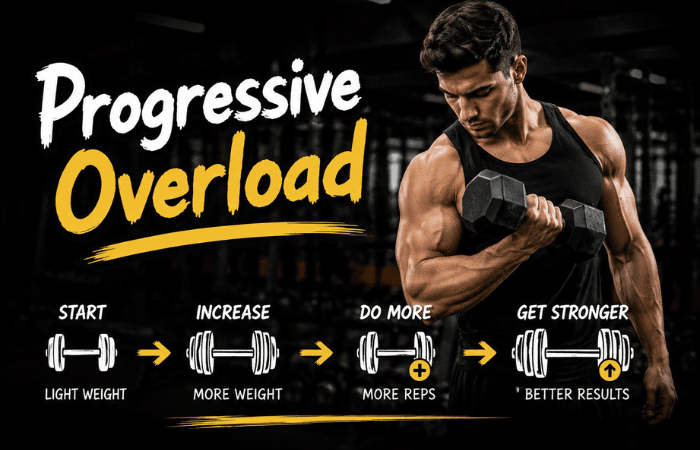
There are eight main ways to apply progressive overload, and increasing the weight is only one of them. This matters because when you cannot add weight, you can still progress by changing another variable. Here are your options:
| Method | How to do it | Best for |
|---|---|---|
| 1. Increase the weight | Add load to the bar, dumbbells, or machine | Strength and overall progress (the classic method) |
| 2. Increase the reps | Do more repetitions with the same weight | Hypertrophy and endurance; when adding weight isn’t yet possible |
| 3. Increase the sets | Add another working set to an exercise | Increasing total volume for muscle growth |
| 4. Increase the frequency | Train a muscle group more often per week | Adding weekly volume and practice on a lift |
| 5. Improve range of motion | Perform each rep through a fuller, deeper range | Better muscle stimulus and mobility |
| 6. Slow the tempo | Lower the weight more slowly to increase time under tension | Hypertrophy and control, without adding load |
| 7. Reduce rest periods | Shorten the rest between sets to raise training density | Conditioning and work capacity |
| 8. Increase exercise difficulty | Progress to a harder variation of the movement | Bodyweight training and when load is limited |
The takeaway is simple: progression is a menu, not a single dish. A well-rounded approach uses several of these levers over time rather than relentlessly chasing heavier weights, which is neither sustainable nor safe forever.
How to Apply Progressive Overload in Practice
The most reliable way to apply progressive overload for most people is a method called double progression, where you first increase your reps within a target range, then increase the weight. It removes the guesswork and keeps you progressing safely without forcing heavier loads before you are ready.
Here is how double progression works. Pick a rep range, say 8 to 12. Start with a weight you can lift for 8 reps with good form. Each session, try to add reps until you can perform all your sets at the top of the range (12 reps). Once you can, increase the weight by the smallest increment available, which will drop your reps back toward the bottom of the range, and begin climbing again.
A worked example on the bench press might look like this:
| Week | Weight | Sets x Reps achieved | Next step |
|---|---|---|---|
| 1 | 60 kg | 3 x 8 | Add reps |
| 2 | 60 kg | 3 x 10 | Add reps |
| 3 | 60 kg | 3 x 12 | Top of range reached, add weight |
| 4 | 62.5 kg | 3 x 8 | Add reps again |
Other common approaches include linear progression, adding a small amount of weight every session or week, which works brilliantly for beginners, and periodisation, where more advanced lifters cycle their weight, reps, and volume in planned phases over weeks and months. Whichever model you use, the principle is the same: do a little more over time.
How Much and How Fast Should You Progress?
You should progress in the smallest increments possible and only as fast as you can while maintaining good form. Slower, steady progress that you can sustain beats big jumps that stall or cause injury.
For most people, that means adding around 2.5 kg (or 5 lb) to upper-body lifts and slightly more to lower-body lifts when you increase weight, or using microplates of 0.5 to 1.25 kg to make even smaller jumps on lifts where a full increment is too much. If you cannot add weight yet, add a single rep or a single set instead. Progress does not have to happen every session, and trying to force it too quickly is one of the most common ways people plateau or get hurt.
Bear in mind that your rate of progress naturally slows over time. Beginners can often add weight almost every session (the famous “newbie gains”), while experienced lifters may add weight only every few weeks and rely more heavily on the other progression levers. This slowdown is completely normal and not a sign you are doing anything wrong.
Progressive Overload for Your Goal
The best way to apply progressive overload depends on your goal, because strength, muscle size, and endurance each respond best to different rep ranges and progression levers. Use this as a guide:
| Goal | Rep range | Main progression lever | Rest between sets |
|---|---|---|---|
| Strength | 1 to 6 reps | Increase weight | 2 to 5 minutes |
| Muscle size (hypertrophy) | 6 to 12 reps | Increase reps, then weight, and add volume | 1 to 2 minutes |
| Muscular endurance | 12 to 20+ reps | Increase reps and reduce rest | 30 to 60 seconds |
None of these are rigid rules, and muscle can be built across a wide range of reps, but they show how progression is tailored to what you are training for. For more on structuring your sets and exercises, see our guide on how many exercises per muscle group.
Progressive Overload for Bodyweight Exercises
Yes, progressive overload absolutely applies to bodyweight training, you simply progress by making the exercises harder rather than by adding external weight. This is how calisthenics athletes build impressive strength using little or no equipment.
The main ways to overload bodyweight exercises are to increase the reps, progress to a harder variation (for example, moving from knee push-ups to standard push-ups to decline or archer push-ups), slow the tempo, increase the range of motion, or eventually add external load with a weighted vest or bands. The principle is identical to weight training: keep making the movement more challenging over time. Our guide on the benefits of calisthenics explores this further.
Tracking Your Progress
The most important habit for applying progressive overload is keeping a training log, because you cannot reliably progress from what you do not measure. Trying to remember last week’s weights and reps is a recipe for drifting along doing the same thing.
Record the exercise, weight, sets, and reps for every working set, then aim to beat one of those numbers next time. A simple notebook or phone app works perfectly. Over weeks and months, that log becomes both your roadmap, telling you exactly what to try to beat, and your proof of progress, showing how far you have come. It is the single most underrated tool in training.
Common Progressive Overload Mistakes
The most common progressive overload mistake is adding weight too quickly at the expense of form, but there are several others worth avoiding:
- Sacrificing form for weight. Adding load while your technique falls apart trains bad habits and invites injury. Good form always comes first.
- Only ever adding weight. Ignoring the other seven levers leaves progress on the table and burns you out. Vary how you progress.
- Not tracking anything. Without a log, progression becomes guesswork and usually stalls.
- Progressing too many variables at once. Adding weight, reps, and sets all in the same week makes sessions unmanageable. Change one thing at a time.
- Expecting linear progress forever. Gains slow down as you advance. That is normal, not failure.
- Neglecting recovery and nutrition. You do not grow from training alone, which is the next crucial point.
What to Do When You Plateau
When you stop progressing, the fix is usually to change your progression lever, take a lighter recovery week, or address your recovery and nutrition, rather than simply trying harder. Plateaus are a normal part of training, not a dead end.
If you have stalled, try switching the variable you are progressing (if you have been chasing weight, focus on reps or an extra set instead). Consider a deload, a planned week of lighter training that lets your body recover and often leads to a jump in performance afterwards. And honestly assess whether you are eating and sleeping enough to support progress, because under-recovery is one of the most common hidden causes of a plateau.
Beginners vs Advanced Lifters
Beginners should progress with simple linear progression and can expect fast gains, while advanced lifters need slower, more varied, and more carefully planned progression. The more trained you are, the harder each new gain becomes.
As a beginner, adding a little weight or a rep almost every session using a straightforward programme will take you a very long way, this is the best time to build the habit of consistent progression. As you become more experienced, you will progress more slowly, lean more on the range of progression methods, and benefit from structured periodisation. Programmes like push pull legs, PHUL, PHAT, and the PPL x Arnold split all provide a framework for applying progressive overload as you advance.
Don’t Forget Nutrition and Recovery
Progressive overload only builds muscle if it is supported by adequate nutrition and recovery, because your body repairs and grows during rest, not during the workout itself. Training provides the stimulus; food and sleep provide the raw materials and the opportunity to adapt.
To build muscle, you generally need enough protein and often a slight calorie surplus, as covered in our guide on bulking vs cutting, along with sufficient sleep and rest days. Push hard with progressive overload but recover poorly, and you will stall or burn out. The two go hand in hand: the overload creates the demand, and recovery meets it.
FAQ
What is progressive overload in simple terms?
Progressive overload means gradually doing a little more in your workouts over time, whether that is more weight, more reps, more sets, or harder variations, so your body is continually forced to adapt and grow. It is the fundamental principle behind building muscle, strength, and fitness.
How quickly should I add weight?
Add weight in the smallest increments possible, and only when you can complete your target reps with good form. For most people that is around 2.5 kg on upper-body lifts and a little more on lower-body lifts, or smaller microplate jumps. Progress does not need to happen every session; slow and steady is more sustainable.
Can you build muscle without progressive overload?
Not for long. You might see initial results as a beginner, but without progressively increasing the demands on your muscles, your body has no reason to keep adapting, and you will plateau. Some form of progressive overload is essential for continued muscle and strength gains.
How do I apply progressive overload as a beginner?
As a beginner, use simple linear progression: pick a programme, start with manageable weights and good form, and add a small amount of weight or an extra rep whenever you can. Keep a log of your lifts and aim to beat your previous numbers over time. This straightforward approach delivers excellent results early on.
Does progressive overload work for bodyweight exercises?
Yes. With bodyweight training you progress by doing more reps, moving to harder exercise variations, slowing your tempo, increasing your range of motion, or adding external load like a weighted vest. The principle is exactly the same as with weights: make the exercise progressively more challenging.
How do I know if I’m progressing enough?
Check your training log. If over a span of weeks you are lifting more weight, doing more reps or sets, or performing harder variations than before, you are progressing. If your numbers have been identical for several weeks, it is time to change a variable, review your recovery, or consider a deload.
The Bottom Line
Progressive overload is the foundation of all training progress: by gradually increasing the demands on your body over time, you give it a continual reason to grow stronger, bigger, and fitter. The key insight is that it is far more than just adding weight, you can progress through reps, sets, frequency, range of motion, tempo, rest, and exercise difficulty, which means there is almost always a way to keep moving forward.
Apply it patiently and consistently, track your workouts, prioritise good form, and support your training with proper nutrition and recovery. Do that, and progress stops being a matter of luck or motivation and becomes something you can all but guarantee. Master this one principle, and you have mastered the most important rule in fitness.

I'm Tomek, your dedicated fitness coach at TheGymGoat. With years of experience as a certified personal trainer, fitness blogger and a passion for empowering individuals, I'm committed to helping you reach your health and wellness goals. I don't do excuses, I make priorities and always base my workout and diet on reserach.
All articles by Tomek →