



ON THIS PAGE
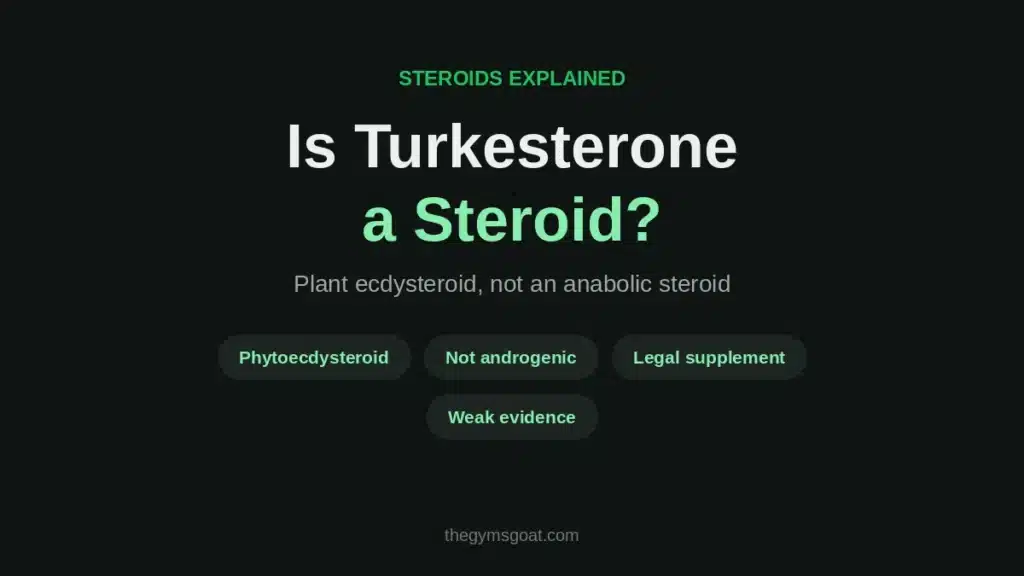
Turkesterone is a steroid in the strict chemical sense, but not the kind that worries most people. It is a phytoecdysteroid, a plant steroid found in the herb Ajuga turkestanica, and it is not an anabolic-androgenic steroid like testosterone. It does not appear to bind the androgen receptor, and it is legal to sell as a supplement in the United States. The harder question is whether it does anything, and the current evidence is thin.
This article explains what turkesterone is, why “steroid” is technically accurate but misleading, what the research on ecdysteroids shows, how it is handled in anti-doping, and what to realistically expect.
This article is informational and not a substitute for individual medical advice. It does not provide dosing guidance. If you have a health condition or take medication, talk to a clinician before adding any supplement.
Is Turkesterone a Steroid? The Short Answer
Yes and no, depending on what you mean by “steroid”.
- Chemically, yes. Turkesterone has the four-ring steroid skeleton that defines a steroid molecule. In that sense cholesterol, vitamin D and cortisol are steroids too.
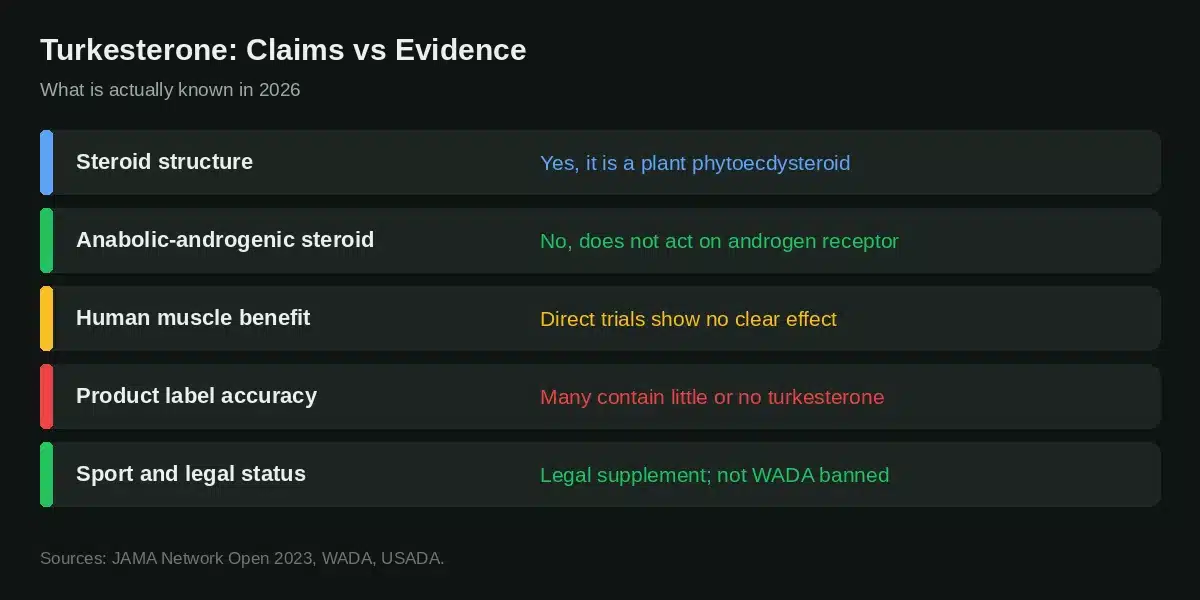
- As an anabolic-androgenic steroid, no. It is not a form of testosterone, it is not thought to activate the androgen receptor, and it does not cause the androgenic effects associated with steroids such as testosterone suppression.
So when a label calls turkesterone a “natural anabolic”, the word steroid is being used loosely. It is a plant compound that happens to share a steroid structure, not a drug in the same category as the anabolic steroids covered in our guide on whether testosterone is a steroid.
What Is Turkesterone?
Turkesterone is a phytoecdysteroid, one of a family of steroid compounds that insects and some plants produce. In insects, ecdysteroids control molting and growth. In plants such as Ajuga turkestanica, spinach and quinoa they appear to play a defensive role. The most studied member of the family is ecdysterone (20-hydroxyecdysone); turkesterone is a close relative that has been marketed heavily as a muscle-building supplement.
The appeal is the claim that ecdysteroids boost muscle protein synthesis without the hormonal side effects of anabolic steroids. That idea comes mostly from older animal and cell studies, plus a small number of human trials on ecdysterone, not turkesterone itself.
How Turkesterone Is Thought to Work
Unlike testosterone and SARMs, turkesterone is not believed to act through the androgen receptor. Laboratory docking studies on the related compound ecdysterone suggest it binds poorly to the androgen receptor, which fits the observation that ecdysteroids do not produce typical androgenic effects.
The leading proposed mechanism involves the estrogen receptor beta (ER-beta) pathway. A 2015 study by Parr and colleagues used computer modeling and animal and cell experiments and concluded that ecdysterone’s muscle effects are non-androgenic and likely run through ER-beta rather than the androgen receptor. Later work from the same group reported that an ER-beta antagonist blocked ecdysterone’s muscle-cell growth, supporting that idea.
Two caveats matter. First, almost all of this mechanistic work is on ecdysterone, not turkesterone. Second, the ER-beta mechanism rests heavily on cell and animal models and computer docking, not confirmed human physiology. It is a plausible hypothesis, not settled science.
What the Human Evidence Shows
Here is the key fact: there is almost no published human research on turkesterone specifically. The human data people cite is usually about ecdysterone, a different ecdysteroid.
The ecdysterone trial people quote
The most referenced study is a 2019 trial by Isenmann and colleagues, published in Archives of Toxicology and supported by the World Anti-Doping Agency. It gave ecdysterone-containing supplements to young men doing resistance training over ten weeks and reported greater gains in muscle mass and bench-press strength than placebo. On the strength of that, the authors recommended adding ecdysterone to the WADA prohibited list.
The results sound impressive, but the study has real limitations. The groups were small, about 10 to 12 people each. It studied ecdysterone, not turkesterone. And the research group’s own later analysis found that many ecdysterone supplements contain far less than their labels claim, which complicates any dose conclusions.
The turkesterone trials that do exist
The small amount of direct turkesterone research is not encouraging. A 2023 crossover study in recreationally active men found that acute turkesterone dosing did not raise IGF-1 and caused no reported digestive distress, but also produced no measurable anabolic signal. A 2025 randomized, double-blind, placebo-controlled trial of 31 active adults taking turkesterone daily for four weeks found no differences versus placebo in body mass, lean mass, fat mass or handgrip strength.
In other words, the best direct human evidence on turkesterone so far shows no clear effect on body composition or strength. That could change with larger and longer studies, but right now the hype runs well ahead of the data.
The Supplement Quality Problem
Even if turkesterone worked, there is a serious question of whether the products contain it. Independent testing has repeatedly found very little actual turkesterone in supplements sold under that name.
A 2023 analysis in JAMA Network Open bought and tested performance supplements, including eight labeled as turkesterone. Four contained no detectable turkesterone at all, and the other four contained only a tiny fraction of the labeled amount, roughly 0.02% to 0.1%. None came within even 10% of the label claim. Independent lab testing publicized by supplement reviewers has reported similar results, with many products containing under 1% of what they advertise.
This echoes the pattern seen with ecdysterone supplements, where one analysis found the labeled content was highly inaccurate in about two-thirds of products tested. The practical takeaway: a bottle labeled turkesterone may contain almost none.
Turkesterone, Ecdysterone and Anti-Doping
Turkesterone is not currently banned in sport. Ecdysterone, its better-studied relative, sits on WADA’s Monitoring Program rather than the Prohibited List. WADA added ecdysteroids to the monitoring program in 2020 to gather data on their use, and ecdysterone still appears on the 2026 Monitoring Program under anabolic agents. Being monitored means WADA is watching usage patterns and may decide later whether to prohibit it; it is not banned today.
Athletes should still be careful. A supplement labeled as a plant ecdysteroid could be contaminated with something that is prohibited, which is a recurring problem across the sports-supplement market. For anyone subject to testing, third-party certified products are the only sensible route. Our overview of whether creatine is a steroid covers how a genuinely well-evidenced, legal supplement compares.
Is Turkesterone Legal?
In the United States turkesterone is sold legally as a dietary supplement. It is not a controlled substance, not an anabolic steroid under the law, and not currently prohibited in sport. That legal status is one reason it became popular: unlike SARMs, which the FDA considers unapproved drugs that cannot be sold as supplements, turkesterone products are generally marketed within supplement rules. For the contrast, see our guide on SARMs vs steroids.
Legal availability is not the same as proven or regulated for quality. Supplements do not need FDA approval before sale, and as the testing data shows, label accuracy for turkesterone is poor.
Realistic Expectations and Safety
If you are deciding whether turkesterone is worth it, weigh three things.
- Evidence of benefit: weak. Direct human trials on turkesterone have not shown clear gains in muscle or strength.
- Product reliability: poor. Many products contain little or no turkesterone.
- Safety: largely unknown. Short studies report few side effects and no obvious liver or kidney stress, but there is no long-term human safety data on turkesterone specifically.
None of that makes turkesterone dangerous in the way an unapproved drug might be, but it does make it a speculative purchase. The reliable drivers of muscle growth remain training and diet. If you want to put money and effort where the evidence is strongest, start with our guides on how to build muscle and how much protein you need per day.
Frequently Asked Questions
Is turkesterone a steroid? Chemically yes, it has a steroid structure as a phytoecdysteroid. But it is not an anabolic-androgenic steroid and is not thought to act on the androgen receptor, so it does not behave like testosterone or anabolic steroids.
Does turkesterone build muscle? The direct human evidence is weak. The main turkesterone trials to date found no significant effect on body composition or strength, and much of the positive data is on the related compound ecdysterone.
Is turkesterone banned in sport? No. Turkesterone is not on the WADA Prohibited List. Ecdysterone is on the 2026 WADA Monitoring Program, which tracks use but does not prohibit it.
Is turkesterone legal? Yes, it is sold legally as a dietary supplement in the US. It is not a controlled substance or an anabolic steroid under the law.
Will turkesterone affect my testosterone? There is no good evidence that it suppresses testosterone, because it does not appear to work through the androgen receptor. Long-term hormonal data in humans is lacking.
Do turkesterone supplements actually contain turkesterone? Often very little. Independent testing, including a 2023 JAMA Network Open analysis, found many products contained no detectable turkesterone or only a tiny fraction of the labeled amount.
The Bottom Line
Turkesterone is a steroid by chemistry but not an anabolic steroid by action. It is a plant ecdysteroid, legal to sell, not banned in sport, and not known to suppress testosterone. On paper that makes it sound like a safe natural edge.
The problem is the evidence. Direct human studies on turkesterone have not shown it meaningfully builds muscle, most of the encouraging data is on a different compound, and independent testing shows many products barely contain it. Long-term safety in humans is untested.
Treat turkesterone as an unproven, poorly regulated supplement rather than a shortcut. The returns on training, protein and consistency are far more certain, and far better documented.
Sources
- Parr MK, et al. Ecdysteroids: a novel class of anabolic agents? Biology of Sport, 2015.
- Isenmann E, et al. Ecdysteroids as non-conventional anabolic agent: performance enhancement by ecdysterone supplementation in humans. Archives of Toxicology, 2019.
- Cohen PA, et al. Presence and quantity of botanical ingredients with purported performance-enhancing properties in sports supplements. JAMA Network Open, 2023.
- Ambrosio G, et al. How reliable is dietary supplement labelling? Experiences from the analysis of ecdysterone supplements. Journal of Pharmaceutical and Biomedical Analysis, 2020.
- US Anti-Doping Agency. What athletes need to know about ecdysteroids. USADA, 2025.

I'm Tomek, your dedicated fitness coach at TheGymGoat. With years of experience as a certified personal trainer, fitness blogger and a passion for empowering individuals, I'm committed to helping you reach your health and wellness goals. I don't do excuses, I make priorities and always base my workout and diet on reserach.
All articles by Tomek →