




ON THIS PAGE
To find how many calories you should eat, start with your TDEE (total daily energy expenditure), the number of calories your body burns in a day. Eat around your TDEE to maintain your weight, about 300 to 500 calories below it to lose fat, or about 200 to 300 calories above it to build muscle with minimal fat gain. Most adults land somewhere between 1,600 and 3,000 calories a day, depending on size, sex, age and activity.
Use the calculator below for a quick estimate, but remember that any calculation is only an estimate. The best method is to work out a starting number, track your weight for two to three weeks, and adjust based on what actually happens. This guide explains what TDEE is, how to calculate it step by step, how to set calories for your goal, and the mistakes that stop most people from getting results.
This article is informational and not a substitute for individual medical or nutrition advice. If you have a medical condition, are pregnant or have a history of disordered eating, speak to a doctor or registered dietitian before changing your diet.
TDEE and Calorie Calculator
Estimate your maintenance calories with the Mifflin-St Jeor equation, then see daily targets for fat loss and muscle gain.
Please fill in age, weight and height with realistic values.
These are estimates, usually within about 10% for healthy adults. Track your weight for two to three weeks and adjust by 100 to 200 kcal if needed. Not intended for children, pregnancy or medical conditions.
What Is TDEE?
TDEE is the total number of calories you burn in a day. It is made up of four parts:
- Basal metabolic rate (BMR): the energy your body needs to stay alive at rest, for breathing, circulation, brain function and maintaining tissues. It is usually the largest part, around 60% of the total for most people.
- Non-exercise activity thermogenesis (NEAT): everything you do that is not formal exercise, such as walking, standing, cleaning and fidgeting.
- Thermic effect of food (TEF): the energy used to digest and process food, roughly 10% of your intake. Protein has the highest thermic effect.
- Exercise activity: the calories burned in planned workouts.
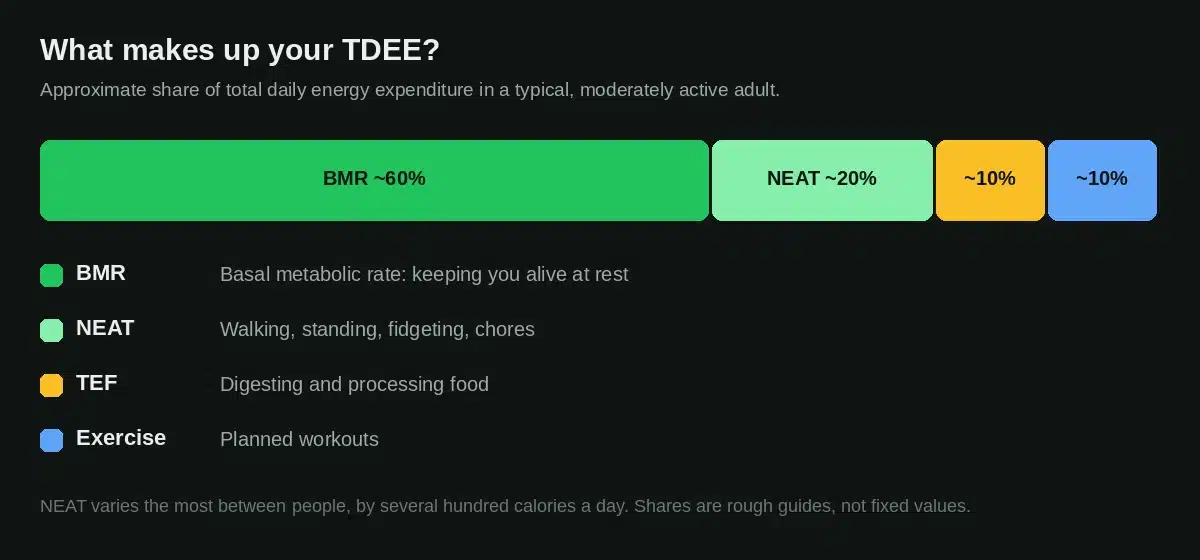
NEAT is the part that varies most between people. Two people of the same size can differ by several hundred calories a day simply because one has an active job and walks everywhere while the other sits most of the day. It is also the part that often drops without you noticing when you diet.
BMR vs TDEE: What Is the Difference?
BMR is what you would burn lying still all day. TDEE is what you actually burn once movement, digestion and exercise are added. You should never eat at your BMR as a target. Your TDEE is always higher, and it is the number to base your calories on.
How to Calculate Your TDEE
Calculating your TDEE takes two steps: estimate your BMR, then multiply it by an activity factor.
Step 1: Estimate Your BMR
The Mifflin-St Jeor equation is the most widely recommended formula for healthy adults. In a review of prediction equations, it estimated resting metabolic rate within 10% of measured values for more people than the other common formulas.
- Men: (10 × weight in kg) + (6.25 × height in cm) − (5 × age in years) + 5
- Women: (10 × weight in kg) + (6.25 × height in cm) − (5 × age in years) − 161
Step 2: Multiply by Your Activity Level
Multiply your BMR by the factor that best matches your typical week. Be honest. Most people overestimate how active they are.
| Activity level | Description | Multiplier |
|---|---|---|
| Sedentary | Desk job, little or no exercise | 1.2 |
| Lightly active | Light exercise 1 to 3 days a week | 1.375 |
| Moderately active | Moderate exercise 3 to 5 days a week | 1.55 |
| Very active | Hard exercise 6 to 7 days a week | 1.725 |
| Extremely active | Physical job plus hard training | 1.9 |
Two Worked Examples
A 35-year-old man, 80 kg and 180 cm, who trains 3 to 5 times a week: BMR = 800 + 1,125 − 175 + 5 = 1,755 calories. TDEE = 1,755 × 1.55 = about 2,720 calories.
A 30-year-old woman, 65 kg and 165 cm, who trains 1 to 3 times a week: BMR = 650 + 1,031 − 150 − 161 = 1,370 calories. TDEE = 1,370 × 1.375 = about 1,880 calories.
These are starting points. Equations are built on averages, and your real TDEE could easily be 10% higher or lower.
How Many Calories Should You Eat for Your Goal?
Once you have your TDEE, set your daily target based on what you want to achieve.
To Lose Fat
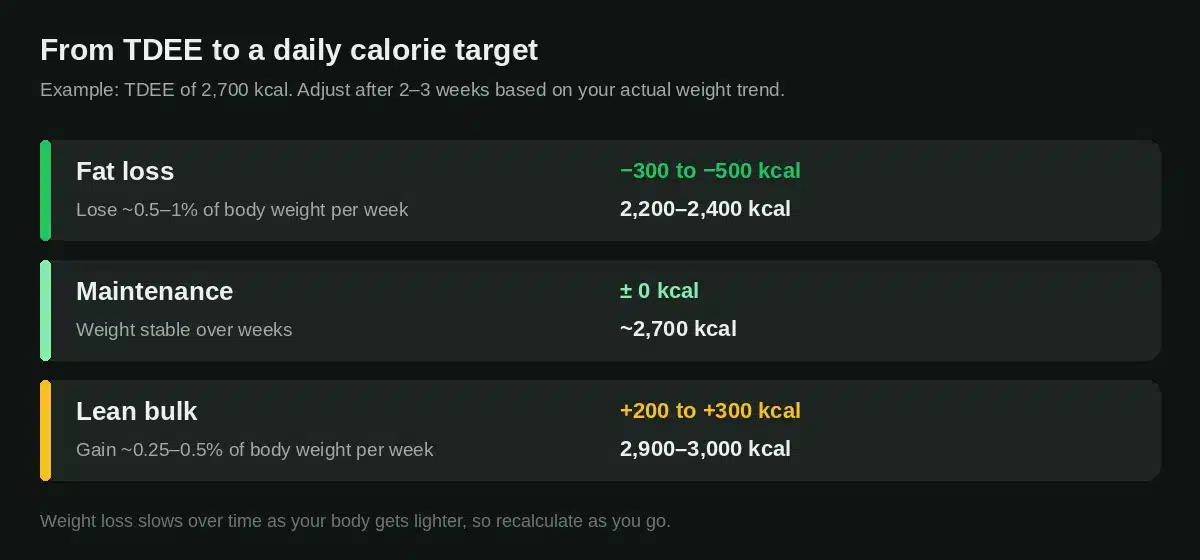
Eat about 300 to 500 calories below your TDEE. That usually leads to a loss of around 0.5 to 1% of your body weight per week, the rate often recommended for keeping muscle while dieting. Larger deficits work faster on the scale but make it harder to hold on to muscle, train well and stick to the plan. Keep protein high during a diet. Our guide to how much protein you need per day explains the targets.
Expect weight loss to slow over time. The old rule that cutting 3,500 calories equals one pound of fat lost overestimates long-term results, because your body burns less as it gets lighter. Research using dynamic models suggests that each 10-calorie change in daily intake eventually leads to a change of about 1 pound (0.45 kg) in body weight, with about half of that reached after a year. Recalculate your calories every few kilograms.
To Maintain Your Weight
Eat at your TDEE. If your weight stays stable over two to three weeks, you have found your maintenance calories. This is also a useful phase between diets or before starting a bulk.
To Build Muscle
Eat about 200 to 300 calories above your TDEE, aiming to gain roughly 0.25 to 0.5% of your body weight per week. Beginners can gain muscle faster and may tolerate a slightly bigger surplus, while experienced lifters gain muscle slowly and mostly add fat with a large surplus. See our comparison of clean bulk vs dirty bulk for how to structure it.
How to Adjust Your Calories
The calculation gets you close. Your scale tells you the rest. Weigh yourself in the morning, after the toilet and before eating, at least three to four times a week. Compare weekly averages rather than single days, since water, salt and carbohydrate intake can shift your weight by a kilogram or more overnight.
- Losing faster than planned: add 100 to 200 calories a day.
- Not losing after two to three weeks: reduce by 100 to 200 calories, or add more daily steps.
- Gaining more than planned on a bulk: reduce the surplus by 100 to 200 calories.
- Not gaining on a bulk: add 100 to 200 calories.
Make one change at a time and give it two weeks before judging it.
What Affects How Many Calories You Need
- Body size: bigger bodies burn more energy, both at rest and when moving.
- Muscle mass: muscle burns more energy than fat at rest, although the difference per kilogram is smaller than many claim.
- Sex: men usually have more lean mass and therefore a higher TDEE at the same weight.
- Age: a large study of energy expenditure across the lifespan found that, adjusted for body size, it stays fairly stable from about age 20 to 60 and declines after that. Weight gain in middle age is more about lifestyle than a slowing metabolism.
- Daily movement: your step count and job often matter more than your workouts.
- Dieting: when you eat less for a long time, your body tends to burn somewhat less, partly because you move less without noticing.
Common Mistakes When Counting Calories
- Overestimating activity: picking a higher multiplier than your lifestyle justifies is the most common reason calculations come out too high.
- Eating back exercise calories: fitness trackers often overestimate how much you burn in workouts.
- Underestimating intake: cooking oil, sauces, drinks and snacks add up quickly. Weighing food for a couple of weeks gives you a reality check.
- Cutting too hard: very low-calorie diets make it hard to train, keep muscle and stick to the plan. Diets below about 800 calories a day should only be followed under medical supervision.
- Never recalculating: as your weight changes, so does your TDEE.
- Ignoring food quality: calories decide weight change, but protein, fibre and whole foods decide how full you feel and what that weight is made of. Our list of high-protein foods makes it easier to hit your targets.
Frequently Asked Questions
How many calories should I eat a day? Most adult women need roughly 1,600 to 2,400 calories a day and most adult men 2,000 to 3,000, according to US dietary guidelines. Your own number depends on your size, age and activity. Calculate your TDEE and adjust from there.
Is a TDEE calculator accurate? It gives a reasonable estimate, usually within about 10% for most healthy adults. That can still mean 200 to 300 calories either way, which is why you should adjust based on your weight trend.
Should I eat the same calories on training and rest days? You can, and it is the simplest approach. Some people eat a little more on training days and less on rest days. What matters most is your weekly average.
How fast should I lose weight? A loss of about 0.5 to 1% of your body weight per week is a sensible target for most people who want to keep muscle while losing fat.
Can I lose fat and build muscle at the same time? Yes, especially if you are new to lifting, returning after a break or carrying more body fat. Eating close to maintenance with high protein and progressive strength training gives you the best chance. Our guide on bulking vs cutting covers when each approach makes sense.
Why have I stopped losing weight? Your TDEE falls as you lose weight, and daily movement often drops during a diet. Small, unnoticed increases in intake are also common. Recalculate your TDEE at your new weight, check your portions and keep your step count up.
The Bottom Line
How many calories you should eat depends on your TDEE, the energy you burn each day through your basal metabolism, daily movement, digestion and exercise. Estimate it with the Mifflin-St Jeor equation and an honest activity factor, then eat about 300 to 500 calories below it to lose fat, at it to maintain, or 200 to 300 above it to build muscle.
Treat the result as a starting point. Track your weight for a few weeks, adjust in small steps, keep protein high and keep moving. Combined with a solid training plan and our guides on how to lose belly fat and how to build muscle, that is all you need to make the numbers work for you.
Sources
- Mifflin MD, St Jeor ST, Hill LA et al. A new predictive equation for resting energy expenditure in healthy individuals. American Journal of Clinical Nutrition, 1990.
- Frankenfield D, Roth-Yousey L, Compher C. Comparison of predictive equations for resting metabolic rate in healthy nonobese and obese adults: a systematic review. Journal of the American Dietetic Association, 2005.
- Hall KD, Sacks G, Chandramohan D et al. Quantification of the effect of energy imbalance on bodyweight. The Lancet, 2011.
- Helms ER, Aragon AA, Fitschen PJ. Evidence-based recommendations for natural bodybuilding contest preparation: nutrition and supplementation. Journal of the International Society of Sports Nutrition, 2014.
- Pontzer H, Yamada Y, Sagayama H et al. Daily energy expenditure through the human life course. Science, 2021.
- Iraki J, Fitschen P, Espinar S, Helms E. Nutrition recommendations for bodybuilders in the off-season: a narrative review. Sports, 2019.

I'm Tomek, your dedicated fitness coach at TheGymGoat. With years of experience as a certified personal trainer, fitness blogger and a passion for empowering individuals, I'm committed to helping you reach your health and wellness goals. I don't do excuses, I make priorities and always base my workout and diet on reserach.
All articles by Tomek →