




ON THIS PAGE
TRT and steroids often involve the same drug, testosterone, but they are not the same thing. Testosterone replacement therapy (TRT) is a medical treatment that restores low hormone levels to the normal range in men with diagnosed hypogonadism, while a steroid cycle deliberately pushes levels far above normal to build muscle or improve performance.
Dose, purpose, diagnosis and supervision are what separate the two. This guide compares them side by side, covers what the latest heart safety research found and explains where the line between them gets blurry.
This article is informational and not a substitute for individual medical advice. It does not provide dosing guidance for any drug. If you think you have low testosterone, talk to a qualified doctor or endocrinologist.
TRT vs Steroids at a Glance
| Factor | TRT | Steroid cycle |
|---|---|---|
| Purpose | Treat diagnosed testosterone deficiency | Build muscle, strength or performance |
| Diagnosis needed | Yes: symptoms plus repeated low morning blood tests | No |
| Target hormone level | Within the normal range | Well above the normal range (supraphysiological) |
| Compounds | Usually testosterone alone | Often several compounds stacked, sometimes oral steroids |
| Supervision | Prescribing clinician, scheduled follow-up | Often none or self-directed |
| Monitoring | Testosterone, hematocrit, prostate risk, blood pressure, symptoms | Inconsistent, depends on the user |
| Product source | Licensed pharmacy | Often black market, quality unknown |
| Fertility | Suppresses sperm production | Suppresses sperm production, often more severely |
| Duration | Usually long term, often lifelong | Cycles, or continuous use in “blast and cruise” |
| Legal status (US) | Legal with a valid prescription | Illegal without a prescription (Schedule III) |
| Sport (WADA) | Needs a Therapeutic Use Exemption | Prohibited at all times |
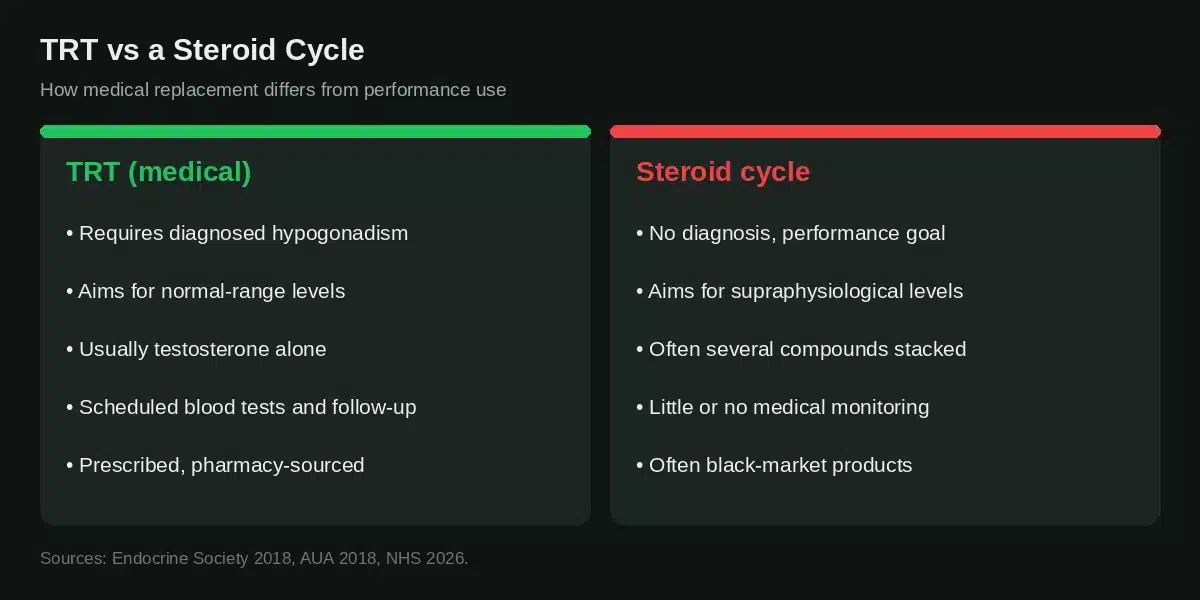
Same Molecule, Different Purpose
Testosterone is itself an anabolic-androgenic steroid. That is the source of much of the confusion: a man on TRT is technically using a steroid, and many people running cycles use testosterone as the base of their stack. If you want the chemistry behind that, our explainer on whether testosterone is a steroid covers it in detail.
So the difference is not in the vial. It lies in four things:
- Dose: TRT aims for normal levels. Cycles aim for levels the body could never produce on its own.
- Goal: TRT treats symptoms of a medical condition. Cycles chase muscle, leanness or strength.
- Supervision: TRT is prescribed and monitored. Cycles are usually self-managed.
- Compounds: TRT is normally testosterone alone. Cycles frequently combine testosterone with synthetic derivatives and other drugs.
What TRT Actually Is
Who Qualifies
Low testosterone on its own is not enough for a TRT prescription under mainstream guidelines. The Endocrine Society’s 2018 clinical practice guideline recommends diagnosing hypogonadism only in men who have symptoms and signs of testosterone deficiency and consistently low testosterone. Testing should use a fasting morning total testosterone measurement with an accurate assay, repeated to confirm the result.
The American Urological Association’s 2018 guideline, reviewed and confirmed as valid in 2024, takes a similar line. It describes a total testosterone below 300 ng/dL as a reasonable cut-off, based on two early-morning measurements taken on separate occasions, together with symptoms or signs.
Symptoms commonly assessed include low libido, erectile dysfunction, fewer morning erections, fatigue, reduced muscle mass and strength, and loss of body hair. Once deficiency is confirmed, guidelines also call for finding the cause, since problems with the pituitary gland, certain medications, obesity and other conditions can all lower testosterone.
Who Should Not Start It
The Endocrine Society recommends against starting testosterone in men who plan to father children in the near term, and in men with breast or prostate cancer, an elevated hematocrit, untreated severe obstructive sleep apnea, severe lower urinary tract symptoms, uncontrolled heart failure, a heart attack or stroke in the past six months, or a clotting disorder (thrombophilia).
How TRT Is Monitored
A properly run TRT program follows a set monitoring plan, especially in the first year. That typically covers:
- Testosterone levels to keep them within the normal range.
- Hematocrit, because testosterone stimulates red blood cell production and thicker blood raises clotting risk.
- Prostate cancer risk, including PSA testing and examination where appropriate.
- Blood pressure, which the FDA added as a class-wide label warning for testosterone products in 2025.
- Symptoms, side effects and adherence, to check the treatment is actually helping.
The point of TRT is to make a man with a diagnosed deficiency feel and function normally. It is not designed to produce a bodybuilding physique, and a well-managed program will not try to.
What a Steroid Cycle Is
A steroid cycle is a planned period of anabolic steroid use, usually lasting weeks to months, aimed at muscle gain, fat loss or strength. Users typically take testosterone at doses well above replacement and often “stack” it with other compounds, such as synthetic injectables or oral steroids, and sometimes other drugs to manage side effects.
None of that is done under standard medical guidelines. Products often come from underground labs with no quality control, so the actual contents and dose can differ from the label. Many users also run a “post-cycle therapy” phase in an attempt to restart natural hormone production, with no guarantee it works.
The results can be dramatic, which is exactly why enhanced physiques are hard to compare with natural ones. Our guide to natural vs enhanced lifters breaks down what that gap looks like. Steroids are also often compared with research chemicals that promise similar results; see our comparison of SARMs vs steroids for how those stack up.
Fertility: The Overlap Most People Miss
Here TRT and steroids behave the same way. Testosterone taken from outside the body signals the brain to cut the hormones that tell the testes to produce testosterone and sperm. Sperm production falls, sometimes to zero.
That is why the Endocrine Society advises against starting testosterone in men who want children in the near term, and why the AUA says men currently trying to conceive should not be prescribed testosterone. The AUA also advises clinicians to discuss the effect of long-term testosterone on sperm production with any patient who may want children later.
The NHS lists reduced sperm count, infertility and testicular shrinkage among the side effects of anabolic steroid misuse. Higher doses and multiple compounds do not make this problem smaller. Anyone considering either path who wants biological children should raise fertility with a doctor first.
Heart Health: What the TRAVERSE Trial Found
For years, doctors worried that testosterone therapy might raise the risk of heart attack and stroke. The TRAVERSE trial, published in the New England Journal of Medicine in June 2023, was designed to answer that question.
It enrolled 5,246 men aged 45 to 80 with symptoms of hypogonadism, two fasting testosterone readings below 300 ng/dL, and either existing cardiovascular disease or high cardiovascular risk. They were randomized to testosterone gel or placebo and followed for a mean of about 33 months.
Key findings:
- Major cardiac events (cardiovascular death, nonfatal heart attack or nonfatal stroke) occurred in 7.0% of the testosterone group and 7.3% of the placebo group, a hazard ratio of 0.96. Testosterone met the trial’s test for non-inferiority.
- Atrial fibrillation was more common with testosterone: 3.5% vs 2.4%.
- Acute kidney injury was more common: 2.3% vs 1.5%.
- Pulmonary embolism was more common: about 0.9% vs 0.5%.
Following TRAVERSE, the FDA announced on February 28, 2025 that it was removing language about increased cardiovascular risk from the boxed warning on testosterone products and adding a class-wide warning about raised blood pressure. In June 2026, HHS asked for further label updates, including removing the limitation of use for age-related hypogonadism. As of November 2026, those were requests rather than finalized label changes.
What TRAVERSE does not tell us matters just as much. It tested a gel adjusted to keep levels within the normal range, in carefully monitored older men. It says nothing about the heart effects of supraphysiological doses, multiple stacked compounds or years of unsupervised use.
Risks of Steroid Cycles
Outside a medical setting, the risk profile changes considerably. The NHS lists high blood pressure, unhealthy cholesterol changes, heart attack, stroke, deep vein thrombosis, liver and kidney damage and fluid retention among the effects of anabolic steroid misuse in both men and women.
Men can also experience erectile dysfunction, hair loss, breast tissue development and severe acne. Psychological effects include aggression, mood swings and paranoia, and the NHS notes that steroids can cause dependence, with withdrawal symptoms such as depression, fatigue and low libido. Sharing needles adds the risk of hepatitis and HIV.
These risks generally rise with dose, duration and the number of compounds used, which is the opposite direction to how a TRT program is designed.
Where the Line Blurs
“Blast and Cruise”
Some steroid users never come off. They alternate high-dose “blasts” with a lower, ongoing “cruise,” and often describe the cruise phase as their “TRT.” That label is misleading. There is no diagnosis behind it, the low phase exists to bridge one cycle to the next, and natural production never gets the chance to recover. Calling it TRT does not make it medical treatment.
Recreational TRT
Some men with normal testosterone seek a prescription because they want the physique or energy they associate with higher levels. Prescribing to someone without a confirmed deficiency goes against both the Endocrine Society and AUA guidelines, and it still carries the fertility, blood and blood pressure effects described above.
Online Clinics
Telehealth has made TRT more accessible, and a well-run service can follow guidelines properly. Quality varies, though. Before starting with any provider, it is reasonable to check that they:
- Confirm low testosterone with repeated early-morning tests, not a single reading.
- Assess symptoms and look for an underlying cause.
- Discuss fertility before prescribing.
- Check hematocrit, prostate risk and blood pressure at baseline and during treatment.
- Aim for normal-range levels rather than “optimized” or above-normal targets.
If a clinic skips these steps, treat that as a warning sign rather than a convenience.
TRT, Steroids and Sport
Testosterone is listed under S1.1 of the World Anti-Doping Agency’s 2026 Prohibited List, a class that is banned at all times, in and out of competition. A tested athlete with a genuine diagnosis needs an approved Therapeutic Use Exemption before using TRT. A prescription alone is not a defense.
Peptides and growth hormone secretagogues are also popular among people moving between TRT and performance use. Our guide on whether peptides are steroids explains how they differ chemically and legally.
Frequently Asked Questions
Is TRT a steroid? TRT uses testosterone, which is an anabolic-androgenic steroid. The difference from steroid use is that TRT restores normal levels in diagnosed men under medical supervision.
Will TRT make me as muscular as someone on a cycle? No. TRT aims to bring levels back into the normal range, while cycles push levels far higher, often with several compounds. Your training and nutrition still drive most of your progress, as covered in our guide on how to build muscle.
Does TRT shut down natural testosterone production? Yes, exogenous testosterone suppresses the body’s own production and sperm output. That is why fertility should be discussed before starting.
Is TRT safe for the heart? In the TRAVERSE trial, testosterone gel did not increase major cardiac events compared with placebo in men with hypogonadism, though atrial fibrillation, pulmonary embolism and acute kidney injury were more common. Those findings do not apply to high-dose steroid use.
Can you stop TRT once you start? Stopping is possible, but natural production may take time to recover and symptoms of low testosterone can return. Any change should be planned with the prescribing doctor.
The Bottom Line
TRT and steroids share a molecule, not a purpose. TRT is a monitored medical treatment that restores normal testosterone levels in men with diagnosed hypogonadism. A steroid cycle aims for levels far above normal, often with several compounds and little or no supervision.
Both suppress natural production and sperm output, so fertility belongs in any conversation about either. The reassuring heart safety data from TRAVERSE applies to properly prescribed, normal-range therapy, not to supraphysiological use.
If you have symptoms of low testosterone, start with proper testing through a doctor who follows established guidelines.
Sources
- Bhasin S, Brito JP, Cunningham GR, et al. Testosterone Therapy in Men With Hypogonadism: An Endocrine Society Clinical Practice Guideline. Journal of Clinical Endocrinology and Metabolism, 2018.
- American Urological Association. AUA Releases New Clinical Guideline for Diagnosis and Treatment of Testosterone Deficiency. AUA, 2018.
- Lincoff AM, Bhasin S, Flevaris P, et al. Cardiovascular Safety of Testosterone-Replacement Therapy. New England Journal of Medicine, 2023.
- U.S. Food and Drug Administration. FDA Issues Class-Wide Labeling Changes for Testosterone Products. FDA, 2025.
- Urology Times. HHS Requests Testosterone Therapy Label Updates, Citing New Safety Data. Urology Times, 2026.
- NHS. Anabolic Steroid Misuse. NHS, 2026.

I'm Tomek, your dedicated fitness coach at TheGymGoat. With years of experience as a certified personal trainer, fitness blogger and a passion for empowering individuals, I'm committed to helping you reach your health and wellness goals. I don't do excuses, I make priorities and always base my workout and diet on reserach.
All articles by Tomek →