



ON THIS PAGE
No, peptides are not steroids. Peptides are short chains of amino acids, while anabolic steroids are fat-soluble molecules built on a four-ring carbon skeleton derived from cholesterol, and the two work through completely different receptors in the body.
The confusion is understandable. Both get discussed in the same gym corners, both are sold online with muscle and recovery promises, and many of the peptides lifters talk about are banned in sport just like steroids. But “not a steroid” does not mean “safe” or “legal to sell,” and that distinction matters far more than the label.
This article is informational and not a substitute for individual medical advice. It does not provide dosing guidance for any drug. If you are considering any hormone, peptide or performance drug, speak with a licensed physician first.
What Peptides Actually Are
A peptide is a chain of amino acids linked by peptide bonds. By convention, chains shorter than roughly 50 amino acids are called peptides and longer ones are called proteins, although the line is blurry. The same amino acids that make up the chicken breast and whey in your diet are the building blocks here; the difference is the sequence and what that sequence does once it reaches a receptor.
Your body makes thousands of peptides, many acting as hormones or signaling molecules. That broad definition is why the word “peptide” covers products with almost nothing in common.
Common peptides people mean when they say “peptides”
- Insulin: a 51-amino-acid hormone that moves glucose into cells. Prescription insulin is one of the oldest peptide drugs in medicine.
- GLP-1 receptor agonists: drugs such as semaglutide mimic the gut hormone GLP-1 and are FDA-approved for type 2 diabetes and, in specific formulations, chronic weight management.
- Collagen peptides: hydrolyzed collagen sold as a food supplement. Once eaten, it is digested like other dietary protein. It has nothing to do with hormones.
- Growth hormone secretagogues and GHRH analogues: compounds such as ipamorelin and CJC-1295 that are designed to make the pituitary release more growth hormone.
- “Healing” peptides: BPC-157 is a 15-amino-acid fragment derived from a protein found in gastric juice, and TB-500 is a fragment of thymosin beta-4. Neither is approved as a drug anywhere in the US.
So “are peptides steroids?” is a bit like asking whether pills are antibiotics. Some peptides are prescription drugs, some are food ingredients, and some are unapproved compounds sold as “research chemicals.”
Why People Confuse Peptides With Steroids
Most lifters first hear about peptides in the same conversations where steroids, SARMs and growth hormone come up. A few other factors blur the line further.
- Similar marketing promises: sellers pitch peptides for muscle growth, fat loss and faster recovery, the same outcomes people associate with anabolic steroids.
- Injections: most peptides are injected because stomach enzymes break them down, so the routine looks familiar to anyone who has seen a steroid cycle.
- The word “hormone”: testosterone is a hormone and so is insulin, but one is a steroid hormone and the other is a peptide hormone. Same category name, very different chemistry.
- Anti-doping lists: both steroids and many peptides are prohibited by the World Anti-Doping Agency, which makes them look interchangeable from the outside.
- Overlapping sellers: the same grey-market websites often stock peptides, SARMs and ancillary drugs side by side.
A similar mix-up happens with supplements. Plenty of people still ask whether creatine counts as a steroid, and our guide on whether creatine is a steroid explains why it does not. Peptides need the same kind of careful sorting, just with higher stakes.
Peptides vs Steroids: The Structural and Mechanism Differences
The clearest way to separate the two is to look at what they are made of and how they send their message to cells.
Structure
Anabolic-androgenic steroids are synthetic relatives of testosterone. Like all steroids, they share a core of four fused carbon rings, and small chemical changes to that skeleton alter how strongly they build muscle, how they are metabolized and how long they last. They are fat-soluble.
Peptides are strings of amino acids. They are generally water-soluble, much larger than a steroid molecule in most cases, and fragile: digestive enzymes cut them apart, which is why so few work as tablets. Oral semaglutide is an exception that needs an absorption enhancer to get through the gut wall.
How they act on the body
Because steroids are fat-soluble, they pass through cell membranes and bind to the androgen receptor inside the cell. That receptor complex then acts directly on DNA, changing which genes are switched on. This direct genetic signal is behind both the muscle-building effect and the androgenic side effects such as acne, hair loss and suppression of natural testosterone production.
Most peptides cannot cross the cell membrane. They bind to receptors on the cell surface and trigger a signaling cascade from the outside. Ipamorelin, for example, acts on the ghrelin receptor in the pituitary, CJC-1295 acts on the growth hormone releasing hormone receptor, and semaglutide acts on the GLP-1 receptor. Their effects depend on the body’s own downstream response, such as releasing more growth hormone, rather than delivering an androgen directly.
That indirect route is one reason peptide claims are often overstated. Raising growth hormone or IGF-1 on a lab report is not the same as building meaningful muscle.
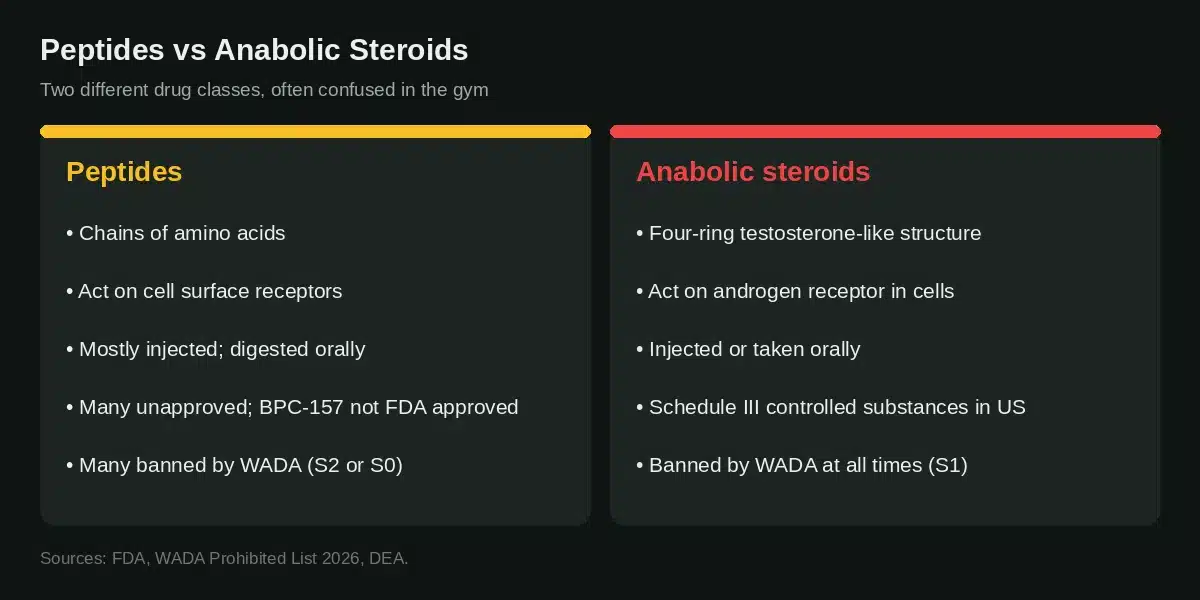
Peptides vs anabolic steroids at a glance
| Feature | Peptides | Anabolic-androgenic steroids |
|---|---|---|
| Basic structure | Chains of amino acids | Four-ring carbon skeleton related to testosterone |
| Solubility | Mostly water-soluble | Fat-soluble |
| Main receptor site | Cell surface receptors (GLP-1, ghrelin, GHRH and others) | Androgen receptor inside the cell |
| How they act | Trigger signaling, often prompting release of other hormones | Directly change gene expression |
| Typical route | Mostly injection; few work orally | Injection or oral, depending on compound |
| US legal status | Varies: approved drugs, supplements or unapproved drugs | Schedule III controlled substances |
| WADA status | Many prohibited (S2 or S0); insulin under S4 | Prohibited at all times (S1) |
| Human evidence for muscle gain | Limited and compound-specific | Well documented, with well-documented risks |
Legal and Regulatory Status in 2026
This is where peptides and steroids differ in a way that surprises many lifters. In the US, anabolic steroids are Schedule III controlled substances under the Controlled Substances Act. Possessing them without a prescription is a federal offense.
Most performance peptides are not controlled substances. That does not make them legal products. A peptide sold for human use without FDA approval is an unapproved new drug, and labeling a vial “for research use only” does not change that when the seller knows buyers will inject it.
The compounding question
Some peptides reached patients through compounding pharmacies, which mix medications for individual prescriptions. In 2023 the FDA placed BPC-157 and a group of other peptides, including CJC-1295 and ipamorelin, in Category 2 of its interim compounding list, meaning substances that may present significant safety risks. The agency’s concerns included possible immune reactions, peptide-related impurities, difficulty characterizing the active ingredient and a lack of human safety data.
The picture has shifted in 2026. As of the FDA’s April 2026 update, BPC-157, CJC-1295, TB-500 and several others are listed as “nominated but withdrawn” rather than Category 2, although the FDA kept its safety statements on the page. In July 2026 the FDA’s Pharmacy Compounding Advisory Committee voted narrowly in favor of adding BPC-157, TB-500 and a few others to the list of substances pharmacies may compound. That vote is advisory, not a final rule.
Then, in late October 2026, the US Department of Health and Human Services published a draft enforcement discretion policy covering six peptides: BPC-157, TB-500, KPV, MOTS-c, semax and epitalon. Under strict conditions, including a valid patient-specific prescription and a registered, documented source, HHS said it does not intend to take action against licensed pharmacies compounding them while rulemaking continues. As of November 2026 the policy is still a draft, it approves nothing, and it explicitly does not cover research-chemical sellers.
Ipamorelin and ibutamoren (MK-677) remain in Category 2 on the FDA’s list. Regulations here are moving quickly, so treat any “it’s legal now” claim from a seller with suspicion and check the date of whatever you read.
Peptides and Drug Testing: WADA Status
For anyone who competes in a tested federation, the answer is simple: most performance peptides are banned at all times, in and out of competition.
- S2 Peptide Hormones, Growth Factors, Related Substances and Mimetics: this class covers growth hormone and its releasing factors, including GHRH analogues such as CJC-1295 and growth hormone secretagogues such as ipamorelin and ibutamoren.
- S0 Non-Approved Substances: BPC-157 is named here, as an example of a substance with no current approval for human therapeutic use.
- S1 Anabolic Agents: this is where anabolic steroids sit.
Different chemical classes, same outcome for a drug-tested athlete. If you are trying to stay natural, understanding what separates natural and enhanced physiques is a better use of your time than searching for compounds that slip past the steroid label.
What the Evidence Says About Muscle and Recovery Claims
Online peptide content tends to present early research as settled science. The reality is much thinner.
BPC-157
A 2025 systematic review in the HSS Journal screened 544 articles and found 36 relevant studies. Thirty-five were preclinical, meaning animal or cell studies. Those studies reported faster healing of muscle, tendon, ligament and bone injuries in animals, which is why the compound attracts so much attention.
The only human study was a small retrospective report of 12 patients with chronic knee pain, with no control group. The reviewers found no human safety data and noted that animal studies did not run longer than six weeks. Promising rodent data is a reason to run trials, not a reason to self-inject an unregulated product.
Growth hormone secretagogues
Compounds such as ipamorelin and CJC-1295 do raise growth hormone in the short term, but higher growth hormone or IGF-1 levels have not reliably translated into meaningful strength gains in controlled research. The FDA’s compounding review also cites serious adverse events, including increased heart rate and a systemic vasodilatory reaction with CJC-1295, and a published report of serious events, including a death, after intravenous ipamorelin in a gastric motility study.
GLP-1 drugs and collagen
Semaglutide has strong clinical evidence for its approved uses, but it is a weight and blood sugar drug, not a muscle builder. During rapid weight loss, keeping protein intake high and training hard matters for holding onto lean mass; our guide to how much protein you need per day covers the practical targets. Collagen peptides are simply a protein source with a less complete amino acid profile than whey or meat.
The Real Risks of “Research Chemical” Peptides
Steroids have decades of documented harms: cardiovascular strain, unfavorable cholesterol changes, liver stress with some oral compounds, testicular shrinkage, infertility and mood effects. Peptides lack that long track record, which is not reassuring. It means the risks are mostly unknown.
The grey-market supply adds its own problems on top of the drug itself:
- No verified identity or purity: a vial can contain the wrong peptide, the wrong amount or degradation products.
- Sterility: injectable products made outside regulated facilities can carry bacterial contamination.
- Immune reactions: the FDA specifically flags immunogenicity and peptide-related impurities as concerns.
- Unknown long-term effects: compounds that promote blood vessel growth or raise growth hormone raise theoretical questions about tissue growth that nobody has studied properly in humans.
The tradeoff rarely makes sense for a recreational lifter. The fundamentals of how to build muscle, consistent progressive overload, enough protein and adequate sleep, deliver far more than any unregulated vial, with none of the unknowns.
Frequently Asked Questions
Are peptides considered steroids? No. Peptides are amino acid chains that act mostly on cell surface receptors, while anabolic steroids are testosterone-like molecules that act on the androgen receptor inside cells. They are different drug classes with different legal and anti-doping categories.
Are peptides legal? It depends on the peptide. Insulin and semaglutide are FDA-approved prescription drugs and collagen peptides are food supplements, while BPC-157, CJC-1295 and similar compounds are not FDA-approved, and selling them for human use outside a lawful pharmacy setting is illegal in the US.
Will peptides show up on a drug test? Standard workplace drug panels do not look for them, but WADA-accredited labs test for many peptides, and BPC-157, CJC-1295, ipamorelin and ibutamoren are all prohibited at all times.
Do peptides build muscle like steroids? There is no good human evidence that popular performance peptides build muscle the way anabolic steroids do. Growth hormone secretagogues raise hormone levels, but that has not reliably produced strength gains in controlled studies.
Is BPC-157 a steroid? No. BPC-157 is a 15-amino-acid peptide. Its healing claims rest almost entirely on animal studies, and human safety data is lacking.
The Bottom Line
Peptides are not steroids. They are amino acid chains that signal through different receptors, and the category stretches from approved medicines like insulin and semaglutide to food supplements to unapproved injectables sold as research chemicals.
The performance peptides lifters hear about online share more with steroids than their chemistry suggests: most are banned in tested sport, none is FDA-approved for muscle or recovery, and the evidence behind them is thin. US regulation is shifting in 2026, but only toward tightly controlled pharmacy compounding, not toward the grey-market vials most people actually encounter.
Sources
- U.S. Food and Drug Administration. Certain Bulk Drug Substances for Use in Compounding that May Present Significant Safety Risks. FDA, 2026.
- Vasireddi N, Hahamyan H, Salata MJ, et al. Emerging Use of BPC-157 in Orthopaedic Sports Medicine: A Systematic Review. HSS Journal, 2025.
- Arnold & Porter. HHS Announces Draft Enforcement Discretion Policy Paving Way for Pharmacies to Compound Certain Peptides While FDA Rulemaking Is Pending. Arnold & Porter Advisory, 2026.
- World Anti-Doping Agency. The Prohibited List. WADA, 2026.
- Drug Enforcement Administration. Drug Fact Sheet: Steroids. DEA, 2022.

I'm Tomek, your dedicated fitness coach at TheGymGoat. With years of experience as a certified personal trainer, fitness blogger and a passion for empowering individuals, I'm committed to helping you reach your health and wellness goals. I don't do excuses, I make priorities and always base my workout and diet on reserach.
All articles by Tomek →