



ON THIS PAGE
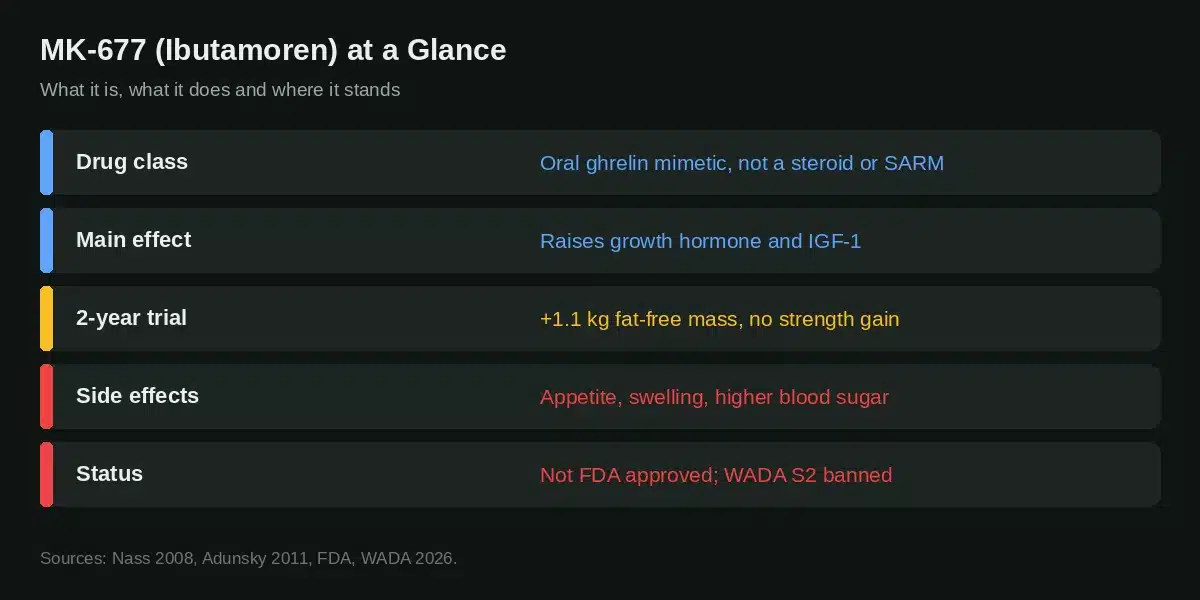
No, MK-677 is not a steroid. MK-677, also called ibutamoren, is an oral growth hormone secretagogue: a small molecule that mimics the hunger hormone ghrelin and prompts the pituitary gland to release more growth hormone, without touching the androgen receptor that steroids act on.
It is also not a SARM and, despite how it is often marketed, not even a peptide. What it is, in regulatory terms, is an unapproved drug that the FDA has flagged for safety concerns and that the World Anti-Doping Agency bans at all times.
This article is informational and not a substitute for individual medical advice. It does not provide dosing or sourcing information for MK-677 or any other drug. Talk to a licensed physician before using any hormone-modifying compound.
What MK-677 (Ibutamoren) Actually Is
Ibutamoren was developed by Merck in the 1990s as an orally active growth hormone secretagogue, a compound that increases the body’s own growth hormone release. The “MK” in its name is Merck’s research code, the same prefix you see on other compounds that came out of its labs.
Its target is the growth hormone secretagogue receptor, the receptor that ghrelin normally binds. Ghrelin is best known as a hunger signal, but it also stimulates growth hormone release. MK-677 activates that same receptor, which explains its two most noticeable effects: higher growth hormone and IGF-1 levels, and a stronger appetite.
Chemically, ibutamoren is a non-peptide small molecule. That is why it works as a tablet or liquid when most growth hormone releasing compounds, such as ipamorelin or CJC-1295, have to be injected. Sellers often lump it in with “peptides,” but structurally it is neither a peptide nor a steroid. If you want the broader picture on that category, our explainer on whether peptides are steroids covers how those compounds differ.
No version of MK-677 has been approved by the FDA for any medical use.
Why MK-677 Gets Called a Steroid (and a SARM)
MK-677 usually shows up in the same online stores, forum threads and “stack” recommendations as SARMs such as ostarine and RAD-140. Many people therefore assume it belongs to the same family, and some go one step further and file all of it under “steroids.”
The labels matter because they describe very different mechanisms:
- Anabolic steroids are synthetic relatives of testosterone that bind the androgen receptor inside cells. For a full breakdown of where the hormone itself fits, see our guide on whether testosterone is a steroid.
- SARMs also bind the androgen receptor, but are designed to act more selectively on muscle and bone. Our comparison of SARMs vs steroids explains why that selectivity is less clean in practice.
- MK-677 does not bind the androgen receptor at all. It works further upstream, on the ghrelin receptor, to increase growth hormone.
One practical consequence: MK-677 is not expected to shut down natural testosterone production in the way steroids and SARMs do, because it does not deliver an androgen signal. That does not make it harmless. It simply means its risk profile sits in a different place, mainly around appetite, fluid, blood sugar and, in one vulnerable population, the heart.
MK-677 vs Steroids vs SARMs Compared
| Feature | MK-677 (ibutamoren) | SARMs | Anabolic steroids |
|---|---|---|---|
| Drug class | Growth hormone secretagogue (ghrelin mimetic) | Selective androgen receptor modulators | Synthetic testosterone derivatives |
| Chemical type | Non-peptide small molecule | Non-steroidal small molecules | Four-ring steroid structure |
| Main target | Ghrelin (GHS) receptor | Androgen receptor | Androgen receptor |
| Primary hormonal effect | Raises growth hormone and IGF-1 | Androgenic signaling, variable selectivity | Strong androgenic and anabolic signaling |
| FDA approval | None | None | Some approved for medical use, by prescription |
| US legal status | Unapproved drug | Unapproved drugs | Schedule III controlled substances |
| WADA category | S2, prohibited at all times | S1, prohibited at all times | S1, prohibited at all times |
What the Research on MK-677 Shows
Unlike many grey-market compounds, ibutamoren has real human trials behind it, because Merck and academic groups tested it as a possible treatment for age-related muscle loss and other conditions. Those trials are useful precisely because they show both what it does and what it does not do.
Nass et al., 2008: two years in healthy older adults
The best-known study, published in the Annals of Internal Medicine, followed 65 healthy adults aged 60 to 81 for two years in a randomized, placebo-controlled design. MK-677 raised growth hormone and IGF-1 into the range typical of healthy young adults.
Fat-free mass rose by about 1.1 kg (2.4 lb) on MK-677, while it fell by about 0.5 kg (1.1 lb) on placebo. Body weight increased by 2.7 kg (6 lb) in the MK-677 group versus 0.8 kg (1.8 lb) on placebo. Limb fat also increased more with MK-677, while visceral and total fat did not differ significantly.
The key finding for lifters: strength and physical function did not change, despite the gain in fat-free mass. The authors noted the study was not powered to detect functional changes, but the result illustrates a recurring theme. More lean mass on a scan, partly from water inside cells, is not the same as becoming stronger.
Murphy et al., 1998: protecting protein during a diet
A small crossover study in the Journal of Clinical Endocrinology and Metabolism put eight healthy volunteers aged 24 to 39 on a calorie-restricted diet for two 14-day periods. In the second week of each period they took MK-677 or placebo.
On placebo, participants kept losing nitrogen, a marker of protein breakdown. On MK-677, nitrogen balance turned slightly positive, and IGF-1 was higher than with placebo. It is an interesting short-term metabolic result, but eight people over seven days says nothing about muscle growth, performance or long-term safety.
Adunsky et al., 2011: the hip fracture trial
The most important safety data comes from a multicenter phase IIb trial in 123 older patients recovering from hip fracture, published in Archives of Gerontology and Geriatrics. MK-677 raised IGF-1 substantially, but most functional measures did not improve compared with placebo.
The trial was stopped early because of a safety signal of congestive heart failure in a small number of patients, and the authors concluded that MK-677 had an unfavorable safety profile in this population. Elderly hip fracture patients are not young lifters, but the signal is consistent with the fluid retention seen in other trials, and it is the reason heart failure appears in the FDA’s warnings.
Documented MK-677 Side Effects
Pulling the clinical data and the FDA’s own warnings together, these are the side effects with real documentation behind them:
- Increased appetite: expected from a ghrelin mimetic. In the two-year Nass trial it eased within a few months, but for anyone trying to stay lean it can make managing calorie intake noticeably harder.
- Fluid retention and swelling: mild, transient lower-leg edema was reported in older adults, and the FDA lists fluid retention as a possible effect.
- Higher blood sugar and lower insulin sensitivity: fasting glucose rose by about 0.3 mmol/L (5 mg/dL) in the Nass trial, and insulin sensitivity decreased. That matters more for anyone with prediabetes or a family history of type 2 diabetes.
- Muscle pain and fatigue: transient muscle pain was reported in the Nass study, and the FDA lists both muscle pain and fatigue.
- Higher cortisol: cortisol rose modestly in the two-year trial.
- Heart failure risk in some people: based on the halted hip fracture trial, the FDA lists an increased risk of congestive heart failure in some individuals.
Long-term effects in healthy young adults are simply unknown, because nobody has studied MK-677 in that group over meaningful timeframes. Combined use with SARMs, which is common online, adds another layer of uncertainty that the FDA itself has flagged.
Legal and Regulatory Status
FDA
Ibutamoren is not approved by the FDA for any use. In September 2025 the agency warned consumers after its lab found undeclared ibutamoren in a growth supplement marketed for children, stating that the compound’s safety and effectiveness have not been established.
On the compounding side, ibutamoren mesylate sits in Category 2 of the FDA’s interim list of bulk substances that may present significant safety risks, as of the agency’s April 2026 update. It was not among the peptides covered by the draft HHS compounding policy published in October 2026. In practical terms, MK-677 sold online as a “research chemical” or “supplement” is an unapproved drug, whatever the label says.
WADA and drug-tested sport
WADA’s Prohibited List names ibutamoren (MK-677) under S2, Peptide Hormones, Growth Factors, Related Substances and Mimetics, in the growth hormone secretagogue subgroup. It is prohibited at all times, in and out of competition. Calling it “not a steroid” offers no protection to a tested athlete.
Is MK-677 a legal alternative to TRT?
No. Testosterone replacement therapy is a prescribed, monitored treatment for diagnosed low testosterone, while MK-677 does not raise testosterone and is not approved for anything. If low testosterone is the real concern, our guide on TRT vs steroids explains how medical treatment differs from performance use.
Is MK-677 Worth the Risk for Lifters?
Looking at the human data honestly, the case is weak. The best long-term trial showed more fat-free mass and body weight but no strength or functional gain, alongside higher blood sugar, reduced insulin sensitivity and swelling. The trial in frail patients was halted for a heart failure signal. And the product most people buy is unregulated, so dose and purity are guesses.
Lifters who care about drug testing or simply about staying natural lose nothing by skipping it. Training with intent, eating enough protein and following a sound plan for how to build muscle remains the reliable path, and it carries none of these unknowns.
Frequently Asked Questions
Is MK-677 a steroid or a SARM? Neither. MK-677 is a growth hormone secretagogue that acts on the ghrelin receptor, while steroids and SARMs both act on the androgen receptor.
Is MK-677 a peptide? No. Ibutamoren is a non-peptide small molecule, which is why it is active when swallowed. It is often sold and discussed alongside peptides because it targets the same receptor as peptide secretagogues like ipamorelin.
Does MK-677 shut down testosterone? It does not act on the androgen receptor, so it is not expected to suppress testosterone the way steroids and SARMs do. That does not make it safe, given its documented effects on blood sugar, insulin sensitivity and fluid balance.
Is MK-677 FDA approved? No. The FDA has not approved ibutamoren for any use, lists it among bulk substances that may present significant safety risks for compounding, and has warned consumers about products containing it.
Is MK-677 banned in sports? Yes. WADA names ibutamoren under S2 as a growth hormone secretagogue, prohibited at all times.
What are the most common MK-677 side effects? The best-documented effects are increased appetite, fluid retention and swelling, higher fasting blood sugar, reduced insulin sensitivity, muscle pain and fatigue. A trial in older hip fracture patients was stopped early over a congestive heart failure signal.
The Bottom Line
MK-677 is not a steroid, not a SARM and not a peptide. It is an oral ghrelin mimetic that raises growth hormone and IGF-1, which gives it a different mechanism and a different side effect profile from androgen-based drugs.
Different does not mean safer. Human trials show it adds body weight and some lean mass without clear strength gains, while raising blood sugar, reducing insulin sensitivity and causing fluid retention, and one trial was halted over heart failure concerns. It is unapproved by the FDA and banned by WADA, so for most lifters the honest verdict is that the risks outweigh what the evidence offers.
Sources
- Nass R, Pezzoli SS, Oliveri MC, et al. Effects of an Oral Ghrelin Mimetic on Body Composition and Clinical Outcomes in Healthy Older Adults: A Randomized Trial. Annals of Internal Medicine, 2008.
- Murphy MG, et al. MK-677, an Orally Active Growth Hormone Secretagogue, Reverses Diet-Induced Catabolism. Journal of Clinical Endocrinology and Metabolism, 1998.
- Adunsky A, Chandler J, Heyden N, et al. MK-0677 (Ibutamoren Mesylate) for the Treatment of Patients Recovering From Hip Fracture: A Multicenter, Randomized, Placebo-Controlled Phase IIb Study. Archives of Gerontology and Geriatrics, 2011.
- U.S. Food and Drug Administration. Agebox iKids Growth Day Formula May Be Harmful Due to Hidden Ingredient. FDA, 2025.
- U.S. Food and Drug Administration. Certain Bulk Drug Substances for Use in Compounding that May Present Significant Safety Risks. FDA, 2026.
- World Anti-Doping Agency. The Prohibited List. WADA, 2026.

I'm Tomek, your dedicated fitness coach at TheGymGoat. With years of experience as a certified personal trainer, fitness blogger and a passion for empowering individuals, I'm committed to helping you reach your health and wellness goals. I don't do excuses, I make priorities and always base my workout and diet on reserach.
All articles by Tomek →