



ON THIS PAGE
If your goal is building stronger, rounder, more powerful glutes, no exercise does it more directly than the hip thrust. While squats and deadlifts train the glutes as part of a bigger movement, the hip thrust isolates hip extension under heavy load, putting maximum tension exactly where you want it. That’s why it has become a staple for everyone from physique competitors and sprinters to everyday lifters chasing a stronger lower body.
This guide covers everything you need: the muscles it works, its real evidence-backed benefits, how to perform it with good form, the mistakes to avoid, the best variations, and how to program it for results.
This article is informational and not a substitute for individual medical or training advice.
What Is a Hip Thrust?
The hip thrust is a lower-body strength exercise in which you rest your upper back against a bench, place a load (usually a barbell) across your hips, and drive your hips upward by squeezing your glutes until your torso is roughly parallel to the floor. It trains hip extension, the core function of the gluteus maximus, through a full range of motion and under heavy, progressively increasing load.
The movement was popularised and researched extensively by strength coach Bret Contreras, often nicknamed “the Glute Guy,” whose work helped turn the hip thrust from a niche movement into one of the most widely used glute-building exercises in the gym. Its appeal is simple: few exercises load the glutes so directly at the point of peak contraction.
Muscles Worked
The hip thrust is a glute-focused movement, but it trains more than that:
- Gluteus maximus: the primary mover and the largest muscle in the body, responsible for driving hip extension. This is the main target.
- Gluteus medius and minimus: smaller glute muscles that assist and stabilise the hips.
- Hamstrings: assist with hip extension throughout the lift.
- Adductors: the inner-thigh muscles contribute to hip extension and stability.
- Quadriceps: work to stabilise the knee at the top of the movement.
- Core and lower back: brace isometrically to keep the torso rigid and safe throughout.
That combination makes it a genuine posterior-chain builder, with the glutes doing the lion’s share of the work.
The Benefits of Hip Thrusts
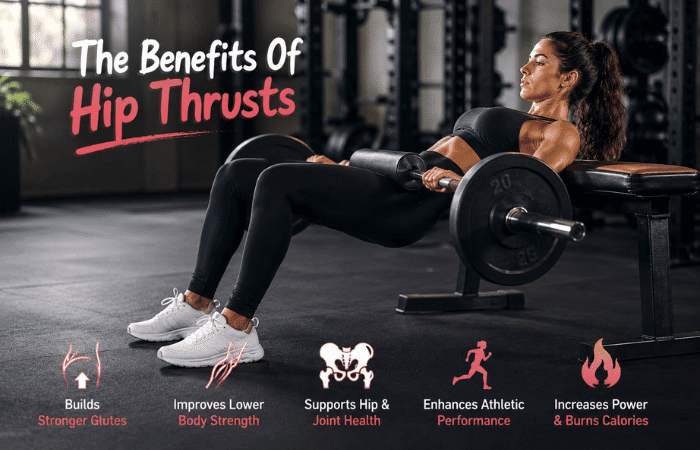
1. Builds Bigger, Stronger Glutes
This is the headline benefit. Because the hip thrust loads the glutes maximally at full hip extension, the exact point where they contract hardest, it’s exceptionally effective for glute growth and strength. Research supports this: a 2024 study in the International Journal of Strength and Conditioning found that adding the barbell hip thrust to a leg routine produced greater increases in gluteus maximus muscle thickness. If a stronger, more developed rear is your goal, the hip thrust belongs in your program, and it pairs perfectly with the wider strategies in our guide on how to get a bigger butt.
2. Improves Athletic Performance
Powerful hip extension is the engine behind sprinting, jumping, and change of direction. Because the hip thrust directly trains that movement pattern under load, it can translate into meaningful gains in explosive lower-body power. Sprinters, field-sport athletes, and lifters alike use it to build the kind of hip drive that shows up in faster sprints and higher jumps.
3. Strengthens the Entire Posterior Chain
Strong glutes rarely work alone. The hip thrust reinforces the whole posterior chain, the glutes, hamstrings, and supporting muscles that power almost every athletic movement and keep you upright. A well-developed posterior chain is one of the biggest contributors to both performance and injury resilience.
4. Carries Over to Your Squat and Deadlift
Weak glutes are a common bottleneck in the big lifts. By strengthening hip extension and teaching you to fire your glutes hard, the hip thrust can improve your lockout and power in both the squat and the deadlift. Many lifters find that dedicated glute work directly boosts these lifts.
5. Supports the Lower Back and Posture
The glutes play a major role in stabilising the pelvis and lower back. Weak or underactive glutes are frequently linked to lower-back discomfort, and strengthening them can improve pelvic stability and support better posture. By building glute strength directly, the hip thrust helps shore up that foundation, which can reduce strain on the lower back in everyday movement.
6. Easy to Load and Progress
Building muscle requires progressive overload, gradually increasing the demand over time, and the hip thrust makes that simple. You can steadily add weight to the bar week after week, and because the movement is relatively stable and back-friendly compared with some heavy compound lifts, many people can load it aggressively. For more on structuring that progression, see our guide on how many exercises per muscle group.
7. Scalable for Every Level
From a complete beginner doing bodyweight glute bridges to an advanced lifter thrusting hundreds of pounds, the hip thrust scales to any level. Its many variations mean there’s always an appropriate version, whether you’re rehabbing, just starting out, or chasing serious size and strength.
How to Do a Hip Thrust With Perfect Form
Form is what makes the hip thrust both effective and safe. Here’s the step-by-step:
- Set up against a bench. Sit on the floor with your upper back (just below the shoulder blades) resting against a sturdy, secured bench.
- Position the load. Roll a barbell over your hips, using a barbell pad or folded mat for comfort. Beginners can start with bodyweight or a dumbbell.
- Plant your feet. Place them flat, roughly shoulder-width apart, positioned so that at the top of the lift your shins are vertical and your knees bent to about 90 degrees.
- Brace and tuck. Tuck your chin slightly, keep your ribcage down, and brace your core before you move.
- Drive through your heels. Push the floor away through your heels and extend your hips upward, squeezing your glutes hard.
- Reach full extension. Rise until your torso is parallel to the floor and your hips are fully extended, without arching your lower back. Aim to finish the movement with your glutes, not by cranking your spine.
- Lower under control. Descend slowly and with control, then repeat.
The cue that matters most: the lift should be driven by your glutes squeezing, with a slight posterior tilt of the pelvis at the top, not by hyperextending your lower back.
Common Hip Thrust Mistakes to Avoid
- Hyperextending the lower back. Arching hard at the top shifts the work onto your spine instead of your glutes. Keep your ribs down and finish with a glute squeeze.
- Pushing through your toes. Driving through the balls of your feet takes tension off the glutes and loads the quads. Push through your heels.
- Incorrect foot placement. Feet too far forward or too close in changes which muscles do the work. Aim for vertical shins at the top.
- Not reaching full hip extension. Cutting the range short leaves gains on the table. Fully lock out your hips each rep.
- Overextending the neck. Keep your chin tucked and gaze forward or slightly up, rather than throwing your head back.
- Ego lifting. Piling on weight at the expense of form is the fastest route to a tweaked back. Master the movement first, then load it.
Hip Thrust Variations
One of the exercise’s strengths is its versatility. Useful variations include:
- Barbell hip thrust: the classic, best for progressive loading and maximum strength and size.
- Single-leg hip thrust: performed one leg at a time to build unilateral strength and iron out imbalances.
- B-stance hip thrust: a staggered-stance version that shifts more load onto one glute while the other assists.
- Dumbbell hip thrust: a convenient option using a dumbbell across the hips, great at home or when a barbell isn’t available.
- Banded hip thrust: adds a resistance band around the knees to increase glute medius activation.
- Machine hip thrust: many gyms now have dedicated machines that make loading and setup easier.
- Glute bridge: a floor-based version with a shorter range of motion, ideal for beginners or as a warm-up.
Hip Thrust vs Glute Bridge
These two are often confused. The key difference is the setup: in a glute bridge your shoulders stay on the floor, whereas in a hip thrust your upper back is elevated on a bench. That elevation gives the hip thrust a much greater range of motion, which generally makes it more effective for building glute size and strength under load. The glute bridge, needing no equipment and placing less demand on the setup, is an excellent starting point and a great warm-up or finisher. Most lifters benefit from using both.
Hip Thrust vs Squat for Glutes
Squats are a phenomenal all-round lower-body exercise, but they distribute the work across the quads, glutes, and more, with the glutes most challenged in the deep, stretched position. The hip thrust, by contrast, targets the glutes specifically and loads them hardest at full contraction. They’re complementary rather than competing: squats build overall lower-body strength and size, while hip thrusts add targeted glute development. The best glute training usually includes both, alongside movements like the leg press and lunges.
How to Program Hip Thrusts
To get results, apply a few simple principles:
- Frequency: training glutes two to three times per week is effective for most people.
- Sets and reps: three to four sets of 8 to 15 reps works well for building size and strength, though the hip thrust responds to a wide rep range.
- Progressive overload: aim to gradually add weight or reps over time. This is non-negotiable for growth.
- Nutrition: muscle is built with enough protein and calories, not from the exercise alone. If growth is your goal, support your training with adequate protein, which you can plan around using our guide on how many protein shakes a day, and appropriate overall intake as covered in our clean bulking guide.
A realistic expectation is important here. Hip thrusts build and strengthen the glute muscle, but they won’t spot-reduce fat or change the underlying width of your hips, which is determined by your skeletal structure and genetics. What they can do is build a stronger, more developed, better-shaped glute, revealed all the more as your overall body composition improves.
Are hip thrusts good for building glutes?
Yes, they’re one of the most effective glute-building exercises available. By loading the glutes maximally at full hip extension, hip thrusts drive both strength and size, and research supports their effect on gluteus maximus growth.
How much weight should I hip thrust?
Start with just your bodyweight or a light load to master the form, then progressively add weight over time. The glutes are a large, strong muscle group, so most people can eventually handle significant loads, but good form always comes first.
Are hip thrusts better than squats for glutes?
For targeting the glutes specifically, hip thrusts have an edge because they isolate hip extension under load. Squats train the glutes as part of a broader movement. The two work best together rather than one replacing the other.
How often should I do hip thrusts?
Two to three times per week is effective for most people, allowing enough training stimulus while leaving time to recover. Recovery is when the muscle actually grows.
Can beginners do hip thrusts?
Absolutely. Beginners can start with the bodyweight glute bridge, then progress to bodyweight hip thrusts and gradually add load. It’s one of the most scalable and beginner-friendly lower-body exercises.
The Bottom Line
The hip thrust has earned its reputation as the king of glute exercises for good reason. It loads the glutes more directly than almost any other movement, builds real strength and size, boosts athletic power, supports your lower back, and carries over to your biggest lifts, all while being simple to learn and easy to progress.
Nail the form, load it progressively, train it a couple of times a week, and support it with sound nutrition, and the hip thrust will reward you with a stronger, more powerful, better-developed lower body. Whether you’re an athlete, a physique enthusiast, or simply want to move and feel better, it’s one of the most worthwhile exercises you can add to your routine.