




ON THIS PAGE
If you want broad, powerful, capable shoulders, no exercise builds them quite like the overhead press. While lateral raises and machines have their place, pressing a heavy weight directly over your head is the single most effective movement for building real shoulder size, strength, and stability. It’s a true test of upper-body power, and one of the most rewarding lifts you can master.
Long considered one of the foundational barbell lifts, the overhead press has fallen in and out of fashion over the years, but it has never stopped being one of the best things you can do for a strong, athletic upper body. Here’s a complete look at the benefits of the overhead press, how to do it properly, its variations, and how to fit it into your training.
This article is informational and not a substitute for individual medical or training advice.
What Is the Overhead Press?
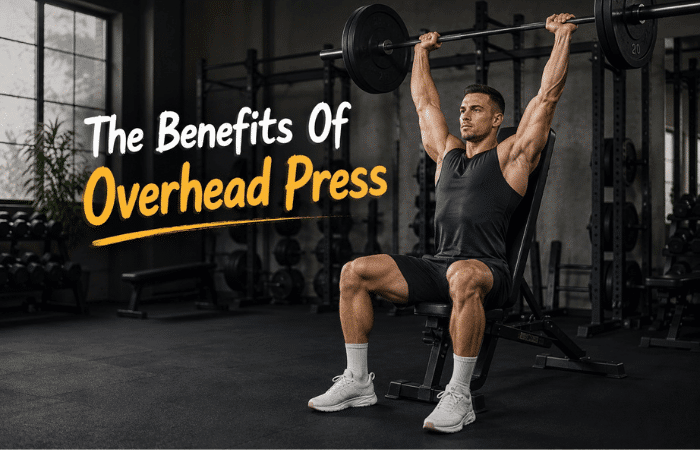
The overhead press, also called the shoulder press, strict press, or military press, is an upper-body compound exercise in which you press a weight from shoulder height to a locked-out position overhead. It can be performed standing or seated, and with a barbell, dumbbells, or kettlebells.
The purest version is the standing strict press, where you press the weight using only your upper body, with no help from your legs. This makes it a genuine measure of upper-body and core strength. When you add a dip and drive from the legs to move heavier weight, the movement becomes a push press, a different, more explosive variation.
Muscles Worked
The overhead press is a true compound movement, training multiple muscle groups at once:
- Deltoids: the primary target, working all three heads of the shoulder, especially the front (anterior) delt.
- Triceps: heavily involved in locking out your arms at the top.
- Upper chest: the clavicular head of the pecs assists in the press.
- Trapezius and upper back: stabilise and support the shoulders throughout.
- Core: your abs, obliques, and lower back brace hard to keep you rigid and prevent you from leaning back, especially when standing.
That combination is exactly why the overhead press is so valued. Few exercises train the shoulders, arms, and core so completely in one movement.
The Key Benefits of the Overhead Press
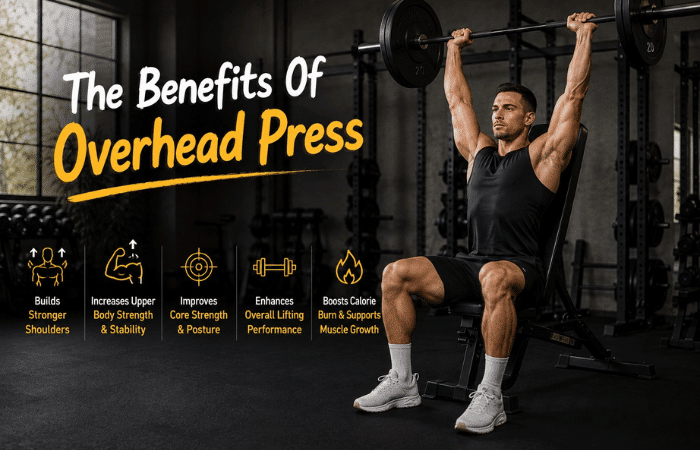
1. Builds Bigger, Stronger Shoulders
This is the headline benefit. The overhead press develops all three heads of the deltoid, building the rounded, capped “boulder shoulder” look that defines a strong upper body. Isolation moves like lateral raises can only take shoulder size and strength so far, heavy overhead pressing is what builds the foundation. If broad, powerful shoulders are your goal, this is the single most important exercise to prioritise.
2. Develops Total Upper-Body Pressing Strength
The overhead press doesn’t just build shoulders, it develops pressing power that carries over across your training. Because it shares muscles with the bench press, notably the triceps and front delts, a stronger overhead press often translates into a stronger bench, particularly at lockout. It also reinforces the pressing strength that shows up in movements like dips and push-ups. Building your press builds your whole upper body.
3. Strengthens Your Core
This is one of the overhead press’s most underrated benefits. When you press a heavy weight overhead while standing, your entire core, abs, obliques, and lower-back muscles, must work hard to keep your torso rigid and stop you from arching backward. In effect, the standing overhead press doubles as a demanding anti-extension core exercise, building genuine functional core strength that few other lifts match.
4. Improves Athletic and Overhead Performance
Think about how many sports and daily tasks involve pushing or moving something overhead: throwing, serving in tennis, a basketball shot, or simply lifting a heavy box onto a high shelf. The overhead press directly trains that overhead strength and stability, making it one of the most functionally useful lifts for athletes and everyday life alike. Its explosive cousin, the push press, shares DNA with Olympic lifts like the power clean.
5. Supports Shoulder Stability and Strength
The shoulder is the most mobile and arguably most injury-prone joint in the body, which makes the strength and stability of the surrounding muscles crucial. Performed with good form, the overhead press strengthens the muscles that support and stabilise the shoulder complex, including the scapular stabilisers and the muscles that work alongside your rotator cuff. Strong, well-trained shoulders are more resilient shoulders. The key caveat is form: pressing with poor technique, or through existing pain, can aggravate the joint rather than help it, so technique comes first.
6. Builds Functional, Real-World Strength
Unlike some machine exercises that move in a fixed path, the overhead press requires you to control and stabilise a free weight through space. That builds practical, transferable strength and coordination, the kind that makes real-world tasks easier and translates directly into better performance in other lifts and activities.
7. Creates an Aesthetic, V-Taper Physique
Wide, developed shoulders are the cornerstone of an impressive physique. By building deltoid width, the overhead press helps create the classic V-taper, broad shoulders tapering to a narrower waist, which makes your whole upper body look more muscular and your waist appear smaller. It’s a key piece of the aesthetic puzzle alongside conditioning work like getting more vascular and defined.
8. Improves Posture
Regularly training your shoulders, upper back, and core with the overhead press encourages better posture. Strengthening these muscles helps counteract the rounded-forward posture that comes from long hours at a desk, helping you stand taller and more upright.
9. An Efficient Compound Movement
Because it trains the shoulders, triceps, upper chest, and core simultaneously, the overhead press gives you a lot of training value from a single exercise. That efficiency makes it a cornerstone of any well-designed upper-body or push-focused routine.
How to Do the Overhead Press With Good Form
Technique is everything with the overhead press, both for results and safety. Here’s how to perform the standing barbell version:
- Set up. Position the barbell in a rack at roughly upper-chest height. Grip it just outside shoulder width, unrack it, and hold it resting at the front of your shoulders, near your collarbone, with your elbows slightly in front of the bar.
- Brace. Stand with feet around shoulder-width apart. Squeeze your glutes and brace your core hard to lock your torso in place and protect your lower back.
- Press. Drive the bar straight up. As it passes your face, tuck your chin slightly back so the bar can travel in a straight line, then push your head “through” the window your arms create as the bar clears the top.
- Lock out. Finish with the bar directly overhead, roughly over the middle of your feet, arms fully extended, shoulders shrugged slightly up.
- Lower under control. Bring the bar back down to your shoulders with control, ready for the next rep.
The golden rule: press the bar in as straight a line as possible, and never turn the movement into a backward lean by overarching your lower back.
Standing vs Seated Overhead Press
Both versions have their place. The standing press is the more complete exercise, demanding far more core and full-body stability, and it’s the truest test of overhead strength. The seated press, usually done against a bench with back support, removes much of that stability demand and isolates the shoulders more directly. Seated pressing can be useful if you have lower-back issues or want to focus purely on the shoulders, though it removes the excellent core benefit and can tempt you into overarching against the bench. For most people, the standing press should be the priority, with the seated version as a useful accessory.
Common Overhead Press Mistakes to Avoid
- Overarching the lower back. The most common and risky mistake. Leaning back turns the lift into an inefficient incline press and strains your spine. Brace your core and squeeze your glutes to stay upright.
- Using leg drive on a strict press. Bending and driving with the legs makes it a push press. There’s nothing wrong with the push press, but if you’re doing a strict press, keep your legs locked.
- Not pressing to full lockout. Cutting the range short leaves strength and size on the table. Finish every rep with arms fully extended overhead.
- Pressing the bar forward. The bar should travel up and slightly back to finish over your midline, not out in front of you.
- Ego lifting. Loading too much weight wrecks your form and invites injury. Master the movement, then add weight gradually.
Overhead Press Variations
One of the best things about the overhead press is its versatility:
- Barbell overhead press: the classic, best for loading heavy and building maximal strength.
- Dumbbell shoulder press: allows a greater range of motion and works each side independently, ironing out imbalances.
- Push press: uses a dip and drive from the legs to move heavier loads, building explosive power.
- Arnold press: a dumbbell variation with a rotation that hits all three delt heads through a long range of motion.
- Landmine press: a more shoulder-friendly angle, excellent for those with shoulder discomfort or as a pressing progression.
- Seated press: for added stability and shoulder isolation.
Overhead Press vs Bench Press
These two presses complement rather than compete with each other. The bench press is a horizontal press that emphasises the chest, while the overhead press is a vertical press that emphasises the shoulders and demands far more core stability. They train the same pressing muscles from different angles, so the strongest, most balanced upper bodies are built by doing both, not choosing one over the other.
How to Program the Overhead Press
To get the most from it:
- Place it early. As a heavy compound lift, do it near the start of your workout when you’re fresh.
- Sets and reps: aim for around 3 to 5 sets. Use lower reps (roughly 3 to 6) for strength and moderate reps (6 to 12) for size.
- Frequency: training it once or twice a week works well for most people.
- Progress gradually. Add small amounts of weight or reps over time. The overhead press progresses more slowly than bigger lifts like the squat, so patience is key.
It fits naturally as the primary pressing movement on push or upper-body days, such as in a push, pull, legs routine or a PHUL programme. Our guide on how many exercises per muscle group can help you fit it into a balanced week.
A Note on Shoulder Health
Because the shoulder is such a complex joint, approach the overhead press with respect. Ensure you have the shoulder mobility to press straight overhead comfortably, warm up thoroughly, and build the weight gradually. If you have an existing shoulder injury or feel pain, don’t push through it, more shoulder-friendly variations like the landmine press or neutral-grip dumbbell press are excellent alternatives, and it’s worth seeking professional guidance. Behind-the-neck pressing in particular demands excellent mobility and is best avoided unless you’re confident and experienced.
FAQ
What muscles does the overhead press work?
Primarily the shoulders (deltoids), with significant involvement from the triceps, upper chest, traps, and core. It’s a true compound movement that trains the whole upper body’s pressing system.
Is the overhead press better than the bench press?
Neither is better, they’re complementary. The overhead press emphasises the shoulders and core, while the bench press emphasises the chest. Doing both builds the most complete, balanced upper body.
Should I do the overhead press standing or seated?
Standing is the more complete exercise, adding a major core and stability demand. Seated pressing isolates the shoulders more and can suit those with lower-back concerns. For most people, standing should be the priority.
Why is my overhead press so weak compared to my bench?
That’s completely normal. The overhead press uses smaller muscles and far less of them than the bench, and it demands more stability, so everyone presses considerably less overhead than they bench. Focus on steady progress rather than comparing the two.
Is the overhead press bad for your shoulders?
Done with good form and appropriate weight, it strengthens and supports the shoulders. Done poorly, or through existing pain, it can aggravate them. Prioritise technique, mobility, and gradual loading, and use shoulder-friendly variations if needed.
The Bottom Line
The overhead press has earned its place among the great foundational lifts. It builds powerful, capped shoulders, develops upper-body pressing strength, forges a strong core, and carries over into sport, daily life, and your other lifts, all while helping create that sought-after V-taper physique.
Treat it with the respect a heavy overhead lift deserves: master your form, warm up properly, progress patiently, and listen to your shoulders. Do that, and the overhead press will reward you with a stronger, broader, more athletic upper body that few other exercises can build.

I'm Tomek, your dedicated fitness coach at TheGymGoat. With years of experience as a certified personal trainer, fitness blogger and a passion for empowering individuals, I'm committed to helping you reach your health and wellness goals. I don't do excuses, I make priorities and always base my workout and diet on reserach.
All articles by Tomek →