




ON THIS PAGE
The best back exercises are the deadlift, pull-up, lat pulldown, bent-over row, dumbbell row, seated cable row, T-bar row, chest-supported row, face pull, and straight-arm pulldown, a combination of vertical pulls for width and horizontal rows for thickness. Because the back is a large, complex group of muscles, no single exercise develops it fully, so building a wide, thick, powerful back means training it from multiple angles.
This guide breaks down each of the best back exercises, exactly how to perform them, and how to combine them into a complete back workout, whether you train in a full gym or at home.
This article is informational and not a substitute for individual medical or training advice.
Understanding Your Back Muscles
Your back is made up of several muscle groups, and building it fully means training all of them. The main players are the latissimus dorsi (the “lats”), the large fan-shaped muscles that create back width and the coveted V-taper; the trapezius and rhomboids of the upper and mid back, which drive back thickness; and the erector spinae of the lower back, which support your spine and posture.
The key principle for a complete back is understanding that different movements build different qualities:
- Vertical pulls (pulling down from overhead, like pull-ups and lat pulldowns) primarily build the lats, and therefore back width.
- Horizontal pulls (rowing toward your torso, like barbell and cable rows) primarily build the mid-back, and therefore back thickness.
- Hinge movements (like the deadlift) build overall back strength and the entire posterior chain.
A back that is only trained with rows will be thick but narrow; one trained only with pulldowns will be wide but flat. Training all three patterns is what builds a genuinely impressive, balanced back. That is the logic behind the ten exercises below.
The 10 Best Back Exercises
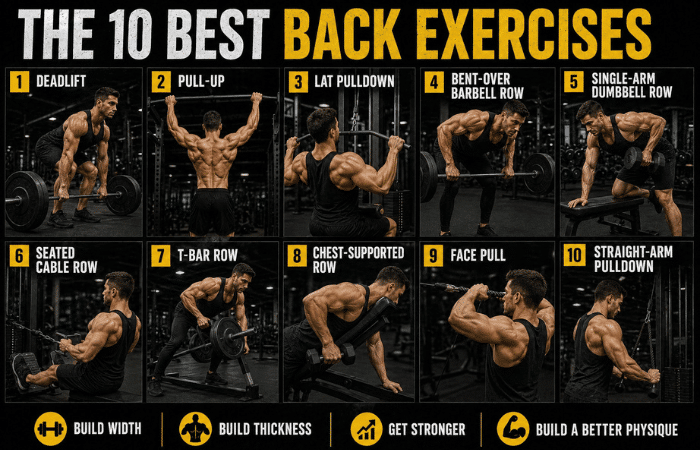
1. Deadlift
The deadlift is the best overall back exercise for building total strength and thickness, working the entire back along with the glutes, hamstrings, and core. No other movement lets you load the posterior chain so heavily.
How to do it: Stand with the bar over your mid-foot, hinge at the hips and bend your knees to grip it just outside your legs. With a flat back and braced core, drive through the floor and stand up tall, keeping the bar close to your body, then lower it under control.
Why it works: It trains the erector spinae, traps, and lats isometrically under heavy load, building a thick, powerful back and enormous full-body strength.
Tip: Keep your back flat and the bar close throughout, never round your lower back. Master the technique with lighter weight first. See our full guide to the deadlift.
2. Pull-Up
The pull-up is the best exercise for building back width, as it targets the lats through a full vertical pulling range using your own bodyweight. It is one of the truest tests of upper-body strength.
How to do it: Hang from a bar with an overhand grip slightly wider than shoulder-width. Pull your chest toward the bar by driving your elbows down and back, squeezing your lats, then lower under control to a full hang.
Why it works: The vertical pulling pattern heavily recruits the lats, building the width that creates a V-taper. Being bodyweight, it also scales endlessly through added load or harder variations.
Tip: If you can’t yet do pull-ups, use a resistance band or the assisted pull-up machine, and progress over time. Our pull-ups guide covers how to build up to them.
3. Lat Pulldown
The lat pulldown is the best machine exercise for building lat width, making it an ideal alternative to pull-ups for beginners or for adding volume. The cable lets you adjust the load precisely.
How to do it: Sit at the machine and grip the bar wider than shoulder-width. With your chest up, pull the bar down to your upper chest by driving your elbows down, squeeze your lats, then return under control.
Why it works: It replicates the vertical pulling pattern of the pull-up with adjustable resistance, so you can target the lats effectively at any strength level.
Tip: Avoid leaning back excessively or yanking the bar down with momentum. Keep the movement controlled and feel your lats do the work.
4. Bent-Over Barbell Row
The bent-over barbell row is the best exercise for building mid-back thickness, letting you row heavy loads to develop the traps, rhomboids, and lats. It is a cornerstone mass builder.
How to do it: Hold a barbell with an overhand grip, hinge forward to around 45 degrees with a flat back, and let the bar hang at arm’s length. Row it toward your lower chest or upper abdomen by driving your elbows back, then lower under control.
Why it works: The horizontal pulling motion under heavy load thickens the entire mid-back, while the braced hinge position also strengthens the lower back and core.
Tip: Keep your back flat and core braced throughout, and avoid using momentum to heave the weight. For variations, see our barbell row alternatives.
5. Single-Arm Dumbbell Row
The single-arm dumbbell row is one of the best exercises for building the back unilaterally with a large range of motion, helping to correct side-to-side imbalances. The supported position also spares your lower back.
How to do it: Place one knee and hand on a bench, with the other foot on the floor. Hold a dumbbell in your free hand at arm’s length, then row it toward your hip by driving your elbow back, squeezing your back at the top, and lower for a full stretch.
Why it works: Working one side at a time allows a fuller range of motion and a strong contraction, while ensuring your stronger side can’t compensate for the weaker one.
Tip: Avoid twisting your torso to lift the weight; keep it stable and let your back do the work.
6. Seated Cable Row
The seated cable row is one of the best exercises for building mid-back thickness with constant tension throughout the movement. The cable keeps your muscles loaded from start to finish.
How to do it: Sit at the machine with your feet braced and a slight bend in your knees, holding the handle with arms extended. Pull the handle to your abdomen by driving your elbows back and squeezing your shoulder blades together, then return under control to a full stretch.
Why it works: The continuous cable tension and strong end-range contraction make it excellent for developing the rhomboids, traps, and lats of the mid-back.
Tip: Keep your torso upright and avoid rocking back and forth. Let your back, not your momentum, move the weight.
7. T-Bar Row
The T-bar row is a superb exercise for building thick, dense mid-back muscle, allowing heavy loading in a supported rowing position. It bridges the gap between a barbell row and a machine row.
How to do it: Straddle the T-bar (or a barbell in a landmine), hinge forward with a flat back, and grip the handles. Row the weight toward your chest by driving your elbows back, squeeze, then lower under control.
Why it works: It lets you row heavy with a natural, supported position, packing size onto the middle of the back with less lower-back strain than a bent-over row.
Tip: Use a full range of motion, allowing a good stretch at the bottom before pulling powerfully.
8. Chest-Supported Row
The chest-supported row is the best rowing exercise for strict form and protecting your lower back, since lying against a pad removes momentum and lower-back strain entirely. This makes it ideal for isolating the back.
How to do it: Lie face down on an incline bench set to around 30 to 45 degrees, holding dumbbells or the machine handles. Row the weight up by driving your elbows back and squeezing your shoulder blades, then lower under control.
Why it works: With your torso fully supported, all the effort goes into your back muscles rather than stabilising your body, giving a clean, strict stimulus with no cheating.
Tip: This is a great option on days when your lower back is fatigued from deadlifts or squats, as it takes the lower back out of the equation.
9. Face Pull
The face pull is the best exercise for developing the rear delts and upper back while improving posture and shoulder health. It targets the small muscles that most training neglects.
How to do it: Set a cable pulley to around head height with a rope attachment. Pull the rope toward your face, flaring your elbows out and squeezing your shoulder blades together, so your hands finish beside your ears, then return under control.
Why it works: It strengthens the rear delts, traps, and rhomboids that support good posture and healthy shoulders, balancing out all the pressing most people do.
Tip: Use light to moderate weight and focus on the squeeze. Face pulls are about quality contraction, not heavy loading.
10. Straight-Arm Pulldown
The straight-arm pulldown is the best isolation exercise for the lats, letting you feel and target them directly without the arms taking over. It is excellent for building the mind-muscle connection.
How to do it: Stand facing a high cable with a straight bar or rope, arms extended in front of you. Keeping your arms straight, pull the bar down to your thighs in an arc using your lats, then return under control.
Why it works: By keeping the arms straight, it removes the biceps from the movement and isolates the lats, making it a superb finisher for building width and feeling your back work.
Tip: Use it at the end of your back session to fully fatigue the lats, focusing entirely on feeling them contract.
Best Back Exercises at a Glance
| Exercise | Equipment | Primary target | Level |
|---|---|---|---|
| Deadlift | Barbell | Whole back, posterior chain | All (technique first) |
| Pull-up | Bar / bodyweight | Lats (width) | Intermediate to advanced |
| Lat pulldown | Cable machine | Lats (width) | All |
| Bent-over barbell row | Barbell | Mid-back thickness | Intermediate |
| Single-arm dumbbell row | Dumbbell | Lats and mid-back | All |
| Seated cable row | Cable machine | Mid-back thickness | All |
| T-bar row | T-bar / landmine | Mid-back thickness | Intermediate |
| Chest-supported row | Dumbbells / machine | Mid-back, strict form | All |
| Face pull | Cable | Rear delts, upper back | All |
| Straight-arm pulldown | Cable | Lats (isolation) | All |
A Sample Back Workout
The best back workout combines a heavy pull, a vertical pull for width, a horizontal row for thickness, and some rear-delt and lat isolation, so you train the whole back across every pattern. Here is a balanced session:
- Deadlift: 3 sets of 5 reps (heavy)
- Pull-ups or lat pulldown: 3 to 4 sets of 8 to 10 reps (width)
- Bent-over row or T-bar row: 3 sets of 8 to 12 reps (thickness)
- Seated cable row or chest-supported row: 3 sets of 10 to 12 reps
- Face pulls: 3 sets of 15 reps (rear delts and posture)
- Straight-arm pulldown: 2 to 3 sets of 12 to 15 reps (lat finisher)
Rest 2 to 3 minutes after heavy pulls and 60 to 90 seconds on the isolation work. Above all, apply progressive overload by gradually adding reps or weight over time, since that steady progression is what builds a bigger, stronger back. For how back training fits into your wider routine, see our guides on how many exercises per muscle group and how to build muscle.
Tips for Training Your Back
To get the most from these exercises, keep these principles in mind:
- Train both width and thickness. Include vertical pulls (for the lats) and horizontal rows (for the mid-back) in your routine.
- Lead with your elbows. Think about pulling with your elbows rather than your hands to engage your back instead of your arms.
- Squeeze your shoulder blades. Retract and squeeze at the peak of each row to fully contract the back muscles.
- Use a full range of motion. Allow a good stretch at the start of each rep, then pull all the way to a strong contraction.
- Prioritise the mind-muscle connection. The back is hard to feel, so use controlled reps and focus on the target muscle working.
- Protect your lower back. Keep it flat and braced on deadlifts and bent-over rows, and use chest-supported options when fatigued.
Frequently Asked Questions
What is the best back exercise? The deadlift is the best exercise for overall back strength and thickness, while the pull-up is the best for building back width. Since a complete back needs both width and thickness, the ideal approach combines vertical pulls like pull-ups with horizontal rows and the deadlift, rather than relying on any single movement.
How do I get a wider back? Build a wider back with vertical pulling exercises that target the lats, primarily pull-ups and lat pulldowns. The lats are the muscles responsible for back width and the V-taper, so prioritising these movements, with a full range of motion and good lat engagement, is the key to widening your back.
How do I build back thickness? Build back thickness with horizontal rowing exercises such as bent-over rows, T-bar rows, and seated cable rows. These movements target the traps, rhomboids, and mid-back muscles that create density and thickness, especially when performed with heavier loads and a strong shoulder-blade squeeze.
How often should I train my back? Training your back once or twice a week works well for most people, allowing enough volume for growth with adequate recovery. Twice a week, with a couple of days between sessions, tends to be ideal for building muscle, provided your total weekly sets are appropriate.
Can I build my back at home? Yes, you can build an impressive back at home with a pull-up bar and a set of dumbbells or resistance bands. Pull-ups build width, while dumbbell rows and band rows build thickness. As with any training, the key is to apply progressive overload by making the exercises progressively harder over time.
Why can’t I feel my back working? Many people struggle to feel their back because they pull with their arms instead of their back muscles. To fix this, use a lighter weight, focus on driving your elbows back and down, squeeze your shoulder blades at the top of each rep, and move slowly and deliberately to build the mind-muscle connection.
The Bottom Line
The best back exercises combine heavy pulls like the deadlift, vertical pulls like pull-ups and lat pulldowns for width, and horizontal rows like the bent-over and cable row for thickness, rounded out with rear-delt and lat isolation. Because the back is such a large, varied muscle group, training it across all these patterns is what builds a wide, thick, powerful back.
Pick a selection of these movements, focus on pulling with your back rather than your arms, use a full range of motion, and apply progressive overload consistently. Support that with good recovery and nutrition, and you will build the strong, impressive back that anchors a great physique.

I'm Tomek, your dedicated fitness coach at TheGymGoat. With years of experience as a certified personal trainer, fitness blogger and a passion for empowering individuals, I'm committed to helping you reach your health and wellness goals. I don't do excuses, I make priorities and always base my workout and diet on reserach.
All articles by Tomek →