




ON THIS PAGE
Mountain climbers are one of those brilliant exercises that deliver a huge amount in a single movement. With nothing but your bodyweight and a bit of floor space, they blend cardio, core work, and full-body strength into one demanding, dynamic exercise. Whether you use them to warm up, as part of a circuit, or as a brutal finisher, they’re a staple in workouts everywhere for good reason.
Here’s a complete look at the real benefits of mountain climbers, how to do them properly, and how to fit them into your training.
This article is informational and not a substitute for individual medical or training advice.
What Are Mountain Climbers?
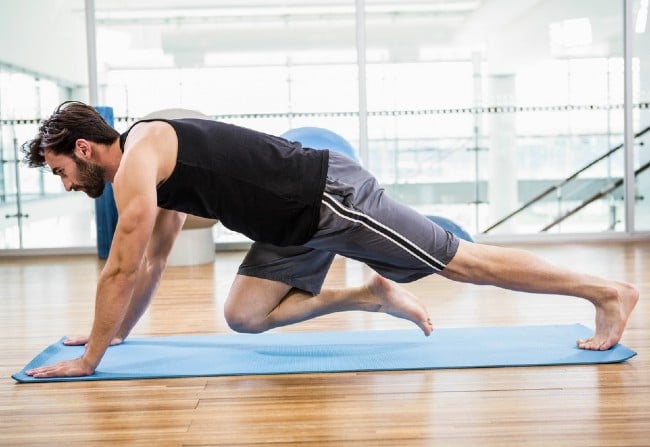
Mountain climbers are a bodyweight exercise performed from a high plank position, hands under your shoulders, body in a straight line. From there, you drive one knee toward your chest, then quickly switch legs in a running-like motion, as if you were climbing a steep mountain on the floor. That combination of a static plank hold and rapid, dynamic leg movement is what makes them so effective, and so challenging.
The result is a true compound exercise that works multiple muscle groups at once while spiking your heart rate, giving you strength and cardio in a single move.
Muscles Worked
Mountain climbers live up to their full-body reputation, working:
- Core: your abs, obliques, and deep stabilising muscles fire constantly to keep your torso stable as your legs move.
- Shoulders, chest, and arms: support your upper body in the plank position throughout.
- Legs and hips: your quads, hamstrings, glutes, and hip flexors drive the knee-to-chest motion.
Few bodyweight moves recruit so much of your body in one exercise.
What Are The Benefits Of Mountain Climbers?
1. A True Full-Body Workout
The standout benefit of mountain climbers is how comprehensively they work your body. Rather than isolating a single muscle, they engage your core, shoulders, arms, and legs all at once, delivering serious “bang for your buck.” This makes them incredibly efficient: instead of doing separate exercises for your core, upper body, and legs, you get a taste of all three in one movement. That whole-body engagement is exactly what makes them such a versatile and popular addition to any routine.
2. Excellent Cardio and Calorie Burn
Don’t be fooled by the fact that you’re on the floor, mountain climbers are a genuine cardiovascular workout. The fast, continuous leg movement rapidly raises your heart rate, training both your aerobic and anaerobic systems. Because they combine that cardio intensity with full-body muscle engagement, they burn calories efficiently, which is why they’re a favourite in HIIT and fat-loss workouts. For a quick, effective way to get your heart pumping without any equipment, they’re hard to beat.
3. Builds Core Strength and Stability
Mountain climbers are a phenomenal core exercise. Holding the plank position forces your abs, obliques, and deep stabilising muscles to work hard to keep your torso rigid and prevent your hips from sagging or twisting as your legs pump. This trains your core to resist movement and stabilise your body, which is exactly how it functions in real life, building genuine functional core strength, better balance, and improved posture. It’s a dynamic step up from a standard plank.
4. Improves Coordination, Agility, and Athleticism
The rapid, alternating movement of your arms and legs demands real coordination, training your brain and body to move in sync. Over time, this sharpens your coordination, agility, and balance, qualities that carry over into sports and everyday movement. Because they also have an explosive, dynamic quality, mountain climbers help develop the kind of athleticism that benefits activities requiring speed and quick direction changes.
5. Time-Efficient and Needs No Equipment
Few exercises are as convenient as the mountain climber. You need no equipment and very little space, so you can do them at home, in the gym, in a hotel room, or in the park. Combined with the fact that they train cardio and strength simultaneously, this makes them one of the most time-efficient exercises around, perfect for squeezing an effective workout into a busy schedule. They slot seamlessly into a bodyweight circuit alongside moves like jumping jacks and burpees.
6. Enhances Mobility
The dynamic knee-to-chest motion repeatedly takes your hips and knees through their range of motion, which helps improve mobility and loosen up those joints. This is part of why mountain climbers work so well as a warm-up, priming your body for the movements ahead while getting your heart rate up.
7. Scalable and Versatile
Mountain climbers suit every fitness level because they’re so easily adjusted. Beginners can perform them slowly and with control, focusing on form, while advanced trainees can go rapid-fire for maximum intensity. You can use them as a gentle warm-up, a steady core exercise, or an all-out finisher, and there are plenty of variations to keep things fresh. You never truly “graduate” from them, you just ramp up the challenge.
An Honest Note on What They Won’t Do
Mountain climbers are excellent for cardio, core, endurance, and conditioning, but they won’t build maximal strength or large muscle on their own. The resistance is limited to your bodyweight and the pace, so if building significant size and strength is your goal, use mountain climbers to complement, not replace, heavier compound lifting. Think of them as a superb conditioning and core tool within a well-rounded programme.
How to Do Mountain Climbers With Good Form
- Start in a high plank position with your hands directly under your shoulders and your body in a straight line from head to heels.
- Brace your core and keep your hips level, in line with your shoulders.
- Drive one knee toward your chest, keeping your foot off the ground.
- Quickly switch, extending that leg back while driving the other knee forward.
- Continue alternating at your chosen pace, keeping your core tight and your back flat throughout.
Breathe steadily and maintain control, quality of movement matters more than sheer speed.
Common Mistakes to Avoid
- Letting your hips rise or sag. Keep your body in a straight line, don’t pike your bottom up or let your hips drop.
- Losing core tension. Brace your core throughout, rather than just moving your legs.
- Bouncing or rushing with poor form. Speed is fine, but not at the expense of control. Slow down if your form breaks.
- Incorrect hand placement. Keep your hands directly under your shoulders to protect your wrists and shoulders.
- Holding your breath. Breathe steadily throughout.
Mountain Climber Variations
- Slow mountain climbers: performed with control to build core strength and nail your form.
- Cross-body mountain climbers: driving your knee toward the opposite elbow to hit the obliques harder.
- Incline mountain climbers: with your hands elevated on a bench, making them easier and more beginner-friendly.
Frequently Asked Questions
What muscles do mountain climbers work? They’re a full-body exercise, primarily working your core (abs and obliques), along with your shoulders, arms, and chest in the plank position, and your legs, glutes, and hip flexors as you drive your knees. Your heart gets a workout too.
Are mountain climbers good for weight loss? Yes. They’re a high-intensity, full-body movement that burns calories efficiently and combines cardio with strength. As part of a consistent routine and a calorie-controlled diet, they can support fat loss effectively.
Do mountain climbers build abs? They build core strength and stability, which develops the underlying ab muscles. However, visible abs depend mainly on having low body fat, so pair mountain climbers with a sensible diet to reveal the definition.
How many mountain climbers should I do? It varies by fitness level and goal. A common approach is performing them for timed intervals, such as 30 to 45 seconds, within a circuit or HIIT workout, repeated for several rounds. Beginners should start with shorter, controlled sets.
Are mountain climbers cardio or strength? Both. They’re a hybrid exercise that combines cardiovascular conditioning with core and full-body strength, which is a big part of what makes them so effective and efficient.
The Bottom Line
Mountain climbers pack cardio, core, and full-body conditioning into one simple, equipment-free movement. They raise your heart rate, strengthen your core, improve your coordination and mobility, and burn calories efficiently, all while being endlessly scalable and doable almost anywhere. Few exercises offer so much for so little.
Just focus on good form over frantic speed, keep your core braced and hips level, and use them to complement your strength training rather than replace it. Add mountain climbers to your warm-ups, circuits, or finishers, and you’ll have one of the most versatile and effective bodyweight moves in your toolkit.

Reda El Is a CSCS trainer, Registered Dietitian, ACE-certified nutritionist, With more than 12 years of experience, also he's a Brazilian Jiu-Jitsu competitor, he has done many articles and information sources on many authority sites, such as lifehack.org, Healthline, eat this, wealthygorilla.com, and more. He always keeps improving and updating his knowledge to help everyone to achieve their goals.
All articles by Reda Elmardi →