



ON THIS PAGE
SARMs and anabolic steroids both act on the androgen receptor, but they are different drugs. Anabolic-androgenic steroids are testosterone and its synthetic relatives, while SARMs (selective androgen receptor modulators) are nonsteroidal experimental compounds designed to affect muscle and bone more than other tissues. In practice neither is safe to self-administer, and SARMs carry extra problems: no FDA approval, unreliable product quality, and a long record of failed drug tests.
This guide explains what SARMs are, how they compare with steroids on structure, effects and side effects, what the clinical research shows, and where they stand legally and in sport as of 2026.
This article is informational and not a substitute for individual medical advice. It does not provide dosing or sourcing information for any drug. If you are using, or considering, SARMs or anabolic steroids, speak with a physician who can assess your health and monitor bloodwork.
SARMs vs Steroids: The Short Answer
The core difference is chemistry and selectivity. Anabolic steroids share the four-ring steroid backbone of testosterone and activate androgen receptors throughout the body. SARMs have a different, nonsteroidal structure and were engineered to activate androgen receptors more strongly in muscle and bone than in the prostate, skin and other tissues.
That selectivity is the theory. In human trials SARMs still suppressed natural testosterone and lowered HDL cholesterol, and case reports describe serious liver injury in recreational users. So while SARMs are often marketed as a “safer steroid”, the evidence does not support that label.
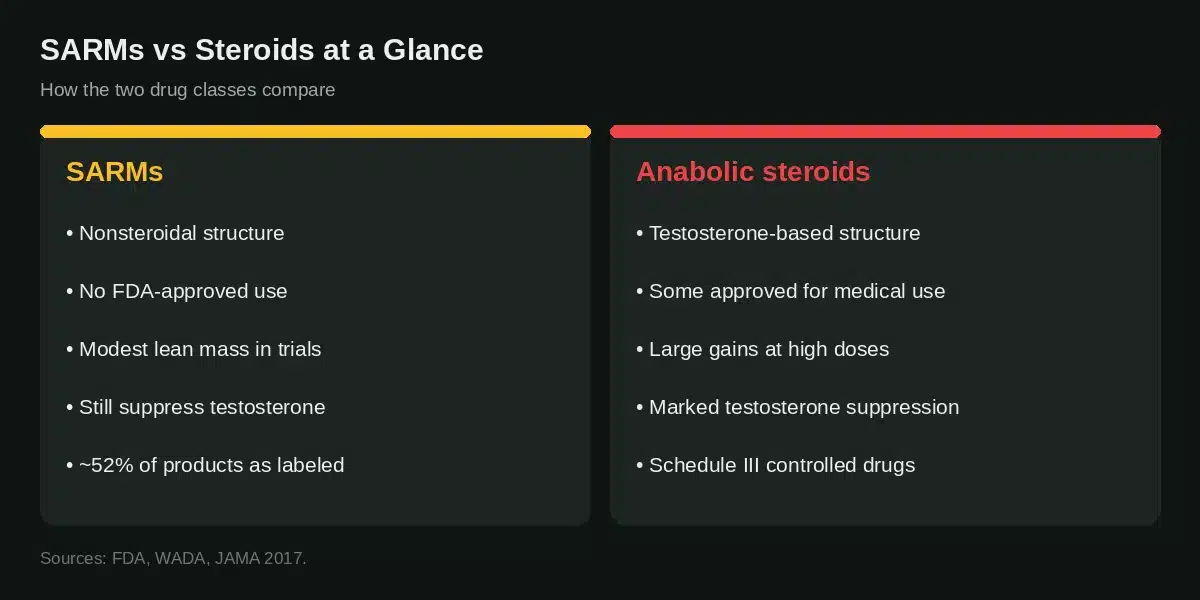
| Factor | SARMs | Anabolic steroids |
|---|---|---|
| Chemical structure | Nonsteroidal, no four-ring steroid core | Steroid backbone based on testosterone |
| Receptor target | Androgen receptor, designed to favor muscle and bone | Androgen receptor in most tissues |
| FDA approval | None approved for any use | Testosterone and a few others approved for specific conditions |
| Muscle effect in trials | Modest lean mass gains | Large, well-documented gains at high doses |
| Testosterone suppression | Yes, dose-dependent | Yes, often marked |
| HDL cholesterol | Lowered in trials | Lowered, especially oral compounds |
| Liver risk | Case reports of liver injury | Known with oral alkylated steroids |
| US legal status | Unapproved drugs; not lawful as supplements | Schedule III controlled substances |
| Sport status (WADA) | Prohibited at all times (S1.2) | Prohibited at all times (S1.1) |
What Are SARMs?
SARMs are a class of investigational drugs that bind to the androgen receptor, the same receptor testosterone uses to signal muscle growth. The word “selective” refers to their design goal: anabolic effects in muscle and bone with fewer androgenic effects in the prostate, hair follicles and skin.
Drug companies developed them to treat conditions such as muscle wasting in cancer, age-related muscle loss and osteoporosis. None has completed the path to approval. Both the FDA and the US Department of Defense describe SARMs as unapproved drugs, and as of 2026 no SARM is approved for any medical use.
Common SARMs you will see named
- Ostarine (also called enobosarm, MK-2866 or GTx-024): the most studied SARM in humans and the one most often linked to failed drug tests.
- LGD-4033 (ligandrol): studied in a small early-phase trial in healthy young men.
- RAD-140 (testolone): investigated in early research with very little published human data.
- S-23, andarine and YK-11: frequently sold online with almost no human safety data. YK-11 is chemically steroidal, so it does not even fit the usual SARM definition.
You will also see MK-677, cardarine (GW-501516) and SR-9009 grouped with SARMs. They are not SARMs. They work through entirely different pathways, which is one reason the “SARMs” label online is so unreliable.
How SARMs and Steroids Differ in Structure
Anabolic-androgenic steroids are, chemically, steroids: molecules built on a four-ring carbon skeleton. Testosterone is the parent compound, and drugs such as nandrolone and oxandrolone are modified versions of it. Our guide on whether testosterone counts as a steroid walks through that chemistry.
SARMs lack that skeleton. Because they are not steroids, the body does not process them the same way. Testosterone can convert into DHT, which drives prostate and hair effects, and into estradiol, which can cause gynecomastia. SARMs are generally not converted that way, which is part of the selectivity argument.
Selectivity claims vs reality
The marketing pitch is simple: steroid-like gains without steroid side effects. The clinical data is more cautious.
- Hormone suppression still occurs. Any compound that activates the androgen receptor strongly enough to build muscle signals the brain to reduce the body’s own testosterone. Trials of enobosarm and LGD-4033 both recorded lower total testosterone.
- Cholesterol still shifts. HDL (“good”) cholesterol fell in a dose-dependent way in these trials, the same pattern seen with oral steroids.
- Selectivity is relative. Reduced prostate stimulation in a lab model does not mean zero effect on the heart, liver or endocrine system.
What the Research Actually Shows
SARMs have been tested in a limited number of controlled human trials, mostly in older adults or patient groups. The effects are real but much smaller than social media suggests.
Ostarine (enobosarm)
The best-known study is a 12-week, double-blind, placebo-controlled phase II trial in healthy elderly men and postmenopausal women. The higher-dose group gained roughly 1.3 kg (about 3 lb) more lean body mass than placebo and improved on a stair-climb test. HDL cholesterol fell in a dose-dependent way, by about a quarter at the higher dose, and one participant stopped for a liver-enzyme rise. That is a meaningful result for a medical setting, but it is not the dramatic transformation promised online.
LGD-4033 (ligandrol)
A 21-day trial in 76 healthy young men tested low doses and found dose-dependent lean mass gains, along with suppressed total testosterone and lowered HDL cholesterol. Hormones and lipids returned toward baseline after the drug was stopped. The study was short and used low doses, so it says little about the higher amounts people take recreationally.
Across the research, the pattern is consistent: modest muscle gains with measurable hormonal and cholesterol changes, studied only over weeks, not years. If your goal is lean mass, the proven levers remain training and nutrition. See our guides on how to build muscle and progressive overload.
Side Effects and Safety Concerns
The documented and reported risks of SARMs include:
- Testosterone suppression. Consistent across human trials and expected to be larger at the doses sold online.
- Lower HDL cholesterol. A cardiovascular concern seen in every controlled trial to date.
- Liver injury. Published case reports and a 2024 review describe drug-induced liver injury in SARM users, often a cholestatic pattern with jaundice, sometimes requiring hospitalization. Many recovered after stopping, but some cases were severe.
- Other reported effects. US military health authorities list possible heart attack and stroke risk, testicular shrinkage, and psychiatric effects, drawing on case reports and regulatory warnings.
Because SARMs have never completed large safety trials, the long-term risks in healthy young adults are simply unknown.
The Product Quality Problem
Even someone who accepts the risks faces a second issue: the products are frequently not what the label claims. A 2017 analysis published in JAMA bought 44 products sold online as SARMs and tested them. Only 52% actually contained the SARM listed. Around 39% contained a different amount than labeled or none of the stated compound at all, 9% contained no active drug, and some contained unapproved substances not on the label.
This is why anti-doping agencies treat SARM-labeled supplements as high risk. USADA has reported that dozens of products on its High Risk List were found to contain ostarine, sometimes unlisted. A buyer genuinely cannot know what is in the bottle.
FDA and Military Warnings
The FDA has repeatedly warned that body-building products containing SARMs are unapproved drugs, not dietary supplements, and that they are linked to serious risks including liver injury that required hospitalization, and increased risk of heart attack and stroke. A December 2025 FDA warning again flagged products marketed with SARM-type ingredients, in one case also finding an undeclared anabolic steroid.
For service members the line is firmer. The Department of Defense bans all SARMs through its Prohibited Dietary Supplement Ingredients List, and the military’s Operation Supplement Safety program warns that a positive result can carry career consequences on top of the health risks.
SARMs in Sport and Anti-Doping
SARMs are banned in sport. The World Anti-Doping Agency lists them under section S1.2, “other anabolic agents”, prohibited at all times both in and out of competition. The 2026 Prohibited List names enobosarm (ostarine), LGD-4033 and RAD140 directly, among others.
Ostarine in particular is one of the most common causes of anabolic-agent positives. USADA has reported more than 100 ostarine findings in a two-year window and dozens of its own cases, many traced to contaminated or mislabeled supplements rather than deliberate doping. For athletes, that contamination risk alone is reason to avoid any product sold as a SARM.
Is Ostarine a Steroid?
No. Ostarine (enobosarm) is a nonsteroidal SARM. It does not have the four-ring steroid structure that defines anabolic-androgenic steroids, and the body does not metabolize it into DHT or estrogen the way it does testosterone.
That distinction matters chemically but changes little in practice. Ostarine still works through the androgen receptor, still suppresses natural testosterone in trials, is still unapproved by the FDA, and is still banned at all times in sport. Not being a steroid does not make it legal, safe or permitted.
Legal Status in the United States
As of 2026, SARMs occupy an awkward legal space. They are not approved drugs, and the FDA’s position is that they cannot be lawfully sold as dietary supplements or marketed for human use. At the same time, they are not formally scheduled as controlled substances at the federal level.
Congress has tried to change that. A SARMs Control Act was introduced in 2018 and again in 2019 (S. 2895) to place SARMs in Schedule III alongside anabolic steroids. Both versions were referred to committee and expired without becoming law. As of 2026 no federal SARMs Control Act has passed, so SARMs remain unapproved and unlawful to market for human use, but not scheduled. State laws and enforcement vary.
Who Should Avoid SARMs
The honest answer is almost everyone. Tested athletes risk sanctions from contamination alone. Service members risk their careers. Anyone who values their liver, cholesterol and natural hormone function is taking an unquantified risk with an unregulated product that may not even contain what the label says.
If the motivation is faster muscle gain, the dependable methods have not changed. Progressive strength training, adequate protein, and patience outperform any shortcut that depends on an unapproved drug of unknown purity. Our pages on daily protein needs and the difference between natural and enhanced training set realistic expectations.
Frequently Asked Questions
Are SARMs safer than steroids? They are marketed that way, but the evidence does not support it. SARMs still suppress testosterone and lower HDL cholesterol in trials, have been linked to liver injury in case reports, and are sold as unregulated products of uncertain content.
Are SARMs legal in the US? They are unapproved drugs that cannot be legally sold as supplements or for human use, but as of 2026 they are not federally scheduled as controlled substances. Proposed SARMs Control Act bills have not passed.
Do SARMs show up on a drug test? Yes. SARMs are banned by WADA and routinely detected in anti-doping testing. Ostarine is among the most frequently reported anabolic-agent findings, sometimes from contaminated supplements.
Is ostarine a steroid? No. Ostarine is a nonsteroidal SARM. It works through the androgen receptor but lacks the steroid ring structure. It is still unapproved and banned in sport.
Will SARMs shut down my natural testosterone? Clinical trials showed dose-dependent suppression of total testosterone. Levels generally recovered after stopping in short studies, but effects at higher recreational doses are not well characterized.
Do SARMs supplements actually contain SARMs? Often not as labeled. A JAMA analysis found only about half of tested products contained the SARM claimed, and many were mislabeled or contained other substances.
The Bottom Line
SARMs and steroids are not the same drug class. Steroids are modified testosterone; SARMs are nonsteroidal compounds built to be more selective. But the practical gap between them is narrower than the marketing implies. Both act on the androgen receptor, both suppress natural testosterone, and both lower HDL cholesterol.
What sets SARMs apart is how little is settled about them. None is FDA approved, the human trials show only modest gains, serious liver injury has been reported, and independent testing shows the products are frequently mislabeled. They are banned in sport and prohibited for military members.
If you want results you can trust, the smart money is still on training, nutrition and recovery, not an unapproved drug of unknown contents. For anything involving your hormones, work with a doctor rather than a supplement label.
Sources
- Dalton JT, et al. The selective androgen receptor modulator GTx-024 (enobosarm) improves lean body mass and physical function in healthy elderly men and postmenopausal women. Journal of Cachexia, Sarcopenia and Muscle, 2011.
- Basaria S, et al. The safety, pharmacokinetics, and effects of LGD-4033, a novel nonsteroidal oral SARM, in healthy young men. Journals of Gerontology Series A, 2013.
- Van Wagoner RM, et al. Chemical composition and labeling of substances marketed as selective androgen receptor modulators and sold via the internet. JAMA, 2017.
- US Food and Drug Administration. Certain bodybuilding products put consumers at risk. FDA, 2025.
- World Anti-Doping Agency. The 2026 Prohibited List. WADA, 2026.
- Leciejewska N, et al. Selective androgen receptor modulator use and related adverse events including drug-induced liver injury. European Journal of Clinical Pharmacology, 2024.

I'm Tomek, your dedicated fitness coach at TheGymGoat. With years of experience as a certified personal trainer, fitness blogger and a passion for empowering individuals, I'm committed to helping you reach your health and wellness goals. I don't do excuses, I make priorities and always base my workout and diet on reserach.
All articles by Tomek →