




ON THIS PAGE
The most reliable ways to increase testosterone naturally are unglamorous: sleep 7 to 9 hours, lose excess body fat, lift weights consistently, eat enough calories and dietary fat, and keep alcohol moderate. Supplements can only help in narrow cases, such as correcting a genuine vitamin D or zinc deficiency, and most “testosterone boosters” sold online have little evidence behind their claims.
As a dietitian, I see the same pattern again and again. Men arrive worried about their hormones, and the biggest problems turn out to be short sleep, a stubborn waistline, or a diet that has been too restrictive for too long. Fix those, and testosterone usually takes care of itself, within the limits of your age and genetics.
This article is informational and not a substitute for individual medical advice. If you have symptoms of low testosterone, a medical condition, or take prescription medication, speak with your doctor before changing your diet, training, or supplement routine.
What Testosterone Does and Why Levels Drop
Testosterone is the main male sex hormone. It supports libido, sperm production, muscle and bone mass, red blood cell production, and aspects of mood and energy. Women produce it too, in much smaller amounts. If you are curious how the natural hormone relates to the drugs used in sport, our explainer on whether testosterone is a steroid covers the chemistry.
Levels naturally decline slowly with age, but lifestyle factors often matter more than the birthday count. Obesity, poor sleep, heavy drinking, chronic under-eating, and some medications can all suppress production.
One realistic caveat before we start. Natural strategies tend to move testosterone back toward your own normal range. They do not push a healthy man far above it, and nothing in this guide works like prescribed hormone therapy.
The Evidence at a Glance
Here is how the main levers compare, based on the human research available as of 2026.
| Lever | Evidence strength | Realistic effect |
|---|---|---|
| Sleep 7 to 9 hours | Strong (controlled lab studies) | Prevents the drop seen with short sleep |
| Losing excess body fat | Strong (meta-analysis) | Meaningful rise in men with obesity; larger loss, larger rise |
| Resistance training | Moderate | Supports body composition; short spikes are not the point |
| Eating enough calories and fat | Moderate | Avoids suppression from chronic dieting or very low fat intake |
| Moderating alcohol | Moderate | Heavy, chronic drinking impairs production |
| Vitamin D or zinc | Limited, only if deficient | Small benefit when correcting a deficiency, likely none otherwise |
| Ashwagandha, tongkat ali | Limited (small trials) | Modest, inconsistent changes |
| Commercial “T boosters” | Weak | Most claims unsupported |
1. Prioritize Sleep
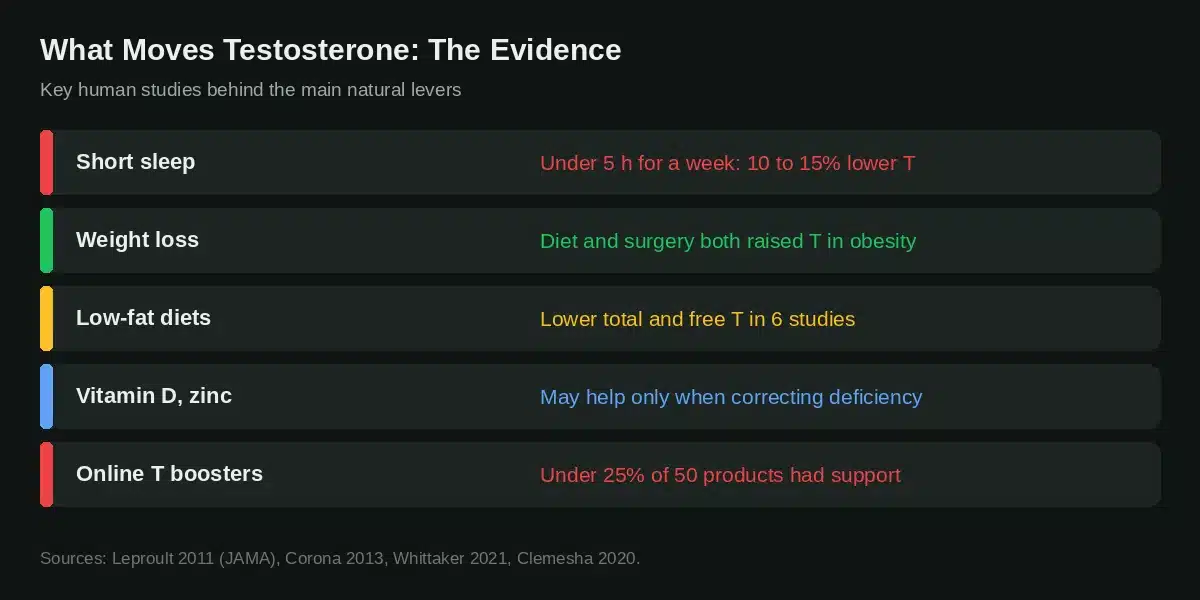
Most testosterone release happens during sleep, so cutting it short has a measurable cost. In a well-known University of Chicago study published in JAMA in 2011, ten healthy young men averaging 24 years old slept less than five hours a night for a week. Their daytime testosterone fell by 10 to 15 percent, and they reported lower mood and vigor as the week went on.
That is a small sample, but the finding fits a broader picture: short sleep, shift work, and untreated sleep apnea are all linked to poorer hormonal health. Practical steps that help most people:
- Keep a consistent wake time, including weekends.
- Aim for 7 to 9 hours in bed asleep, not just in bed scrolling.
- Limit caffeine in the 6 to 8 hours before bed.
- If you snore loudly or wake unrefreshed, ask your doctor about sleep apnea screening.
2. Lose Excess Body Fat
If you carry significant excess weight, this is likely your biggest lever. Fat tissue converts some testosterone into estradiol, and obesity is closely tied to lower testosterone in men.
The encouraging part is that the relationship works in reverse. A 2013 meta-analysis by Corona and colleagues pooled 24 studies and found that both low-calorie diets and bariatric surgery raised total testosterone in men with obesity. Surgery produced roughly three times the increase seen with diet, and across studies, greater weight loss predicted a larger rise.
You do not need extreme measures to start. A moderate calorie deficit, enough protein to protect muscle, and steady training will do the job for most people. Our guides on how to lose belly fat and how many calories you should eat walk through the numbers.
3. Lift Weights, With Realistic Expectations
Resistance training belongs on this list, but not for the reason social media suggests. A hard leg session does cause a short-lived rise in testosterone. Research from McMaster University led by Daniel West found that these post-workout spikes were not linked to muscle growth. In one study, 56 young men trained for 12 weeks, and their acute hormone responses did not predict gains in muscle or strength.
So the value of lifting is long-term. It builds muscle, improves insulin sensitivity, and helps you lose fat while keeping lean mass, all of which support healthier hormone levels. Train each major muscle group two or three times a week and add load or reps over time. Our guide on how to build muscle lays out a sensible structure.
One warning for endurance athletes and enthusiastic gym-goers: very high training volume combined with too little food can suppress testosterone. More is not always better.
4. Eat Enough, and Don’t Fear Dietary Fat
This is where I see the most well-meaning mistakes. Long, aggressive diets send the body a clear signal that energy is scarce, and reproductive hormones are among the first things it downregulates. Sports medicine describes this as relative energy deficiency in sport (RED-S), and it affects men as well as women.
Fat intake matters too. A 2021 meta-analysis by Whittaker and Wu, published in The Journal of Steroid Biochemistry and Molecular Biology, pooled six intervention studies with 206 men. Low-fat diets lowered both total and free testosterone compared with higher-fat diets. Coverage of the paper described a drop of roughly 10 to 15 percent when men moved from about 40 percent to about 20 percent of calories from fat. The authors were clear that the evidence base is small and that more randomized trials are needed.
A practical dietitian’s approach:
- Avoid crash diets. If you are cutting, take regular maintenance phases.
- Keep fat at a moderate level rather than slashing it. Olive oil, nuts, eggs, oily fish, and avocado are easy wins.
- Hit your protein target from a mix of whole foods. Our list of high-protein foods makes this simpler.
- Eat plenty of vegetables, fruit, and whole grains for overall metabolic health.
5. Keep Alcohol Moderate
Reviews published by the US National Institute on Alcohol Abuse and Alcoholism describe how heavy, chronic drinking disrupts the hormonal axis that controls testosterone and can damage the testes directly. The occasional drink is unlikely to matter much. Regular heavy drinking, and binge sessions that also wreck your sleep, are a different story.
6. Correct Vitamin D or Zinc Deficiency, Not Normal Levels
Both nutrients play roles in testosterone production, but the evidence only supports correcting a shortfall.
Vitamin D
In a 2011 trial by Pilz and colleagues, 54 overweight men who were vitamin D deficient at the start took daily vitamin D3 or a placebo for 12 months during a weight-loss program. The vitamin D group saw a small but statistically significant rise in testosterone. The men started out deficient, and the study was a small part of a weight-loss trial, so it says little about men with healthy vitamin D levels. A blood test tells you whether this is relevant to you.
Zinc
Older controlled work, including a 1996 study by Prasad and colleagues, linked restricting dietary zinc to lower testosterone in young men. That supports getting enough zinc from food such as meat, shellfish, legumes, and seeds. It does not show that extra zinc raises testosterone in men who already get enough, and high-dose zinc over long periods can cause its own problems.
7. Manage Stress
Chronic stress, poor recovery, and the sleep loss that often comes with them can all weigh on hormonal health. Daily walks, time outdoors, reasonable work boundaries, and genuine rest days are a good foundation, and they make every other habit on this list easier to keep.
Supplements: What the Research Actually Shows
Ashwagandha
Ashwagandha has the most interesting human data among herbs, but it is still thin. In a 2019 randomized, placebo-controlled crossover trial by Lopresti and colleagues, 57 overweight men aged 40 to 70 took an ashwagandha extract or placebo for eight weeks each. Testosterone rose 14.7 percent more on ashwagandha than on placebo, yet there were no significant differences in fatigue, vigor, or sexual well-being. The authors called for larger studies.
Tongkat ali
A 2022 meta-analysis in Medicina pooled five randomized trials with 232 men taking Eurycoma longifolia (tongkat ali). Testosterone increased overall, but the effect was only significant in men with low testosterone at baseline, not in healthy men. The authors noted high variation between studies, signs of publication bias, and quality problems with some commercial products.
Fenugreek and others
Fenugreek appears in many blends, but its evidence comes from small trials with mixed results. The same goes for D-aspartic acid and most other popular ingredients. If you are weighing up trendier compounds, our article on whether turkesterone is a steroid covers that one in detail.
Commercial “testosterone boosters”
A study by Clemesha, Thaker, and Samplaski, published in The World Journal of Men’s Health, examined the first 50 “testosterone booster” products returned by a Google search. Across 109 listed components, fewer than 25 percent of the products had data supporting their claims. Zinc, fenugreek, and vitamin B6 were among the most common ingredients, and some products contained vitamins or minerals above the tolerable upper intake level.
My view as a dietitian: a booster will not fix short sleep, excess body fat, or a diet that is too restrictive. If you have done the basics and still feel unwell, the next step is a blood test, not another tub of capsules.
When to See a Doctor
Consider talking to your doctor if you notice a combination of symptoms such as persistently low libido, erectile problems, fewer morning erections, low energy, reduced muscle mass, or unexplained low mood. These symptoms are non-specific and have many possible causes, which is exactly why testing matters.
The Endocrine Society’s 2018 guideline recommends diagnosing low testosterone only when symptoms are present and blood levels are consistently low, confirmed with repeat morning fasting tests. It cites a harmonized reference range of about 264 to 916 ng/dL (9.2 to 33 nmol/L) for total testosterone in men, though individual labs may use slightly different ranges.
If testing confirms a true deficiency, your doctor will look for the cause and discuss options. Our article on TRT vs steroids explains how medically supervised therapy differs from performance-enhancing use.
Your 7-Point Checklist
- Sleep 7 to 9 hours on a consistent schedule, and get snoring checked.
- If you carry excess body fat, lose it gradually with a moderate calorie deficit.
- Lift weights two to four times a week and progress steadily.
- Avoid prolonged crash diets and keep dietary fat at a moderate level.
- Keep alcohol moderate and avoid binge drinking.
- Test vitamin D (and discuss zinc) before supplementing, and correct only real deficiencies.
- If symptoms persist, get two morning blood tests through your doctor before trying boosters.
Frequently Asked Questions
How long does it take to raise testosterone naturally? It depends on the cause. Sleep-related drops can recover within days to weeks, while changes from fat loss build over months as weight comes down.
What foods increase testosterone? No single food raises testosterone meaningfully. A diet with enough total calories, moderate fat, adequate protein, and zinc-rich foods such as meat, shellfish, and legumes supports normal production.
Does lifting weights increase testosterone? Lifting causes a short rise after a session, but research suggests these spikes do not drive muscle growth. The real benefit comes from better body composition over time.
Do testosterone boosters work? Most do not have good evidence. A review of 50 popular products found fewer than a quarter had data supporting their claims, and a few herbs show only modest, inconsistent effects in small trials.
What is a normal testosterone level for men? The Endocrine Society cites a reference range of roughly 264 to 916 ng/dL (9.2 to 33 nmol/L) for total testosterone, measured in a morning fasting sample. Your lab’s range may differ slightly.
The Bottom Line
Increasing testosterone naturally is mostly about removing what suppresses it. Sleep enough, lose excess fat, lift consistently, eat enough food and fat, and keep alcohol in check.
Supplements play a small role at best, mainly when they correct a deficiency confirmed by a blood test. If symptoms persist after you have fixed the basics, see a doctor and get properly tested rather than guessing.
Sources
- Leproult R, Van Cauter E. Effect of 1 week of sleep restriction on testosterone levels in young healthy men. JAMA, 2011.
- Whittaker J, Wu K. Low-fat diets and testosterone in men: Systematic review and meta-analysis of intervention studies. The Journal of Steroid Biochemistry and Molecular Biology, 2021.
- Clemesha CG, Thaker H, Samplaski MK. “Testosterone Boosting” Supplements Composition and Claims Are not Supported by the Academic Literature. The World Journal of Men’s Health, 2020.
- Lopresti AL, Drummond PD, Smith SJ. A Randomized, Double-Blind, Placebo-Controlled, Crossover Study Examining the Hormonal and Vitality Effects of Ashwagandha (Withania somnifera) in Aging, Overweight Males. American Journal of Men’s Health, 2019.
- Leisegang K, Finelli R, Sikka SC, Panner Selvam MK. Eurycoma longifolia (Jack) Improves Serum Total Testosterone in Men: A Systematic Review and Meta-Analysis of Clinical Trials. Medicina, 2022.
- Endocrine Society. Testosterone Therapy in Men With Hypogonadism: An Endocrine Society Clinical Practice Guideline. Journal of Clinical Endocrinology and Metabolism, 2018.

Reda El Is a CSCS trainer, Registered Dietitian, ACE-certified nutritionist, With more than 12 years of experience, also he's a Brazilian Jiu-Jitsu competitor, he has done many articles and information sources on many authority sites, such as lifehack.org, Healthline, eat this, wealthygorilla.com, and more. He always keeps improving and updating his knowledge to help everyone to achieve their goals.
All articles by Reda Elmardi →