



ON THIS PAGE
Broad, capped shoulders are the foundation of an impressive physique. They create the coveted V-taper, make your waist look smaller, fill out a t-shirt, and project strength and athleticism like nothing else. It’s no wonder “how to get wider shoulders” is one of the most common goals in the gym.
But there’s a lot of confusion and false promises around the topic, so let’s be honest from the start about what you can and can’t change, and then get into exactly how to build the widest shoulders your body is capable of. Done right, the transformation can be dramatic.
This article is informational and not a substitute for individual medical or training advice.
Can You Actually Get Wider Shoulders?
Yes, but it’s important to understand what’s actually happening. Your shoulder width comes from two things:
- Your bone structure, specifically the length of your collarbones and the width of your frame. This is genetic and cannot be changed.
- Your shoulder muscles, the deltoids that sit on top of your shoulder joints. These absolutely can be built, and dramatically so.
Here’s the good news: while you can’t lengthen your collarbones, muscle is what creates the visible width most people are after. By building the deltoids, particularly the side portion, you widen your silhouette, broaden your frame’s appearance, and completely transform how wide your shoulders look. So no, you can’t change your skeleton, but you have far more control over your shoulder width than you might think. The key is training the right muscles in the right way.
The Anatomy of Wide Shoulders
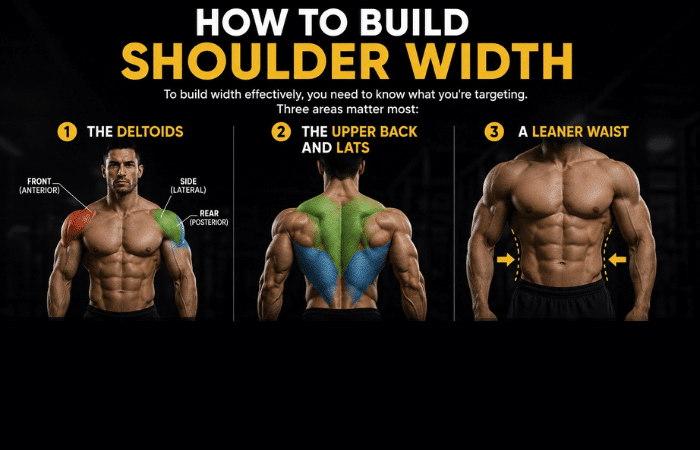
To build width effectively, you need to know what you’re targeting. Three areas matter most:
The deltoids. Your shoulder muscle has three heads: the front (anterior), side (lateral or medial), and rear (posterior). For width specifically, the side delt is king. It’s the muscle that sits on the outside of your shoulder, and developing it is what physically pushes your shoulders wider when viewed from the front. Most people who want broader shoulders are really asking how to build their side delts.
The upper back and lats. True broadness isn’t only about the delts. Wide lats and a developed upper back add width from behind and complete the V-taper, the tapering shape from broad shoulders down to a narrow waist that makes a physique look powerful.
A leaner waist. Width is relative. The narrower your waist, the broader your shoulders appear by contrast. This is why reducing body fat around your midsection enhances the illusion of width, a key part of the aesthetic we cover in our guide on getting more vascular and defined.
How to Get Wider Shoulders: The Strategy
1. Prioritise Your Side Delts
This is the single most important principle. Because the side delt creates width, it should be the star of your shoulder training. Yet it’s often the most neglected head, because most pressing exercises hammer the front delt while the side gets comparatively little direct work. If you want width, you need to give your side delts dedicated, high-priority attention, and lateral raises are the tool for the job.
2. Build Overall Delt Mass With Pressing
While isolation builds the details, heavy compound pressing builds the foundation of size and strength across the whole shoulder. The overhead press is the best exercise for this, developing all three delt heads and giving you the base of mass that width is built on. Combine heavy pressing for size with lateral raises for width, and you have the winning formula.
3. Don’t Neglect Your Rear Delts
The rear delts are the most under-trained shoulder muscle of all, and ignoring them is a mistake. Well-developed rear delts give your shoulders a fuller, rounder, three-dimensional look rather than a flat one, and they improve your posture, which itself makes your shoulders look broader. Exercises like face pulls and reverse flyes are essential.
4. Build Your Back and Lats
Don’t fall into the trap of training only the front of your body. A wide upper back and strong lats add genuine breadth and are half of the V-taper equation. Movements like pull-ups and rows widen your back and make your whole upper body look broader and more complete.
5. Apply Progressive Overload and Enough Volume
Muscle grows in response to progressive overload, gradually increasing the demands on it over time, and the side delts in particular respond well to higher training volume. That means training them frequently, often two to three times per week, with enough sets to drive growth. Our guide on how many exercises per muscle group helps you set your volume sensibly.
6. Eat to Build Muscle
You cannot build wider shoulders without building muscle, and building muscle requires adequate protein and enough overall calories to support growth. Aim for a solid protein intake, which you can plan around with our guide on how many protein shakes a day, and consider a slight calorie surplus if growth is your priority, as explained in our bulking vs cuttingguide.
7. Lean Up to Enhance the V-Taper
Because width is relative to your waist, getting leaner can make your shoulders look noticeably broader without adding a single millimetre of muscle. Trimming body fat sharpens the contrast between your shoulders and your midsection, amplifying the V-taper illusion.
8. Fix Your Posture
Rounded, hunched shoulders collapse your frame and hide the width you’ve built. Standing tall with your shoulders back, supported by strong rear delts and upper back, instantly makes your shoulders appear broader and more powerful. Good posture is free width.
The Best Exercises for Wider Shoulders
Build your shoulder training around these:
- Lateral raises (dumbbell or cable): the number-one exercise for width. Raise the weights out to your sides with control, leading with your elbows, and focus on feeling the side delt work rather than swinging heavy weight.
- Overhead press: the foundational mass and strength builder for the whole shoulder.
- Upright rows: a compound movement that hits the side delts and traps (use a comfortable grip width to protect your shoulders).
- Face pulls: excellent for the rear delts and upper back, and brilliant for posture and shoulder health.
- Rear delt flyes (reverse flyes): direct isolation for the often-neglected rear delts.
- Pull-ups and lat pulldowns: build the lat width that completes the V-taper.
- Rows: develop the upper-back thickness and breadth that add to your overall broadness.
A Sample Shoulder-Width Workout
Here’s how it might come together in a single session:
- Overhead press: 4 sets of 6 to 10 reps
- Dumbbell lateral raises: 4 sets of 12 to 20 reps
- Face pulls: 3 sets of 15 to 20 reps
- Cable lateral raises: 3 sets of 15 to 20 reps
- Reverse flyes: 3 sets of 12 to 15 reps
Notice the emphasis: one heavy press for mass, then a high volume of lateral and rear delt work for width and balance. Train shoulders like this once or twice a week, alongside back work for the lats.
Common Mistakes to Avoid
- Only training the front delts. Endless pressing overdevelops the front delt while the width-building side delt lags. Prioritise lateral raises.
- Ego-lifting your lateral raises. Swinging heavy dumbbells with momentum takes the work off the side delts. Go lighter and controlled.
- Ignoring the rear delts and back. This leads to imbalance, poor posture, and a flat, less broad look.
- Expecting to change your bones. No exercise widens your skeletal frame. Focus your energy on muscle, where the real, achievable gains are.
- Neglecting nutrition. You can’t grow muscle you’re not feeding. Training hard while under-eating protein stalls your progress.
How Long Does It Take?
Building noticeably wider shoulders takes consistent training over months, not weeks. The side delts can be a stubborn muscle, so patience and persistence are essential. With dedicated, progressive training and proper nutrition, most people see meaningful development over several months, and continued improvement for years. It’s a long game, but a highly rewarding one.
Can you actually make your shoulders wider?
Yes, by building the deltoid muscles, especially the side delts, which physically add width to your frame. You can’t change your underlying bone structure, but muscle is what creates the visible width most people want, and it’s very much within your control.
What is the best exercise for wider shoulders?
Lateral raises are the best exercise for width, because they directly target the side delts responsible for making your shoulders look broad. Pair them with overhead pressing for overall shoulder mass.
Why aren’t my shoulders getting wider?
The most common reasons are neglecting the side delts in favour of pressing, not training with enough volume or progression, poor lateral raise technique, or not eating enough to build muscle. Prioritise direct side delt work and be patient.
Do wider shoulders make your waist look smaller?
Yes. Broader shoulders create the V-taper, which makes your waist appear narrower by contrast. Getting leaner enhances this effect further, so building shoulders and trimming your waist work together.
How often should I train shoulders for width?
The side delts respond well to frequency and volume, so training them two to three times a week works well for most people, provided you allow enough recovery between sessions.
The Bottom Line
You have far more control over your shoulder width than you might have believed. While your bone structure is fixed, the muscle that creates real, visible broadness is entirely trainable, and the side delts are your key to unlocking it. Prioritise lateral raises, build overall mass with overhead pressing, develop your rear delts and back, eat to grow, lean up to sharpen the taper, and stand tall.
Stay consistent with that formula and be patient, because the side delts take time. Do the work, and you’ll build the broad, capped, powerful shoulders that transform your entire physique.

I'm Tomek, your dedicated fitness coach at TheGymGoat. With years of experience as a certified personal trainer, fitness blogger and a passion for empowering individuals, I'm committed to helping you reach your health and wellness goals. I don't do excuses, I make priorities and always base my workout and diet on reserach.
All articles by Tomek →