


ON THIS PAGE
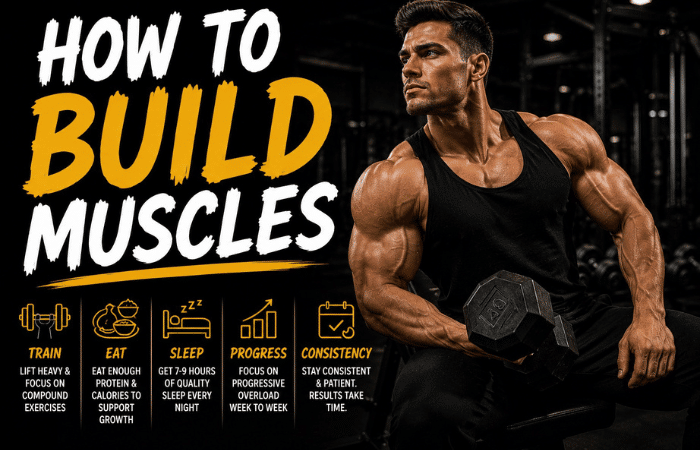
To build muscle, you need to do three things consistently: train your muscles with progressively challenging resistance exercise, eat enough calories and protein to support growth, and give your body enough recovery to adapt. Get those three essentials right and applied over time, and muscle growth is not just possible but close to guaranteed, regardless of your genetics or starting point.
This complete guide walks you through exactly how to build muscle, from the science of how it works to a practical, step-by-step approach to training, nutrition, and recovery that works for beginners and advanced lifters alike.
This article is informational and not a substitute for individual medical or nutrition advice.
How Muscle Growth Actually Works
Muscle grows when you repeatedly challenge it beyond what it is used to, then feed and rest it so it can repair itself bigger and stronger than before. This process is called muscle hypertrophy.
When you lift weights or perform challenging resistance exercise, you create mechanical tension and small amounts of stress in the muscle fibres. In response, and provided you supply enough protein, energy, and rest, your body increases muscle protein synthesis, repairing those fibres and adding a little more muscle tissue so it is better prepared for the same demand next time. Do this consistently, week after week, and those small additions accumulate into visible, lasting muscle. The entire art of building muscle is simply creating that stimulus, then giving your body what it needs to respond to it.
The Three Essentials of Building Muscle
Every effective muscle-building plan comes down to three pillars working together. Neglect any one of them and your results will suffer:
| Pillar | What to do | Why it matters |
|---|---|---|
| Training | Progressive resistance training with enough volume and effort | Provides the stimulus that tells your body to build muscle |
| Nutrition | Enough calories, and plenty of protein | Supplies the energy and raw materials to build new tissue |
| Recovery | Sufficient sleep and rest between sessions | Muscle is repaired and built during recovery, not during training |
Let’s break down each one.
Part 1: How to Train to Build Muscle
The most effective way to train for muscle growth is to perform resistance exercise that becomes progressively more challenging over time, with enough volume and effort to stimulate each muscle. Here is how to get every element right.
Apply Progressive Overload
Progressive overload, gradually increasing the demands on your muscles over time, is the single most important training principle for building muscle. Without it, your body has no reason to keep adapting, and you will plateau no matter how hard you work. You can progress by adding weight, doing more reps or sets, or improving your form and range of motion. This principle is so fundamental that we have a complete guide dedicated to it: progressive overload. Master it, and you have mastered the engine of muscle growth.
Do Enough Volume
Training volume, the total amount of work you do for a muscle, is one of the biggest drivers of growth, with most people building muscle well on around 10 to 20 hard sets per muscle group per week. Too little and you under-stimulate the muscle; far too much and you struggle to recover. Start toward the lower end and add volume over time as you adapt. Our guide on how many exercises per muscle group explains how to structure this.
Train in the Right Rep Ranges
Muscle can be built across a wide range of reps, but the classic hypertrophy range of 6 to 12 reps per set offers an ideal balance of load and volume for most people. What matters most is that your sets are genuinely challenging, taking each set close to failure (leaving one to three reps in reserve) is what drives growth, whether you are doing 6 reps or 15.
| Reps per set | Primarily builds | Best for |
|---|---|---|
| 1 to 5 | Strength | Getting stronger, powerlifting |
| 6 to 12 | Muscle size | Hypertrophy (the sweet spot) |
| 12 to 20+ | Muscular endurance | Endurance, plus some growth |
Choose the Right Exercises
The best muscle-building exercises are compound movements, which train multiple muscles at once, supported by isolation exercises that target individual muscles. Compounds like squats, deadlifts, bench presses, rows, and overhead presses give you the most muscle-building return for your effort, so they should form the backbone of your training. Add isolation work, such as curls, lateral raises, and flyes, to bring up specific muscles.
Build your sessions around the big lifts like the squat and deadlift, then round them out with targeted work, our muscle-group guides such as the best chest exercises show how to combine compounds and isolation for each body part.
Train Each Muscle Often Enough
Training each muscle group about twice a week produces better growth for most people than hitting it just once. Spreading your weekly volume across two sessions per muscle keeps muscle protein synthesis elevated more consistently and lets you do each set with better quality and effort.
Follow a Structured Programme
The easiest way to tie all of this together is to follow a proven training programme rather than training randomly. A good programme manages your volume, frequency, and progression for you. Popular, effective options include push pull legs, PHUL, PHAT, and, for advanced lifters, the PPL x Arnold split. Pick one that fits your schedule and stick with it long enough to progress.
Part 2: How to Eat to Build Muscle
To build muscle, you need to eat slightly more calories than you burn, with enough protein to supply the raw materials for new muscle tissue. Training provides the signal to grow; food provides the building blocks. Get this wrong and even perfect training will fall flat.
Eat in a Calorie Surplus
Building muscle generally requires a modest calorie surplus, eating a little more than your body burns each day, to give it the extra energy to create new tissue. A surplus of roughly 10 to 20 percent above your maintenance calories is ideal: enough to build muscle, but not so much that you gain excessive fat. This is the essence of a “lean bulk,” which we cover in our guides on bulking vs cutting and clean vs dirty bulking.
Prioritise Protein
Protein is the most important nutrient for building muscle, as it provides the amino acids your body uses to repair and grow muscle tissue. Aim for roughly 1.6 to 2.2 grams of protein per kilogram of bodyweight per day, spread across your meals. Good sources include lean meats, fish, eggs, dairy, and plant proteins like beans, lentils, and tofu. If you struggle to hit your target from food alone, a protein shake is a convenient top-up, as discussed in our guide on how many protein shakes a day.
Don’t Neglect Carbs and Fats
Carbohydrates and fats matter too: carbs fuel your training and recovery, while fats support hormone production, including the hormones involved in muscle growth. Fill most of your plate with quality carbs (rice, oats, potatoes, fruit, and vegetables) and healthy fats (nuts, olive oil, oily fish), alongside your protein, for a diet that supports both performance and growth.
Calculate Your Muscle-Building Calories and Macros
Use the calculator below to estimate your daily calories and protein, carb, and fat targets for building muscle at a lean, steady rate. It calculates your maintenance calories, adds an appropriate surplus for your goal, and splits your macros for you, giving you a clear, practical starting point.
Muscle-Building Calorie & Macro Calculator
Estimate the daily calories and protein, carbs, and fat to build muscle at a lean, steady rate.
Maintenance
0 kcal/day
To build muscle
0 kcal/day
Protein
0 g
0% of calories
Carbs
0 g
0% of calories
Fat
0 g
0% of calories
How to use this: These figures are a starting point, not a precise prescription. Aim to gain weight slowly, around 0.25–0.5 kg (0.5–1 lb) per week, to keep fat gain to a minimum. Track your weight over 2–3 weeks: if you’re gaining too fast, reduce calories slightly; if the scale isn’t moving, add a little more. This is an estimate for healthy adults and is not medical or nutrition advice.
Treat the numbers as a starting point, then adjust based on real-world results, which brings us to a key rule: track your progress and let the scale and mirror guide your fine-tuning.
Part 3: How to Recover to Build Muscle
Muscle is built during recovery, not during your workout, so adequate rest and sleep are just as essential as training and nutrition. If you train hard but recover poorly, you will stall, or worse, go backwards.
Prioritise Sleep
Sleep is when much of your muscle repair and growth happens, so aim for seven to nine hours of quality sleep per night. Poor sleep blunts recovery, reduces performance, and disrupts the hormones involved in building muscle, making it one of the most underrated factors in your progress. If you improve just one recovery habit, make it your sleep.
Take Rest Days and Avoid Overtraining
Your muscles need time between sessions to repair and grow, so build rest days into your week rather than training the same muscles every day. Most people thrive on three to five training days a week with rest days in between. More is not always better; consistently under-recovering leads to fatigue, stalled progress, and a higher risk of injury.
Manage Stress
Chronic stress raises cortisol and impairs recovery, so managing your overall stress supports better muscle growth. You cannot always control life's pressures, but prioritising sleep, taking rest, and building in downtime all help your body stay in a state where it can build muscle effectively.
How Long Does It Take to Build Muscle?
Building noticeable muscle typically takes a few months of consistent training and eating, with your rate of growth fastest as a beginner and slowing as you become more advanced. You may feel stronger within weeks, but visible size usually takes two to three months to become apparent, and building a significantly muscular physique takes years of consistency.
Here is a realistic guide to how much muscle you can expect to build naturally:
| Experience level | Realistic muscle gain (men) | Realistic muscle gain (women) |
|---|---|---|
| Beginner (year 1) | ~0.5 to 1 kg per month | ~0.25 to 0.5 kg per month |
| Intermediate | ~0.25 to 0.5 kg per month | ~0.1 to 0.25 kg per month |
| Advanced | Slower, harder-won gains | Slower, harder-won gains |
These are approximate averages, and genetics, age, and consistency all play a role. The key message is to be patient: real, lasting muscle is built gradually, and anyone promising dramatic gains in weeks is not being honest with you.
Building Muscle: Beginners vs Advanced
Beginners build muscle quickly with simple training and can even gain muscle while losing fat, whereas advanced lifters progress more slowly and need more precise training and nutrition. Knowing where you stand helps set the right expectations.
As a beginner, you will experience rapid "newbie gains," so keep things simple: a straightforward full-body or push pull legs programme, consistent progressive overload, enough protein, and good recovery will take you a very long way. As you become more advanced, gains come more slowly and require greater attention to detail, higher and better-managed training volume, more precise nutrition, and structured programming to keep progressing. The fundamentals never change, but the margins get finer.
Common Muscle-Building Mistakes to Avoid
The most common muscle-building mistake is failing to apply progressive overload, but several others hold people back too:
- Not progressing over time. Doing the same weights and reps forever stalls growth. Always aim to do a little more.
- Eating too little protein or too few calories. You cannot build much muscle without the raw materials and energy to do so.
- Programme hopping. Constantly switching plans prevents the consistent progression that builds muscle. Stick with one long enough to progress.
- Ego lifting with poor form. Lifting too heavy with sloppy technique reduces the stimulus to the target muscle and invites injury.
- Neglecting recovery. Too little sleep or rest sabotages the growth your training earns.
- Impatience. Expecting fast results and quitting early is perhaps the biggest mistake of all. Muscle takes time.
- Doing too much cardio or dieting too hard. Excessive cardio or a large calorie deficit while trying to build muscle works against you.
Do You Need Supplements to Build Muscle?
No, you do not need supplements to build muscle, but a few evidence-backed options can help support a solid diet and training plan. The two most useful are protein powder, a convenient way to hit your protein target, and creatine, one of the most researched and effective supplements for strength and muscle, as covered in our guide on how long creatine takes to work. Beyond these, most supplements are overhyped and unnecessary. Nail your training, protein, calories, and sleep first, as these matter far more than any supplement ever will.
Can Women Build Muscle the Same Way?
Yes, women build muscle using exactly the same principles as men: progressive resistance training, sufficient protein and calories, and good recovery. Women generally build muscle more slowly in absolute terms, largely due to lower testosterone levels, which also means the common fear of becoming "bulky" is unfounded. Resistance training helps women build a strong, toned, healthy physique, and the approach in this guide applies equally to everyone.
What is the fastest way to build muscle?
The fastest way to build muscle is to train each muscle group with progressive resistance two to three times a week, eat in a modest calorie surplus with 1.6 to 2.2 grams of protein per kilogram of bodyweight, and get plenty of sleep and recovery. There are no shortcuts, but doing these fundamentals consistently and correctly produces the quickest realistic results.
How much protein do I need to build muscle?
Aim for roughly 1.6 to 2.2 grams of protein per kilogram of bodyweight per day to build muscle. For an 80 kg person, that is around 130 to 175 grams daily, spread across your meals. Hitting this protein target consistently is one of the most important factors in gaining muscle.
Can you build muscle without weights?
Yes, you can build muscle without weights using bodyweight exercises like push-ups, pull-ups, dips, and squats, as long as you apply progressive overload by making the movements harder over time. Our guide on calisthenics explains how. Weights make progression easier to manage, but they are not strictly necessary, especially for beginners.
Can I build muscle and lose fat at the same time?
es, though it is easiest for beginners, people returning from a break, and those with more body fat to lose. Known as body recomposition, it involves training hard, eating enough protein, and keeping calories around maintenance. For most experienced lifters, however, focusing on either building muscle or losing fat at a time is more effective.
How long does it take to see muscle growth?
You will typically start to see noticeable muscle growth after about two to three months of consistent training and proper nutrition, though you may feel stronger sooner. Building a significantly muscular physique takes years of consistent effort. Patience and consistency are essential.
Why am I not building muscle?
The most common reasons are not applying progressive overload, eating too little protein or too few calories, inconsistent training, poor recovery, or simply not giving it enough time. Review each of the three essentials, training, nutrition, and recovery, honestly, and address whichever is the weakest link.
The Bottom Line
Building muscle comes down to three essentials done consistently over time: train your muscles with progressively challenging resistance exercise, eat enough calories and protein to fuel growth, and recover well with plenty of sleep and rest. There is no secret or shortcut, just the patient, consistent application of these fundamentals.
Start by following a structured programme, applying progressive overload, hitting your protein and calorie targets, and prioritising your recovery. Track your progress, stay patient through the inevitable slow periods, and trust the process. Do that, and you will build muscle, it is one of the most reliable and rewarding things you can achieve in the gym.

I'm Tomek, your dedicated fitness coach at TheGymGoat. With years of experience as a certified personal trainer, fitness blogger and a passion for empowering individuals, I'm committed to helping you reach your health and wellness goals. I don't do excuses, I make priorities and always base my workout and diet on reserach.
All articles by Tomek →