



ON THIS PAGE
Yes, testosterone is a steroid. Chemically it is a steroid hormone built from cholesterol, and pharmacologically it is the original anabolic-androgenic steroid that every synthetic version is modeled on.
That answer needs context, though. When people at the gym say “steroids,” they rarely mean the testosterone your body makes every morning. They usually mean synthetic or injected hormones taken at doses far above anything the body produces on its own.
This article is informational and not a substitute for individual medical advice. If you have questions about your hormone levels or any medication, speak with a qualified doctor or endocrinologist.
The Short Answer: Yes, but the Word Means Two Things
“Steroid” is both a chemistry term and a gym term, and the two definitions do not overlap perfectly.
In chemistry, a steroid is any molecule with a specific four-ring carbon skeleton. Testosterone has that skeleton, so it is a steroid in exactly the same way cortisol and estradiol are.
In everyday and sporting language, “steroids” is shorthand for anabolic-androgenic steroids (AAS) used to build muscle or improve performance. Testosterone belongs here too. It is the reference compound of the whole class, and in the United States it is regulated as an anabolic steroid under federal law.
So testosterone is a steroid on both counts. What separates a healthy man’s natural hormone from a bodybuilder’s “gear” is not the molecule. It is the source, the dose and the reason for using it.
What Makes a Molecule a Steroid?
All steroid hormones share a backbone of four fused carbon rings, three with six carbons and one with five. Small changes to the side groups attached to that backbone produce hormones with completely different jobs.
The Steroid Hormone Family
Your body makes every one of its steroid hormones from cholesterol. The main groups are:
- Glucocorticoids such as cortisol, which help regulate blood sugar, inflammation and the stress response.
- Mineralocorticoids such as aldosterone, which manage sodium, potassium and blood pressure.
- Estrogens such as estradiol, the main female sex hormones, also present in men.
- Progestogens such as progesterone, central to the menstrual cycle and pregnancy.
- Androgens such as testosterone and its more potent derivative dihydrotestosterone (DHT).
Vitamin D is a close relative. Its active form, calcitriol, is classed as a secosteroid because one of its rings is broken open, but it is synthesized along a related pathway and acts like a hormone.
Corticosteroids vs Anabolic Steroids
When a doctor prescribes “steroids” for asthma, eczema or a flared-up joint, they mean corticosteroids: drugs such as prednisolone or hydrocortisone that mimic cortisol and calm inflammation. They do not build muscle. Used long term at high doses, they can actually break down muscle and bone.
Anabolic steroids are a separate class that mimic testosterone. The NHS describes them as manufactured medicines with limited medical uses, and notes that corticosteroids are a different and far more commonly prescribed type of steroid.
Corticosteroids vs Anabolic Steroids vs Testosterone
| Feature | Corticosteroids | Synthetic anabolic steroids | Testosterone |
|---|---|---|---|
| What they mimic | Cortisol | Testosterone | It is the natural hormone itself |
| Made by the body? | Cortisol yes, the drugs are synthetic | No, lab-modified molecules | Yes, mainly in the testes, smaller amounts in ovaries and adrenal glands |
| Main effect | Reduce inflammation and immune activity | Increase muscle protein synthesis, plus androgenic effects | Male development, muscle, bone, libido, red blood cell production |
| Builds muscle? | No, can cause muscle loss with long-term use | Yes, especially at high doses | Yes, effect rises with dose |
| Typical medical use | Asthma, arthritis, skin conditions, autoimmune disease | Limited: some wasting conditions, anemia, specific cases | Diagnosed testosterone deficiency, delayed puberty |
| US legal status | Prescription drugs, not controlled | Schedule III controlled substances | Schedule III controlled substance |
| WADA status | Restricted by route and timing | Prohibited at all times | Prohibited at all times |
What Testosterone Does in the Body
Testosterone is produced mainly by the Leydig cells of the testes, under signals from the brain’s hypothalamus and pituitary gland. Women produce it too, in the ovaries and adrenal glands, at much lower levels.
Its roles go well beyond muscle:
- Sexual development: drives male puberty, including voice deepening, body and facial hair and growth of the reproductive organs.
- Reproduction: supports sperm production and libido.
- Muscle and strength: increases muscle protein synthesis and helps preserve lean mass.
- Bone: helps maintain bone mineral density, partly through conversion to estradiol.
- Blood: stimulates red blood cell production, which is why high doses can thicken the blood.
- Mood and energy: low levels are associated with fatigue and low mood, although many other factors play into both.
For lifters, the important point is that natural testosterone is one input among many. Training stimulus, total calories, protein intake and sleep do far more of the work for a natural athlete than small differences in hormone levels within the normal range. Our guide on how to build muscle covers those drivers in detail.
Natural Production and Normal Levels
Total testosterone in men is usually reported in nanograms per deciliter (ng/dL). Labs historically used different assays, which made “normal” hard to compare between clinics.
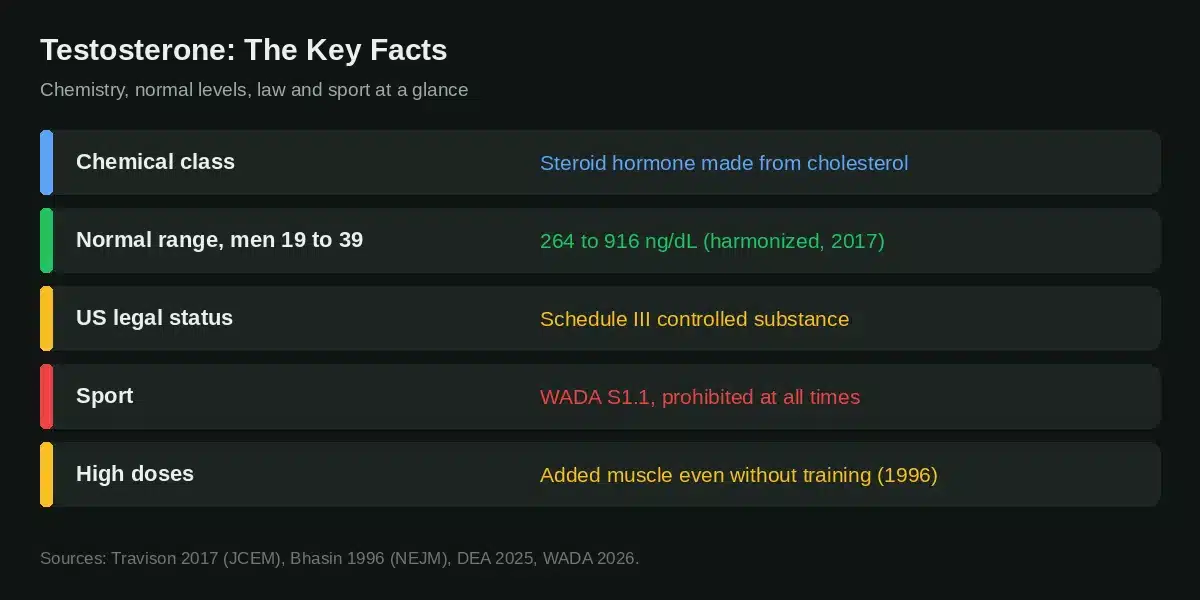
To fix that, a 2017 study in the Endocrine Society’s Journal of Clinical Endocrinology and Metabolism, led by Thomas Travison, harmonized data from 9,054 men across four large cohorts in the US and Europe and calibrated it against a CDC reference method. For healthy, non-obese men aged 19 to 39, the reference range (2.5th to 97.5th percentile) was 264 to 916 ng/dL, with a median of 531 ng/dL.
A few practical points about those numbers:
- Testosterone follows a daily rhythm and is typically highest in the morning, which is why clinical tests are taken early in the day.
- A single low reading does not mean deficiency. Guidelines require symptoms plus repeated low morning results.
- Levels tend to drift lower with age, obesity, poor sleep and some chronic illnesses.
Why “Steroids” at the Gym Usually Means Something Else
When someone is described as “on steroids,” the concern is not that they have testosterone. Everyone does. The concern is that they are adding hormones from outside the body, usually at doses that push blood levels well above the natural ceiling.
That can mean injected testosterone itself (often as esters such as testosterone cypionate or enanthate, which release slowly), or synthetic derivatives such as nandrolone, trenbolone, oxandrolone and stanozolol. They were designed to favor muscle-building (anabolic) over masculinizing (androgenic) effects, but none separates the two completely.
The result is a physique and strength profile that natural training cannot match over the long run. If you want to understand what that difference looks like in practice, see our breakdown of natural vs enhanced lifters.
What the Research Shows About High Doses
The clearest evidence that testosterone dose matters comes from a 1996 randomized trial by Shalender Bhasin and colleagues in the New England Journal of Medicine. Forty-three healthy men were split into four groups: placebo or testosterone, each with or without a supervised strength program, for 10 weeks. The testosterone dose was well above normal replacement levels.
The headline finding surprised many people at the time. Men who took testosterone and did no training at all still increased the cross-sectional area of their triceps and quadriceps and gained strength in the bench press and squat compared with placebo. The group that combined testosterone with training gained the most, adding about 6 kg (13 lb) of fat-free mass.
That study is often quoted on forums as proof that steroids “work.” It does show that. It also shows why natural and enhanced results cannot be compared fairly, and why visual estimates such as FFMI are used as a rough reality check. The trial was short and tightly monitored, so it says little about long-term health effects.
Is Testosterone Legal?
United States
Testosterone is a Schedule III controlled substance. Congress placed anabolic steroids in Schedule III through the Anabolic Steroid Control Acts of 1990 and 2004, and the DEA’s October 2025 fact sheet lists testosterone among the main anabolic steroids prescribed in the US. It is legal only with a valid prescription, and possessing or supplying it without one is a federal offense.
United Kingdom and Elsewhere
In the UK, anabolic steroids are Class C drugs that can only be supplied by pharmacists against a prescription. According to the NHS, possession for personal use is not illegal, but supplying them, including giving them to friends, can carry an unlimited fine or up to 14 years in prison. Most other countries also restrict testosterone to prescription use, although the details of possession laws vary widely.
Sport
The World Anti-Doping Agency lists testosterone under S1.1, anabolic androgenic steroids, in its 2026 Prohibited List. The S1 class is prohibited at all times, in and out of competition. Athletes with a genuine medical need can apply for a Therapeutic Use Exemption, which requires documented diagnosis and is not granted automatically.
Medical Use vs Performance Use
Testosterone has real, approved medical uses. The DEA lists testosterone deficiency, delayed puberty, anemia, breast cancer and AIDS-related tissue wasting among the conditions anabolic steroids are prescribed for.
The most common use by far is testosterone replacement therapy (TRT) for men with diagnosed hypogonadism. According to the Endocrine Society’s 2018 guideline, diagnosis should be made only in men with symptoms and signs of deficiency plus consistently low testosterone confirmed by repeated fasting morning tests. Treatment aims to bring levels back into the normal range, with regular monitoring of testosterone and hematocrit and evaluation of prostate cancer risk.
Performance use flips that logic. The goal is not to restore normal but to exceed it, usually without a diagnosis, often with several compounds at once and often without medical supervision. Same molecule, very different risk profile.
Risks at Supraphysiological Doses
The NHS lists a broad range of side effects linked to anabolic steroid misuse. In men these include reduced sperm count, infertility, testicular shrinkage, erectile dysfunction, hair loss, breast tissue development and severe acne. In women they include a deeper voice, excess body and facial hair, menstrual problems, smaller breasts and clitoral enlargement.
In both sexes, the NHS flags raised blood pressure, unhealthy cholesterol changes, heart attack, stroke, blood clots, liver and kidney damage and psychological effects such as aggression, mood swings and paranoia. Dependence is also a recognized problem, with withdrawal symptoms like depression, fatigue and low libido when use stops.
One effect catches many first-time users off guard: adding testosterone from outside tells the brain to stop signaling the testes. Natural production and sperm output drop, sometimes for a long time after use ends.
Testosterone, Creatine and Peptides: Clearing Up the Confusion
Because “steroid” gets used loosely, plenty of non-steroid products get lumped in with testosterone.
Creatine is not a steroid or a hormone. It is a compound made from amino acids that your muscles use to regenerate energy during short, hard efforts. It does not share testosterone’s ring structure and is not a controlled substance. We cover the details in is creatine a steroid.
Peptides are short chains of amino acids, not four-ring steroids, although some are prohibited in sport and many sold online are not approved for human use. Our guide on whether peptides are steroids explains the chemistry and the legal grey areas.
Frequently Asked Questions
Is testosterone an anabolic steroid? Yes. Testosterone is the natural anabolic-androgenic steroid, and synthetic AAS are derivatives of it. US federal law classifies it as a Schedule III anabolic steroid.
Is TRT the same as taking steroids? It uses the same hormone, but the goal is different. TRT aims to restore normal levels in diagnosed men under medical monitoring, while performance use typically aims for levels well above normal.
Do women have testosterone? Yes. Women produce testosterone in the ovaries and adrenal glands, at much lower levels than men, and it contributes to libido, bone health and muscle.
Is cortisol a steroid? Yes. Cortisol is a glucocorticoid steroid hormone. Corticosteroid medicines mimic it to reduce inflammation, and they do not build muscle.
Can a drug test tell natural testosterone from injected testosterone? Anti-doping labs use markers such as the testosterone to epitestosterone ratio, longitudinal profiles in the Athlete Biological Passport and isotope analysis that can indicate a synthetic origin. Standard workplace drug tests usually do not screen for it.
Can you tell by looking if someone uses testosterone? Not with certainty. Some signs make it more or less likely, which we explain in how to tell if someone is natural.
The Bottom Line
Testosterone is a steroid by every definition: a cholesterol-derived steroid hormone and the original anabolic-androgenic steroid. Your body makes it naturally, and in healthy young men it typically sits somewhere between about 264 and 916 ng/dL.
What turns testosterone into “steroids” in the gym sense is taking it from outside the body, usually at supraphysiological doses and without medical supervision. That is when the legal issues, the anti-doping rules and the health risks come into play.
If you suspect low testosterone, get properly tested by a doctor. If you are training naturally, focus on the fundamentals: progressive overload, enough food and protein, and consistent sleep.
Sources
- Bhasin S, Brito JP, Cunningham GR, et al. Testosterone Therapy in Men With Hypogonadism: An Endocrine Society Clinical Practice Guideline. Journal of Clinical Endocrinology and Metabolism, 2018.
- Travison TG, Vesper HW, Orwoll E, et al. Harmonized Reference Ranges for Circulating Testosterone Levels in Men of Four Cohort Studies in the United States and Europe. Journal of Clinical Endocrinology and Metabolism, 2017.
- Bhasin S, Storer TW, Berman N, et al. The Effects of Supraphysiologic Doses of Testosterone on Muscle Size and Strength in Normal Men. New England Journal of Medicine, 1996.
- Drug Enforcement Administration, Diversion Control Division. Anabolic Steroids. DEA Drug and Chemical Evaluation Section, 2025.
- NHS. Anabolic Steroid Misuse. NHS, 2026.
- USADA. Athlete Advisory: What’s New on the 2026 WADA Prohibited List?. USADA, 2025.

I'm Tomek, your dedicated fitness coach at TheGymGoat. With years of experience as a certified personal trainer, fitness blogger and a passion for empowering individuals, I'm committed to helping you reach your health and wellness goals. I don't do excuses, I make priorities and always base my workout and diet on reserach.
All articles by Tomek →