



ON THIS PAGE
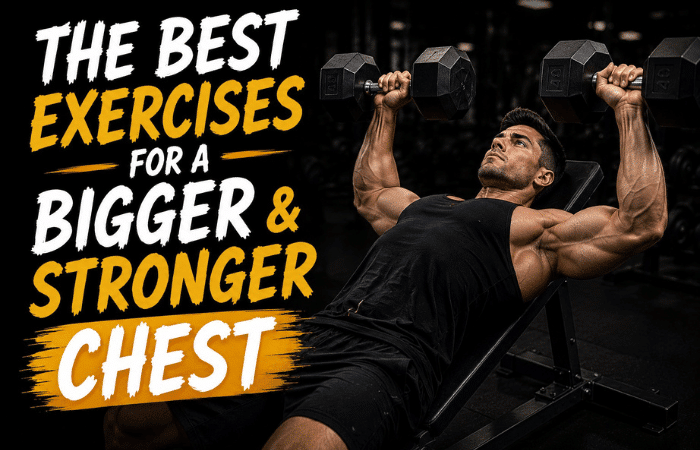
The best chest exercises are the barbell bench press, incline bench press, dumbbell press, chest dips, push-ups, dumbbell flyes, cable crossovers, and the machine chest press, a combination of heavy presses for mass and flyes for a deep stretch and squeeze. No single exercise builds a complete chest on its own, so the real secret is training your chest across multiple angles with a mix of these movements.
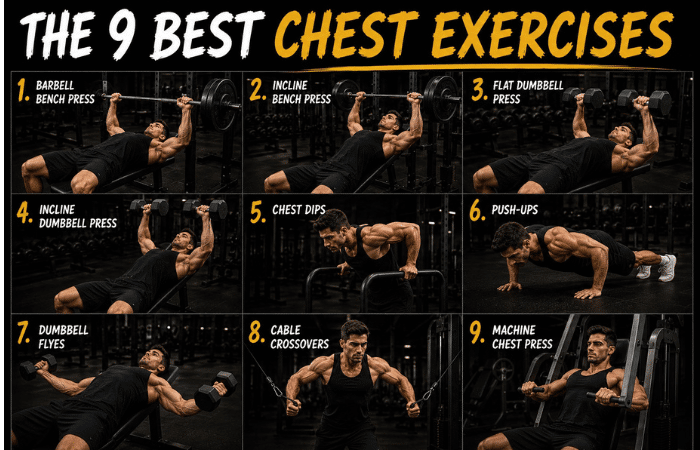
This guide breaks down each of the best chest exercises, exactly how to perform them, and how to combine them into an effective chest workout, whether you train in a full gym or at home. We included an image that shows each exercise as well, but if you still feel unsure about how to perform them, then ensure to contact a local PT or start by watching YouTube tutorials.
This article is informational and not a substitute for individual medical or training advice.
Understand Your Chest Muscles
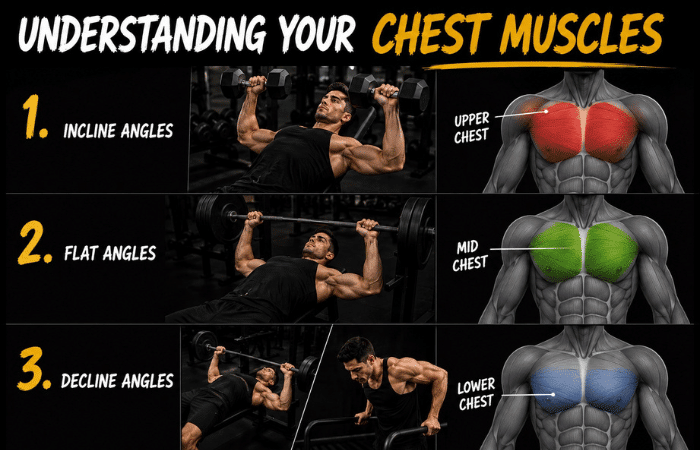
Your chest is built primarily around one large muscle, the pectoralis major, which has two sections that different exercises can emphasise. The clavicular head forms your upper chest, while the larger sternal head makes up the mid and lower chest. Underneath sits the smaller pectoralis minor.
This matters because the angle you press at shifts the emphasis between these areas. Understanding this is the key to building a full, balanced chest rather than an uneven one:
- Incline angles (pressing upward) bias the upper chest, the area that most commonly lags behind.
- Flat angles work the chest as a whole, with an emphasis on the mid chest.
- Decline angles and dips (pressing downward) bias the lower chest.
On top of that, you have two movement types: presses, which build the most mass and strength, and flyes, which stretch and squeeze the chest through horizontal adduction. A complete chest routine uses both, across a range of angles. You cannot fully isolate one region, but you can absolutely bias the emphasis, which is what these exercises let you do.
The 9 Best Chest Exercises
1. Barbell Bench Press
The barbell bench press is the single best exercise for building overall chest mass and strength, which is why it is considered the king of chest movements. It lets you move the most weight and progressively overload more easily than any other chest exercise.
How to do it: Lie on a flat bench with your eyes under the bar. Plant your feet, squeeze your shoulder blades together and down into the bench, and grip the bar slightly wider than shoulder-width. Unrack it, lower it under control to your mid-chest with your elbows at roughly a 45-degree angle to your body, then press it back up powerfully.
Why it works: It trains the entire chest along with the shoulders and triceps, and its heavy-loading potential makes it unmatched for building strength and size.
Tip: Keep your shoulder blades retracted throughout and avoid flaring your elbows straight out to protect your shoulders. Learn more in our full guide to the bench press.
2. Incline Bench Press
The incline bench press is the best exercise for building your upper chest, the area that gives the chest a full, well-rounded look and most often needs extra attention. It can be done with a barbell or dumbbells.
How to do it: Set an adjustable bench to an incline of around 30 to 45 degrees. Lie back, retract your shoulder blades, and press the barbell or dumbbells from your upper chest to full extension, then lower under control.
Why it works: The upward pressing angle shifts emphasis onto the clavicular (upper) head of the chest, developing the area that flat pressing tends to under-train.
Tip: Avoid setting the incline too high (above 45 degrees), or the shoulders take over. A moderate incline keeps the tension on your upper chest.
3. Flat Dumbbell Press
The flat dumbbell press is one of the best exercises for overall chest development with a greater range of motion than the barbell. The dumbbells allow your chest to stretch further at the bottom and work each side independently.
How to do it: Lie on a flat bench holding a dumbbell in each hand at chest level. Press them up and slightly together until your arms are extended, then lower them under control until you feel a stretch across your chest.
Why it works: The extended range of motion and independent arm action provide an excellent muscle-building stimulus and help correct strength imbalances between sides.
Tip: Don’t clash the dumbbells at the top; stop just short to keep continuous tension on the chest. See more options in our guide to chest exercises with dumbbells.
4. Incline Dumbbell Press
The incline dumbbell press combines the upper-chest emphasis of an incline with the extra range of motion of dumbbells, making it one of the most effective upper-chest builders available.
How to do it: Set the bench to around 30 to 45 degrees, hold a dumbbell in each hand, and press from the upper chest to full extension, lowering slowly for a deep stretch.
Why it works: It targets the often-lagging upper chest while allowing a fuller stretch and independent arm movement, a superb combination for growth.
Tip: Use a slow, controlled lowering phase to maximise the stretch and time under tension on your upper chest.
5. Chest Dips
Chest dips are the best bodyweight exercise for building the lower chest, and they double as a serious strength and mass builder for the whole pressing chain. A slight forward lean is what shifts the focus to the chest.
How to do it: Grip parallel bars and support yourself with arms straight. Lean your torso forward, bend your knees, and lower yourself until you feel a stretch in your chest, then press back up. The forward lean is essential.
Why it works: The downward pressing motion and forward lean heavily recruit the lower chest, while also hitting the triceps and shoulders.
Tip: Lean forward throughout to bias the chest; staying upright shifts the work to the triceps. Add weight with a belt as you get stronger. Read our full guide to dips.
6. Push-Ups
Push-ups are the best equipment-free chest exercise, making them ideal for home workouts and beginners while still challenging advanced lifters through harder variations. They work the chest, shoulders, triceps, and core all at once.
How to do it: Start in a plank position with hands slightly wider than shoulder-width. Keeping your body in a straight line, lower your chest to just above the floor, then push back up to full extension.
Why it works: They train the entire chest with bodyweight resistance and can be endlessly progressed, from knee push-ups to decline, archer, and weighted variations, making progressive overload possible without equipment.
Tip: Elevate your feet to emphasise the upper chest, or elevate your hands to make them easier. Our push-ups guidecovers the many variations.
7. Dumbbell Flyes
Dumbbell flyes are the best exercise for stretching and isolating the chest, providing a movement that presses cannot replicate. Rather than pushing, you bring your arms together in an arc.
How to do it: Lie on a flat (or incline) bench holding a dumbbell in each hand above your chest with a slight bend in your elbows. Lower the weights out to the sides in a wide arc until you feel a stretch across your chest, then bring them back together as if hugging a barrel.
Why it works: Flyes train the chest’s function of horizontal adduction through a long stretch, targeting the muscle in a way that complements pressing beautifully.
Tip: Keep a fixed, slight elbow bend throughout and use a moderate weight, flyes are about the stretch and squeeze, not heavy loading.
8. Cable Crossovers
Cable crossovers are the best exercise for keeping constant tension on the chest through the entire range of motion, which flyes with dumbbells lose at the top. The adjustable pulleys also let you target different areas of the chest.
How to do it: Stand between two cable stations with the pulleys set high, a handle in each hand. Step forward with a slight lean, and with a slight elbow bend, bring both handles down and together in front of you, squeezing your chest, then return under control.
Why it works: The cables maintain tension throughout, and by adjusting the pulley height (high, middle, or low) you can bias the lower, mid, or upper chest respectively.
Tip: Focus on squeezing your chest at the point where your hands meet, and control the return rather than letting the weight snap back.
9. Machine Chest Press
The machine chest press is the best chest exercise for beginners and for training safely to failure, as the fixed path removes the need to balance the weight. It is also a great option when you have no spotter.
How to do it: Adjust the seat so the handles are at mid-chest height. Press the handles forward to full extension, then return under control until you feel a stretch, keeping your back against the pad.
Why it works: The guided movement lets you focus purely on contracting the chest and makes it easy and safe to push close to failure, ideal for building the mind-muscle connection.
Tip: Machines are excellent for finishing your chest off after free-weight pressing, when fatigue makes balancing dumbbells or a barbell riskier.
Best Chest Exercises at a Glance
| Exercise | Equipment | Primary emphasis | Level |
|---|---|---|---|
| Barbell bench press | Barbell | Overall chest and strength | All |
| Incline bench press | Barbell / dumbbells | Upper chest | All |
| Flat dumbbell press | Dumbbells | Overall chest, big range of motion | All |
| Incline dumbbell press | Dumbbells | Upper chest | All |
| Chest dips | Dip bars | Lower chest | Intermediate to advanced |
| Push-ups | Bodyweight | Overall chest | All |
| Dumbbell flyes | Dumbbells | Chest stretch and isolation | Intermediate |
| Cable crossovers | Cable machine | Constant tension, all areas | All |
| Machine chest press | Machine | Overall chest, beginner-friendly | Beginner |
A Sample Chest Workout
The most effective chest workout combines a heavy press, an upper-chest movement, a lower-chest movement, and an isolation exercise, so you train the whole chest across every angle. Here is a simple, balanced session:
- Barbell bench press: 4 sets of 6 to 8 reps
- Incline dumbbell press: 3 sets of 8 to 12 reps
- Chest dips: 3 sets of 8 to 12 reps
- Cable crossovers or dumbbell flyes: 3 sets of 12 to 15 reps
Rest 2 to 3 minutes between the heavy pressing sets and 60 to 90 seconds on the isolation work. Above all, apply progressive overload, aim to add reps or weight over time, because that steady progression is what actually builds a bigger chest. For how to fit chest training into your wider routine, see our guide on how many exercises per muscle group.
Tips for Training Your Chest
To get the most from these exercises, keep these principles in mind:
- Train at multiple angles. Use flat, incline, and decline or dip movements to develop the whole chest, not just one part.
- Prioritise your upper chest. If it lags, as it does for most people, do your incline work first while you are fresh.
- Use a full range of motion. Lower the weight until you feel a genuine stretch, then press all the way up. Partial reps build a partial chest.
- Focus on the mind-muscle connection. Consciously feel your chest doing the work rather than just moving the weight.
- Protect your shoulders. Retract your shoulder blades and keep your elbows at around 45 degrees, not flared straight out.
- Progress over time. Track your lifts and gradually increase the weight or reps.
FAQ
What is the single best chest exercise?
The barbell bench press is the best all-round chest exercise, as it builds overall mass and strength and allows the heaviest loading. That said, no single exercise develops the entire chest, so the best results come from combining the bench press with incline and lower-chest movements.
How do I build my upper chest?
Build your upper chest with incline pressing movements, such as the incline barbell or dumbbell press, performed at around 30 to 45 degrees. The upward pressing angle emphasises the clavicular head of the chest. Prioritising these early in your workout, when you are freshest, produces the best results.
Can I build a big chest with just push-ups?
You can build a solid chest with push-ups alone, as a beginner or when training at home, provided you apply progressive overload. Progress to harder variations like decline, archer, or weighted push-ups over time to keep challenging the muscle, since bodyweight-only training still needs to get progressively harder.
How often should I train my chest?
Training your chest once or twice a week works well for most people, allowing enough volume for growth while leaving time to recover. Twice a week, with a couple of days between sessions, tends to be ideal for building muscle, as long as your total weekly sets are appropriate.
How many chest exercises should I do in a workout?
Three to four chest exercises per workout is ideal for most people, enough to cover the different angles (a flat press, an incline movement, a lower-chest movement, and an isolation exercise) without excessive volume. Quality and progressive overload matter more than simply doing more exercises.
Why isn’t my chest growing?
The most common reasons a chest stops growing are a lack of progressive overload, insufficient training volume, using a limited range of motion, neglecting the upper chest, or inadequate recovery and nutrition. Ensure you are gradually increasing your weights or reps, training through a full range, hitting all angles, and eating and sleeping enough to support growth.
The Bottom Line
The best chest exercises combine heavy presses for mass and strength, the barbell bench, incline press, and dumbbell press, with lower-chest movements like dips and isolation work like flyes and cable crossovers for a full, balanced stretch and squeeze. Because no single exercise builds a complete chest, training across flat, incline, and decline angles is what develops the whole muscle.
Pick a handful of these movements, train through a full range of motion with good form, and apply progressive overload consistently, and a bigger, stronger chest will follow. Combine that with proper recovery and nutrition, and you have everything you need to build the chest you are after.

I'm Tomek, your dedicated fitness coach at TheGymGoat. With years of experience as a certified personal trainer, fitness blogger and a passion for empowering individuals, I'm committed to helping you reach your health and wellness goals. I don't do excuses, I make priorities and always base my workout and diet on reserach.
All articles by Tomek →