




ON THIS PAGE
Today we’re talking about the benefits of dips. Not the kind you scoop with chips, but one of the most effective bodyweight exercises you can do for your upper body.
Getting in shape is tough, whatever your goal, but the right exercises make it far easier, and dips are one of the most underrated movements out there. When people think about building muscle they picture heavy dumbbells, bending barbells, and machines stacked with plates. All of that works, but a simple bodyweight movement like the dip deserves a place right alongside it.
Dips build the triceps and chest, strengthen your core, carry over to your pressing lifts, and can be done almost anywhere. They scale from complete beginner to heavily weighted, which means they stay useful for life. Here’s a thorough look at what dips do, the muscles they work, how to perform them properly, and how to get the most from them.
This article is informational and not a substitute for individual medical or training advice.
What Are Dips?
A dip is essentially an inverted, vertical push-up. You support your bodyweight on two parallel bars (or a dip station, bench, or sturdy chairs), then bend your elbows to lower your body before pressing back up to the start. The movement is one of the cornerstones of calisthenics and a close cousin of the push-up, training many of the same pushing muscles from a different angle.
There are two main styles, and the difference matters:
- Triceps dips: keeping your torso upright and vertical shifts the emphasis onto the triceps.
- Chest dips: leaning your torso forward and flaring the elbows slightly shifts more load onto the lower chest.
You can emphasise one or the other simply by changing your body position, which is part of what makes the dip so versatile.
What Are The Benefits Of Dips?
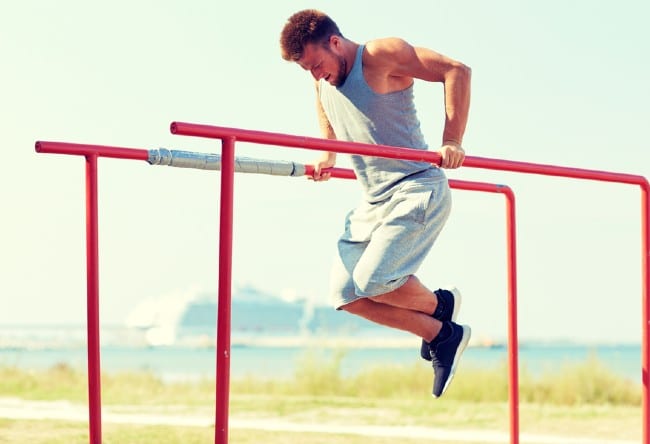
Now that we’ve looked at what dips are, let us take a look at some of the main benefits and the different dips exercise variations that are out there.
1. Outstanding for Building the Triceps
When people say “dips,” they usually mean triceps dips, and for good reason. The dip is one of the most effective triceps builders there is, working all three heads of the muscle and adding real size, strength, and definition. If you want that horseshoe-shaped triceps, dips belong in your routine.
2. Builds Bigger Arms
If you want bigger arms, dips beat endless curls. The triceps make up roughly two-thirds of your upper arm, so they contribute far more to overall arm size than the biceps do. Neglect them and you’ll end up with a prominent bicep on an otherwise small arm that looks out of proportion. Dips pack mass onto the triceps, which is what genuinely fills out a sleeve.
3. Strengthens the Chest
Dips aren’t just a triceps exercise. By leaning your torso forward, you shift significant tension onto the lower chest, making the dip one of the most underused yet effective chest builders around. Many lifters who struggle to develop the lower pecs find that chest dips fill that gap, complementing pressing work like the bench press and dumbbell chest exercises.
4. Engages and Strengthens the Core
To stay stable while suspended on the bars, your core has to brace throughout the entire movement. That constant engagement builds genuine core strength as a byproduct of training your upper body. It won’t reveal abs on its own (that comes from being lean enough for them to show), but it does strengthen the trunk effectively.
5. Improves Your Pressing Power
Because dips build the triceps so well, and the triceps are central to nearly every pressing movement, they carry over directly to your other lifts. A stronger set of triceps means a stronger bench press, overhead press, and clean and press. Dips are one of the best assistance exercises you can do to push past a pressing plateau.
6. A True Compound Exercise
Although the triceps and chest get the headlines, the dip is a genuine compound movement that recruits multiple muscle groups at once. The triceps, chest, shoulders, upper back, and core all contribute, which makes dips efficient for building an aesthetic, well-developed upper body from a single exercise.
7. Highly Scalable in Both Directions
Few exercises scale as well as the dip. If full dips are too hard, you can regress them using an assisted dip machine, a resistance band looped under your knees, or bench dips with your feet on the floor. Once they become easy, you can load them heavily by clipping plates to a dip belt or draping a chain over your shoulders, the way Dwayne “The Rock” Johnson is often seen training. That range means dips remain challenging from your very first rep to advanced strength, and you can add resistance with a weighted vest too.
8. Builds Real Muscle Efficiently
Dips are a legitimate hypertrophy exercise. A few hard sets taken close to failure deliver a serious growth stimulus to the triceps and chest in very little time. Four to six focused sets will leave your triceps burning and do as much as a far longer machine-based routine, which makes them ideal when you’re short on time.
9. Supports Injury Resilience
Strengthening the triceps and the muscles around the shoulder and chest can help build resilience against common pressing injuries, such as triceps strains that often affect lifters who press heavy with underdeveloped triceps. The important caveat: dips themselves must be done with good form, since dropping too deep or letting the shoulders roll forward can aggravate the shoulder joint. Done well, they support your joints; done carelessly, they can strain them.
10. Trains Almost Anywhere
You don’t need a gym to do dips. A dedicated dip station is ideal, but two sturdy parallel surfaces, the edge of a solid table, parallel bars at a park, or a pair of stable chairs all work. That accessibility makes dips easy to keep up at home or while travelling, with little or no equipment required.
11. Affordable and Equipment-Light
Because dips need so little kit, they can save you money. A simple dip stand or a parallel bar setup is inexpensive, and bench or chair dips cost nothing at all. For anyone training on a budget or building a home gym piece by piece, dips deliver a lot of value for very little outlay.
12. Quick and Time-Efficient
Dips let you train your triceps and chest hard in just a few minutes. There’s no loading and unloading plates or queuing for machines. When you’re pressed for time, a handful of dip sets is one of the most efficient upper-body finishers you can do.
13. Beginner-Friendly to Learn
While building the strength for full dips takes time, the movement pattern itself is simple to understand. There’s no complex technique to study for hours, which makes dips approachable. Beginners can start with assisted or bench variations and progress steadily toward full bodyweight dips.
14. Supports Fat Loss
As a demanding compound movement, dips burn energy and build calorie-hungry muscle, which supports fat loss as part of a sensible program. A set of dips won’t match a long run for calories burned, but combined with good nutrition and overall training, they contribute on the strength side of the equation.
15. Boosts the Metabolic Effect of Training
Like other resistance exercises, dips build lean muscle, and muscle is metabolically active tissue that supports your overall energy expenditure over time. The effect of any single exercise is modest, but as part of consistent resistance training, dips contribute to a healthier metabolism.
16. Supports Mental Wellbeing
Like all exercise, dips trigger the release of endorphins that lift your mood, and building strength and a physique you’re proud of supports confidence and body image. Their accessibility makes them easy to do consistently, and consistency is what makes these benefits stick.
17. Versatile Across Training Styles
Dips fit into almost any program. They feature in bodybuilding routines for chest and triceps development, in calisthenics progressions, and in structured plans like the PHAT and PHUL workouts, where they anchor push-focused training. However you train, there’s a place for dips.
What Muscles Do Dips Work?
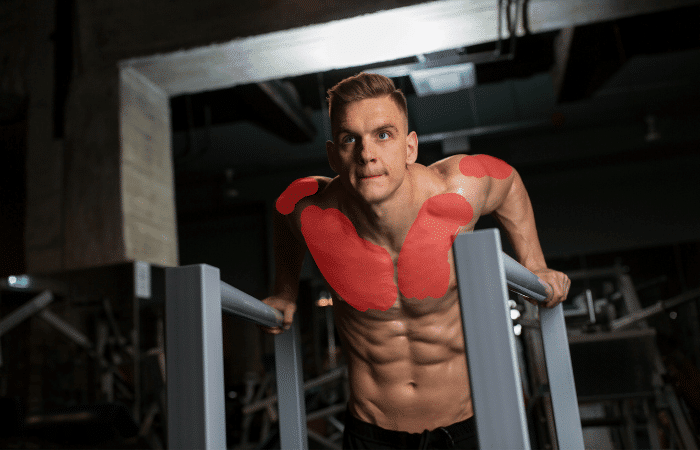
Dips are an excellent compound exercise that engages several muscle groups at once. Here’s what’s actually doing the work:
| Muscle | Role during the dip |
|---|---|
| Triceps brachii | Primary mover, extends the elbows. Emphasised in the upright, vertical dip |
| Pectoralis major | Major contributor, especially when leaning forward. Drives the pressing motion |
| Anterior deltoids | Assist the press and stabilise the shoulders |
| Rhomboids and levator scapulae | Stabilise the shoulder blades and maintain position |
| Pectoralis minor and serratus anterior | Help stabilise the scapulae for proper form |
| Forearms | Maintain grip and control on the bars |
One point worth clearing up, because some sources get it wrong: dips do not work the biceps. The biceps flex the elbow, while a dip extends it, so the triceps are the prime mover and the biceps are essentially uninvolved. If you want to train your arms with bodyweight pulling, pull-ups are the movement that hits the biceps.
How to Do Dips Correctly
Whether on a dip station or at home, the fundamentals are the same:
- Set up. Grip two parallel, stable surfaces roughly shoulder-width apart and press yourself up so your arms are fully extended, body supported.
- Position your legs. Cross your ankles behind you or bend your knees slightly. Keeping your legs tucked closer to your body makes the movement a little easier.
- Choose your emphasis. Stay upright to target the triceps, or lean your torso forward to target the chest.
- Lower under control. Bend your elbows and descend slowly until they reach roughly a 90-degree angle. Avoid sinking so deep that you feel strain at the front of the shoulder.
- Press back up. Drive through your palms and straighten your arms to return to the start, keeping the movement smooth and controlled.
- Reps. Aim for around 8 to 12 reps per set, starting with 2 to 3 sets and building up as you get stronger.
How to Do Dips at Home
You genuinely don’t need a gym. Here’s how to set up safely with household items:
- Find a sturdy surface. Two stable, parallel surfaces strong enough to hold your bodyweight, such as two solid chairs, the edges of a sturdy table, or a kitchen counter for bench-style dips.
- Check stability. Make sure nothing wobbles before you load it with your weight.
- Grip and support. Position yourself between or on the surfaces, grip firmly, and press up to the starting position.
- Lower and press. Bend your elbows to lower under control, then push back up, keeping your torso aligned and core braced.
- Progress over time. As you get stronger, add resistance with a dip belt or weighted vest, or elevate your feet for bench dips to increase the load.
A note on form at home: keep your shoulders down and back rather than letting them creep up toward your ears, and don’t bounce out of the bottom. Controlled reps build more strength and protect your shoulders.
Common Dip Mistakes to Avoid
Ego over form. Adding weight before you can do clean bodyweight reps usually wrecks technique. Earn the load.
Going too deep. Sinking far past 90 degrees stresses the shoulder joint. Stop at a comfortable depth.
Shrugging the shoulders. Letting your shoulders rise toward your ears puts them in a vulnerable position. Keep them down and back.
Bouncing the bottom. Jerking out of the bottom risks injury and reduces tension on the muscle. Stay controlled.
Ignoring your goal. Drifting between upright and forward-leaning without intent means you train neither the triceps nor the chest optimally. Pick your emphasis.
FAQs About Dips Exercise
What Do Dips Work?
Primarily the triceps and chest, with the shoulders, upper back, and core assisting and stabilizing. An upright torso emphasizes the triceps, while leaning forward emphasizes the chest.
How To Do Assisted Dips?
To make dips easier while you build strength, use an assisted dip machine, which supports part of your weight, or loop a resistance band under your knees on a dip bar. Bench dips, with your hands on a bench behind you and your feet on the floor, are another good regression. As you get stronger, progress toward full bodyweight dips.
Do Dips Work Biceps?
No. Dips are a pushing exercise that extends the elbow, so they train the triceps, not the biceps. To build the biceps with bodyweight, do pull-ups or chin-ups instead.
Are Dips Better for Chest or Triceps?
Both, depending on your form. Staying upright targets the triceps, while leaning forward with elbows slightly flared targets the chest. You can prioritise either by adjusting your body position.
Can Dips Build a Big Chest?
Yes. Chest-focused dips are an excellent and underrated chest builder, particularly for the lower pecs. Combined with pressing movements, they help develop a full, strong chest.
The Bottom Line
Dips are one of the most effective and versatile upper-body exercises you can do. They build powerful triceps and a strong chest, engage the core, carry over to all of your pressing lifts, and scale from assisted beginner versions all the way to heavily weighted sets. Best of all, you can do them almost anywhere with minimal equipment.
The keys are simple: pick your emphasis (upright for triceps, forward-leaning for chest), keep your shoulders down and your depth sensible, and progress gradually. Add dips to your routine and your chest and triceps will thank you for it.

Reda El Is a CSCS trainer, Registered Dietitian, ACE-certified nutritionist, With more than 12 years of experience, also he's a Brazilian Jiu-Jitsu competitor, he has done many articles and information sources on many authority sites, such as lifehack.org, Healthline, eat this, wealthygorilla.com, and more. He always keeps improving and updating his knowledge to help everyone to achieve their goals.
All articles by Reda Elmardi →