





ON THIS PAGE
The squat is often called the king of leg exercises, and for good reason. But it isn’t the only path to strong, muscular legs, and it isn’t the right fit for everyone. Whether you’re dealing with knee or back issues, lack a barbell and rack, train at home, or simply want some variety, there are plenty of excellent exercises that build your lower body just as effectively.
Here’s a complete guide to the best squat alternatives, what each one is good for, and how to choose the right ones for your situation.
This article is informational and not a substitute for individual medical or training advice.
Why You Might Need a Squat Alternative
There are several perfectly valid reasons to swap out the squat:
- Joint pain or injury: knee, hip, or lower-back issues can make heavy barbell squatting uncomfortable.
- No equipment: you might not have access to a barbell, squat rack, or heavy weights, especially when training at home.
- Mobility limitations: some people struggle to reach a good squat depth with proper form.
- Variety or burnout: you may simply want to keep leg day fresh or target your muscles from different angles.
Whatever your reason, the good news is that the muscles the squat trains, primarily your quads, glutes, hamstrings, and core, can all be worked hard through other movements.
A Quick Note: Are Squats Dangerous?
Before we dive in, it’s worth clearing something up. Squats, including deep squats, are not inherently dangerous. Research consistently shows they’re safe and effective for healthy people when performed with good technique. So if you can squat comfortably and want to, there’s no need to avoid the squat itself. These alternatives are for those who can’t, shouldn’t, or would rather not squat, not a warning against squatting.
Top 5 Squat Alternatives
1. Leg Press
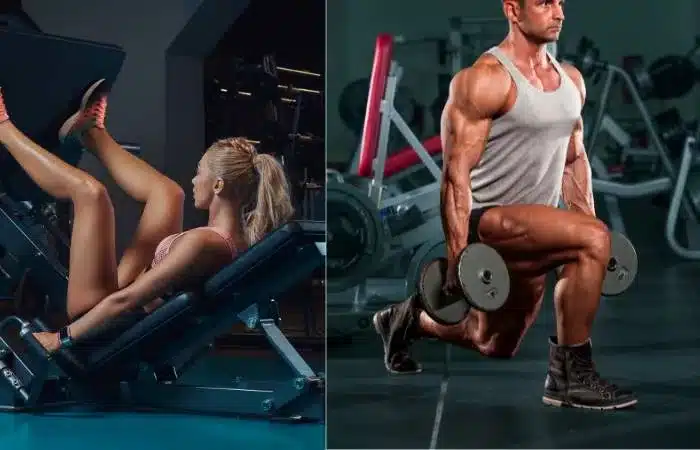
The leg press is arguably the best all-round squat alternative. This machine lets you train your quads and glutes with heavy loads while your back is fully supported, sparing your spine the heavy compression of a barbell squat. That makes it ideal for anyone with lower-back concerns or those who want to push serious weight with less technical demand. Adjusting your foot position changes the emphasis, as we explain in our guide on foot placement for the leg press, and you can read more about the machine in our leg press benefits guide.
| Pros | Cons |
|---|---|
| Allows for heavy resistance training | Limited range of motion |
| Targets multiple leg muscles simultaneously | Requires machine access |
| Offers lower back support | May not mimic functional movements |
| Adjustable for various fitness levels | Potential for incorrect form without supervision |
How you perform this exercise correctly:
- Adjust the machine: Sit on the leg press machine and adjust the seat so that your knees are at a 90-degree angle when your feet are placed on the platform. Adjust the weight to an appropriate level for your fitness level.
- Position your feet: Place your feet shoulder-width apart on the footplate. Ensure that your heels are flat and your toes are pointing slightly outward.
- Engage your core: Before pushing the weight, engage your core to stabilize your body throughout the movement.
- Push the weight: Extend your knees and hips to push the platform away from you. Keep your back firmly against the backrest throughout the movement.
- Control the descent: Slowly lower the weight back down by bending your knees until they are at a 90-degree angle again. Avoid locking out your knees at the top of the movement to maintain tension on your muscles.
- Repeat: Perform the desired number of repetitions, ensuring that you maintain proper form throughout the set.
Start with a weight that you can handle comfortably and gradually increase the resistance as you get stronger. And always prioritize proper form over lifting heavy weights. Work on the negatives and slowly go down rather than stressing through the leg pressing.
2. Bulgarian Split Squats
A genuine game-changer for lower-body strength, the Bulgarian split squat is a single-leg exercise that builds your quads, glutes, and balance while ironing out muscular imbalances between your legs. With your rear foot elevated on a bench behind you, you lower into a lunge-like position, working one leg intensely at a time. It takes practice to master the balance, but that’s part of its value. It needs minimal equipment, just your bodyweight or a pair of dumbbells, making it a superb home or gym option.
| Pros | Cons |
|---|---|
| Targets each leg individually | Requires balance and coordination |
| Builds strength in quads, glutes, and hamstrings | May be challenging for beginners |
| Improves balance and stability | Limited range of motion compared to squats |
| Can be performed with minimal equipment |
How to perform Bulgarian Split Squats correctly:
- Set up: Stand facing away from a bench or elevated surface, about two feet in front of it. Place the top of one foot on the bench behind you, laces down. Your other foot should be planted firmly on the ground in front of you, ensuring your stance is stable.
- Engage your core: Before you start moving, engage your core muscles to stabilize your body throughout the exercise.
- Lower your body: Slowly lower your body towards the ground by bending your front knee. Your back knee should bend as well, almost touching the ground. Keep your torso upright and your chest lifted throughout the movement.
- Drive through your front heel: Push through your front heel to return to the starting position, straightening your front leg. Ensure you maintain tension in your leg muscles throughout the movement.
- Repeat on both sides: Complete the desired number of repetitions on one leg before switching to the other leg.
- Maintain proper form: Pay attention to your knee alignment, ensuring it tracks in line with your toes to prevent strain on your joints.
3. Walking Lunges
Lunges are a fantastic, equipment-free way to build your legs and glutes while also improving balance and coordination. Walking lunges in particular give your hamstrings and glutes a great workout. As a single-leg movement, they also help correct side-to-side imbalances. They’re endlessly versatile, done with bodyweight, dumbbells, or a barbell, and you can explore the full range in our guides on the benefits of lunges and various alternatives to lunges.
| Pros | Cons |
|---|---|
| Works multiple muscle groups simultaneously | Requires space for movement |
| Improves balance and coordination | May be challenging for those with knee issues |
| Can be done anywhere with little equipment | Requires proper form for effectiveness |
| Helps increase lower body strength |
How to perform walking lunges correctly:
- Start in a standing position: Stand tall with your feet hip-width apart and your hands on your hips or by your sides.
- Step forward: Take a large step forward with your right foot, landing on your heel first.
- Lower your body: Bend both knees to lower your body towards the ground, ensuring your front knee is aligned with your ankle and your back knee nearly touches the ground. Keep your torso upright and your chest lifted throughout the movement.
- Push off: Push off your front foot to bring your back foot forward, stepping into the next lunge.
- Repeat: Continue alternating legs as you walk forward, performing lunges with each step.
- Maintain proper form: Pay attention to your knee alignment, ensuring it tracks in line with your toes to prevent strain on your joints. Also, engage your core muscles to stabilize your body throughout the movement.
Walking lunges are a fantastic addition to any workout routine, offering a dynamic way to strengthen your legs and improve your overall fitness. You can do them just about anywhere, making them a convenient choice for busy schedules. Give them a try and feel the burn!
4. Goblet Squat
If it’s the barbell back squat specifically you want to avoid, the goblet squat is a brilliant substitute. Holding a single dumbbell or kettlebell against your chest keeps your torso upright, which is gentler on the lower back and easier to learn than a barbell squat. It’s beginner-friendly, doubles as a mobility drill for those working on their depth, and still hammers the quads, glutes, and core. A perfect option for home training with minimal equipment.
5. Hip Thrusts
When your goal is glute development or you need to avoid loading your spine, the hip thrust is outstanding. It targets the glutes more directly than almost any other exercise, with no compression on your lower back, making it a great choice for those with back concerns. It’s a cornerstone of building a stronger backside, as covered in our guides on hip thrust benefitsand how to get a bigger butt.
6. Step-Ups
Simple but effective, step-ups involve stepping up onto a raised platform or bench, driving through the leading leg. They build single-leg strength in a functional, real-world movement pattern and can be scaled easily by adjusting the height of the step and adding dumbbells. Starting with a lower step keeps them knee-friendly for those with sensitive joints.
7. Wall Sits
For a no-equipment option that torches your quads, the wall sit is hard to beat. This isometric hold, sitting against a wall with your thighs parallel to the floor, builds quad endurance and mental toughness with zero impact on your joints, making it a great gentle option. Learn more in our guide on wall sit benefits.
8. Leg Extensions and Leg Curls
These machine-based isolation exercises let you target your quads (leg extensions) and hamstrings (leg curls) individually, without the whole-body demand of a squat. Leg curls in particular are very knee-friendly, and both are useful for adding focused leg volume or training around an injury.
9. Glute Bridges
A more accessible, floor-based cousin of the hip thrust, the glute bridge requires no equipment and builds the glutes and posterior chain while being extremely gentle on the knees and back. It’s an excellent starting point for beginners or a solid finisher for anyone.
10. Resistance Band Squats
If you train at home with minimal kit, resistance bands offer a joint-friendly way to add resistance to squatting movements and other leg exercises. They’re portable, affordable, and gentle on the joints, as we cover in our guide on the benefits of resistance bands.
The Best Squat Alternative for Your Situation
- For bad knees: try the leg press (with your feet placed higher on the platform), hip thrusts, glute bridges, leg curls, wall sits, and low step-ups, all of which reduce stress on the knees.
- For a bad back: the leg press, goblet squats, hip thrusts, and Bulgarian split squats let you train your legs hard without heavy spinal loading.
- For no equipment: bodyweight lunges, Bulgarian split squats, wall sits, step-ups, and glute bridges need little or nothing.
- For glute focus: hip thrusts, glute bridges, and Bulgarian split squats hit the glutes hard.
- For quad focus: the leg press, leg extensions, and goblet squats emphasise the quads.
How to Choose
The best squat alternative depends on your goals, your equipment, and any physical limitations. In most cases, you don’t have to pick just one, combining a couple of these, such as a leg press for heavy loading and Bulgarian split squats for single-leg strength, gives you a well-rounded lower-body workout. Focus on progressively adding weight or reps over time, whichever exercises you choose, since that progression is what drives results.
Frequently Asked Questions
What is the best alternative to squats? The leg press is the best all-round alternative for most people, as it trains the same muscles with heavy loads while supporting your back. Bulgarian split squats, lunges, and hip thrusts are also excellent, and the right choice depends on your goals and any limitations.
Can you build legs without squats? Absolutely. Exercises like the leg press, lunges, Bulgarian split squats, hip thrusts, and step-ups all build strong, muscular legs and glutes. Squats are effective, but they’re far from the only way to train your lower body.
What squat alternative is best for bad knees? Leg presses (with a higher foot placement), hip thrusts, glute bridges, leg curls, and wall sits all strengthen the legs with less stress on the knees. Always start light and stop if you feel pain, and consider professional guidance for a knee issue.
Are squat alternatives as effective as squats? Many are highly effective for building leg and glute strength and size. Some, like the leg press for heavy loading or Bulgarian split squats for single-leg strength, offer unique benefits of their own. The key, as with any exercise, is training hard and progressively over time.
Which squat alternative works the glutes most? The hip thrust is the standout for glute development, targeting them more directly than the squat itself. Glute bridges and Bulgarian split squats are also excellent glute builders.
The Bottom Line
While the squat is a superb exercise, it’s far from irreplaceable. Whether you’re working around an injury, training at home, or just after some variety, exercises like the leg press, Bulgarian split squats, lunges, hip thrusts, and step-ups can build strong, powerful legs and glutes without a barbell squat in sight.
Choose the alternatives that suit your body, goals, and equipment, train them with good form and progressive overload, and your lower body will keep getting stronger, no squats required.

I'm Tomek, your dedicated fitness coach at TheGymGoat. With years of experience as a certified personal trainer, fitness blogger and a passion for empowering individuals, I'm committed to helping you reach your health and wellness goals. I don't do excuses, I make priorities and always base my workout and diet on reserach.
All articles by Tomek →


