


ON THIS PAGE
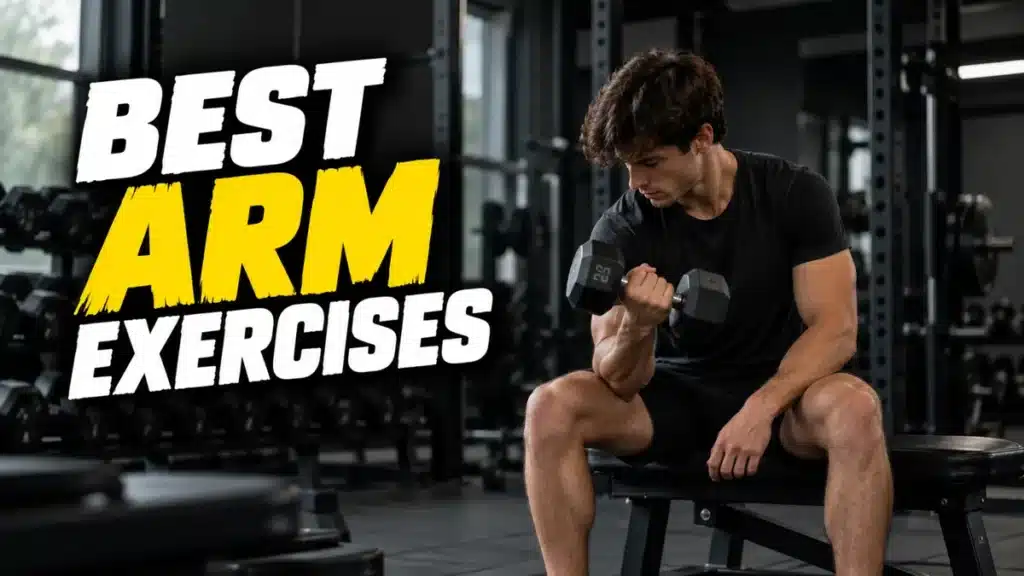
The best arm exercises are the close-grip bench press, chin-up, barbell curl, overhead triceps extension, incline dumbbell curl, dips, preacher curl, skull crusher, hammer curl and triceps pushdown. Together they train the biceps, brachialis and all three heads of the triceps through both long and short muscle lengths, which is what builds bigger, stronger arms.
Most people overtrain curls and undertrain everything else. The triceps is the largest muscle crossing the elbow, and recent research shows that the position you train a muscle in can matter as much as the exercise itself. This guide breaks down each of the 10 best arm exercises, how to do them properly, why they work, and how to combine them into a complete arm workout.
This article is informational and not a substitute for individual medical or training advice.
Understanding Your Arm Muscles
Your upper arm has two main muscle groups. On the front sit the elbow flexors: the biceps brachii, the brachialis underneath it, and the brachioradialis running into the forearm. On the back sits the triceps brachii, with its long, lateral and medial heads.
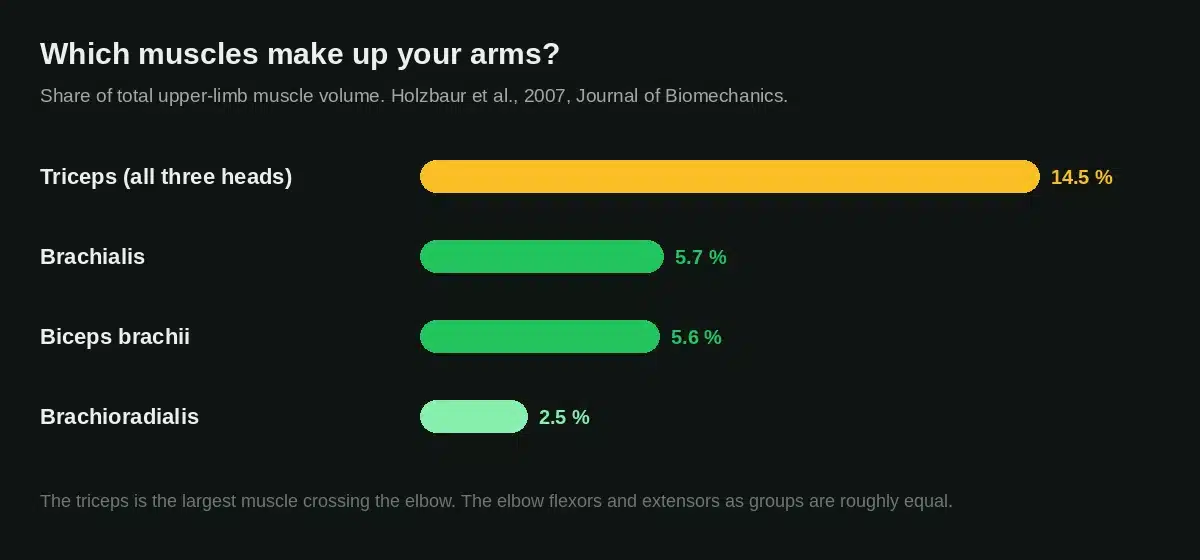
A detail many lifters miss is that the biceps is only part of the front of your arm. In a well-known study of upper-limb muscle volumes, the brachialis was about the same size as the biceps, and the triceps alone was roughly two and a half times the volume of the biceps. Training only biceps curls leaves most of your arm undertrained.
The long head of the triceps and the long head of the biceps both cross the shoulder as well as the elbow. That means your arm position changes how much they are stretched. Exercises with the arms overhead stretch the long head of the triceps, while curls with the arms behind the body stretch the long head of the biceps. Covering these positions is the logic behind the ten exercises below.
The 10 Best Arm Exercises
1. Close-Grip Bench Press
The close-grip bench press is the best compound exercise for the triceps. It lets you load the triceps far more heavily than any isolation movement, while the chest and front delts help you move serious weight.
How to do it: Lie on a flat bench and grip the bar about shoulder-width apart. Lower it to your lower chest with your elbows tucked at roughly 30 to 45 degrees from your body, then press back up to full lockout.
Why it works: The narrower grip shifts more of the work from the chest to the triceps, especially in the top half of the press. It builds raw pressing strength that carries over to the regular bench press.
Tip: Avoid going too narrow. Hands touching together strains the wrists and elbows without adding anything for the triceps.
2. Chin-Up
The chin-up is the best compound exercise for the biceps. With an underhand grip, your biceps and brachialis work hard to bend the elbows while your lats pull your body up.
How to do it: Hang from a bar with a shoulder-width, palms-facing-you grip. Pull your chest toward the bar by driving your elbows down, then lower under control to a full hang.
Why it works: You lift your whole bodyweight, so the elbow flexors handle a far heavier load than in most curls. The supinated grip puts the biceps in a stronger position than an overhand pull-up.
Tip: If you cannot yet do chin-ups, use a resistance band or slow negatives. Our guide to the benefits of pull-ups covers how to build up to your first rep.
3. Barbell Curl
The barbell curl is the classic mass builder for the biceps. It lets you use more weight than any other curl variation, which makes it ideal for progressive overload.
How to do it: Stand holding a barbell or EZ-bar with an underhand, shoulder-width grip. Keep your elbows by your sides and curl the bar up to shoulder height, then lower it slowly to full extension.
Why it works: A supinated grip maximises biceps involvement. A 2023 EMG study of competitive bodybuilders found higher biceps excitation with a palms-up grip than with neutral or palms-down grips.
Tip: If a straight bar bothers your wrists, switch to an EZ-bar. Keep the swing to a minimum. A little body English on the last rep is fine, but most reps should be strict.
4. Overhead Triceps Extension
The overhead triceps extension is the best isolation exercise for the triceps, and the one most lifters are missing. With your arms overhead, the long head of the triceps is fully stretched.
How to do it: Hold a dumbbell with both hands, or attach a rope to a low cable and face away from it. With your elbows pointing up, lower the weight behind your head until you feel a deep stretch, then extend your arms back overhead.
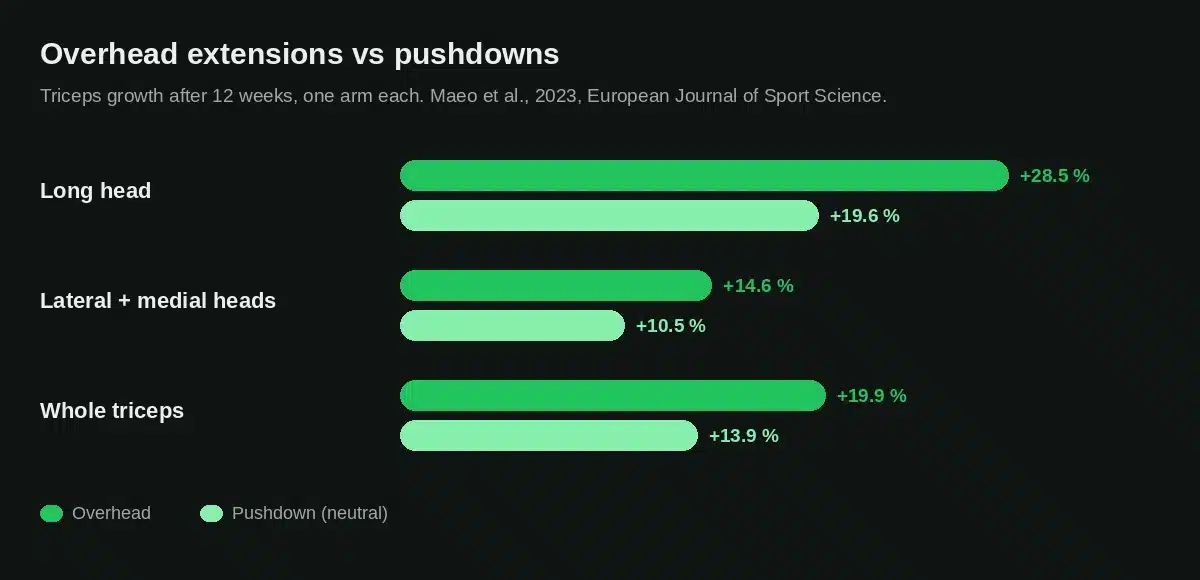
Why it works: In a 12-week study by Maeo and colleagues, each participant trained one arm with overhead cable extensions and the other with pushdowns. The overhead arm gained about 1.5 times more volume in the long head and about 1.4 times more in the whole triceps.
Tip: Keep your elbows from flaring wide and control the bottom of each rep. The stretch is where most of the benefit comes from.
5. Incline Dumbbell Curl
The incline dumbbell curl trains the biceps from a stretched position. Sitting back on an incline bench lets your arms hang behind your body, which lengthens the long head of the biceps.
How to do it: Set a bench to about 45 to 60 degrees and sit back with a dumbbell in each hand, arms hanging straight down. Curl the weights up without moving your upper arms forward, then lower them all the way.
Why it works: A 2025 study comparing incline and preacher curls found that the incline curl produced slightly more growth near the shoulder end of the arm, while the preacher curl grew the elbow end more. Using both covers the whole muscle.
Tip: Go lighter than you would on a standing curl. The stretched position makes this exercise much harder, and heavy weights tend to pull your shoulders forward.
6. Dips
Dips are one of the best bodyweight exercises for the triceps, with the chest and front delts working alongside them. They let you load the triceps heavily without any equipment beyond parallel bars.
How to do it: Support yourself on parallel bars with straight arms. Keep your torso fairly upright, lower yourself until your upper arms are about parallel to the floor, then press back up to lockout.
Why it works: An upright torso keeps the emphasis on the triceps, while leaning forward shifts more work to the chest. As you get stronger, you can add weight with a dip belt.
Tip: Only go as deep as your shoulders comfortably allow. Our guide to the benefits of dips covers technique and safer variations.
7. Preacher Curl
The preacher curl isolates the biceps by locking your upper arms against a pad. Because you cannot swing, every rep is strict, and the bottom of the movement is particularly hard.
How to do it: Sit at a preacher bench with the back of your upper arms flat on the pad. Hold an EZ-bar or dumbbells with an underhand grip, lower the weight under control until your arms are nearly straight, then curl it back up.
Why it works: The preacher curl loads the biceps hardest when the elbows are nearly straight. A 2023 study by Pedrosa and colleagues found that training the first part of the preacher curl, where the biceps is long, produced more growth near the elbow than training the final part.
Tip: Never let the weight drop into the bottom position. Control it all the way, since that is where both the benefit and the injury risk sit. See our full guide to preacher curl benefits.
8. Skull Crusher
The skull crusher, or lying triceps extension, is a heavy isolation exercise that trains all three heads of the triceps. It is a staple in bodybuilding programmes for good reason.
How to do it: Lie on a flat bench holding an EZ-bar above your chest with straight arms. Keeping your upper arms still, bend your elbows to lower the bar toward your forehead or just behind your head, then extend back up.
Why it works: Lowering the bar behind your head rather than to your forehead puts the long head under more stretch, borrowing some of the benefit of overhead work while letting you use more weight.
Tip: If your elbows ache, switch to dumbbells or a cable variation, and keep the reps in the 8 to 15 range rather than going very heavy.
9. Hammer Curl
The hammer curl uses a neutral grip, palms facing each other, which shares the work between the biceps, brachialis and brachioradialis. It builds thickness in the arm and the top of the forearm.
How to do it: Stand with a dumbbell in each hand, palms facing your body. Curl the weights up while keeping that neutral grip, then lower them under control.
Why it works: With a neutral grip, the biceps contributes less and the other elbow flexors take a bigger share of the work. That makes the hammer curl a useful complement to supinated curls rather than a replacement.
Tip: Most people can use more weight on hammer curls than on regular curls. Take advantage of it, but keep your elbows pinned to your sides.
10. Triceps Pushdown
The triceps pushdown is a simple, joint-friendly finisher that lets you pile on volume with very little fatigue. It mainly trains the lateral and medial heads.
How to do it: Stand at a high cable with a rope or straight bar. Tuck your elbows to your sides and push the handle down until your arms are fully straight, then let it rise back up until your forearms are just above parallel.
Why it works: The cable keeps tension on the triceps throughout the movement, and the exercise is easy to learn and hard to do wrong. It works best alongside overhead extensions, since it does not stretch the long head.
Tip: Squeeze hard at the bottom of each rep. With a rope, spread the ends apart at lockout for a stronger contraction.
Best Arm Exercises at a Glance
| Exercise | Main muscle | Type | Best for |
|---|---|---|---|
| Close-grip bench press | Triceps | Compound | Heavy triceps strength |
| Chin-up | Biceps and brachialis | Compound | Heavy biceps loading |
| Barbell curl | Biceps | Isolation | Biceps mass and strength |
| Overhead triceps extension | Triceps (long head) | Isolation | Triceps growth in a stretch |
| Incline dumbbell curl | Biceps (long head) | Isolation | Biceps in a stretch |
| Dips | Triceps and chest | Compound | Bodyweight pressing strength |
| Preacher curl | Biceps | Isolation | Strict curls, distal biceps |
| Skull crusher | Triceps | Isolation | Heavy triceps isolation |
| Hammer curl | Brachialis and brachioradialis | Isolation | Arm and forearm thickness |
| Triceps pushdown | Triceps (lateral and medial) | Isolation | Volume and finishing |
A Sample Arm Workout
The best arm workout starts with a heavy compound movement, then adds curls and extensions that train the biceps and triceps in both stretched and shortened positions. Here is a balanced session:
- Close-grip bench press: 3 sets of 6 to 8 reps
- Chin-ups: 3 sets of as many good reps as you can, or 6 to 10 with added weight
- Incline dumbbell curl: 3 sets of 10 to 12 reps
- Overhead triceps extension: 3 sets of 10 to 12 reps
- Hammer curl: 2 sets of 10 to 12 reps
- Triceps pushdown: 2 sets of 12 to 15 reps
Rest 2 to 3 minutes after the heavy compound lifts and 60 to 90 seconds on the isolation work. Above all, apply progressive overload by gradually adding reps or weight over time. For how arm training fits into your wider week, see our guide on how many exercises per muscle group.
If you already train chest and back hard, your arms get a lot of indirect work from pressing and pulling. In that case two or three arm exercises per session, on top of a well-designed push pull legs split, is often enough.
Tips for Training Your Arms
- Train the triceps as hard as the biceps. It is the larger muscle, and it adds more size to your arms than another set of curls.
- Use stretched positions. Overhead extensions, incline curls and preacher curls train the muscles at long lengths, which research increasingly links to better growth.
- Use a full range of motion. Lower every rep all the way down before you lift again.
- Control the weight. Swinging and bouncing take the work away from the arms and put the elbows at risk.
- Get enough weekly volume. A meta-analysis by Schoenfeld and colleagues found that more weekly sets were associated with more muscle growth, with 10 or more sets per muscle per week linked to the largest gains.
- Eat for growth. Arms will not grow without enough calories and protein. Our list of high-protein foods makes it easier.
Frequently Asked Questions
What is the best exercise for bigger arms? There is no single best exercise, but the close-grip bench press and chin-up let you load the triceps and biceps most heavily. Pair them with an overhead triceps extension and an incline or preacher curl for the most complete arm growth.
Should I train biceps or triceps for bigger arms? Both, but do not neglect the triceps. It is the largest muscle crossing the elbow, roughly two and a half times the volume of the biceps, so it has more potential to add size.
How many times a week should I train arms? Two sessions per week works well for most people. You can train arms on their own day or add a few arm exercises to your push and pull days.
Can I build big arms with dumbbells only? Yes. Dumbbell curls, incline curls, hammer curls, overhead extensions and dumbbell skull crushers cover nearly everything. Add dips and chin-ups if you have access to bars.
How many reps should I do for arm growth? Most arm exercises work well in the 8 to 15 rep range. Heavier compound lifts like the close-grip bench press can go lower, around 6 to 8 reps. What matters most is taking your sets close to failure and adding reps or weight over time.
Why are my arms not growing? The most common reasons are too little volume, not training close enough to failure, sloppy form, neglecting the triceps, and not eating enough. Fix those before changing exercises.
The Bottom Line
The best arm exercises combine heavy compound movements like the close-grip bench press and chin-up with curls and extensions that train the biceps and triceps in both stretched and contracted positions. Overhead extensions, incline curls and preacher curls deserve a place in every arm programme, and the triceps deserve at least as much attention as the biceps.
Pick a selection of these movements, use a full range of motion, keep your form strict, and apply progressive overload consistently. Support that with good recovery, enough protein and a sensible plan to build muscle, and your arms will grow bigger and stronger.
Sources
- Maeo S, Wu Y, Huang M et al. Triceps brachii hypertrophy is substantially greater after elbow extension training performed in the overhead versus neutral arm position. European Journal of Sport Science, 2023.
- Pedrosa GF, Simões MG, Figueiredo MOC et al. Training in the Initial Range of Motion Promotes Greater Muscle Adaptations Than at Final in the Arm Curl. Sports, 2023.

I'm Tomek, your dedicated fitness coach at TheGymGoat. With years of experience as a certified personal trainer, fitness blogger and a passion for empowering individuals, I'm committed to helping you reach your health and wellness goals. I don't do excuses, I make priorities and always base my workout and diet on reserach.
All articles by Tomek →


